
If you’ve ever felt a small knot in your stomach when you check your bank balance, or wondered where your entire salary disappeared to within the first two weeks of the month, you’re not alone. Most people never actually sit down and learn how money works — they just react to it. Bills come, you pay them. Salary comes, you spend it. Emergency happens, you panic.
That reactive relationship with money has a name for its opposite: personal finance. And the good news is that it isn’t reserved for accountants, economists, or people who love spreadsheets. It’s a practical, learnable skill — much like cooking or driving — that anyone can pick up with the right guidance and a bit of consistency.
In this guide, we’ll break down exactly what personal finance means, why it matters more today than ever before, and how you — as a complete beginner — can start building healthy money habits from scratch. By the end, you’ll have a clear, actionable roadmap rather than vague advice like “just save more.”
What Is Personal Finance?
Personal finance is the practice of managing your money — how you earn it, spend it, save it, invest it, and protect it — in a way that helps you meet both your everyday needs and your long-term goals.
It covers everything from the small daily decisions (should I order food or cook at home tonight?) to the big life decisions (should I buy a house, and how much loan can I actually afford?).
In simple terms, personal finance answers questions like:
- How much of my income should I save every month?
- What’s the smartest way to spend without regret later?
- How do I protect myself financially if something unexpected happens?
- How do I make my money grow instead of just sitting idle?
- What steps do I need to take today to retire comfortably decades from now?
Personal finance isn’t a get-rich-quick formula, and it isn’t about depriving yourself of everything enjoyable either. At its core, it’s about being intentional — making sure your money is working toward the life you actually want, rather than disappearing without a trace.
According to Investopedia’s definition of personal finance, the field covers budgeting, banking, insurance, mortgages, investments, retirement planning, tax planning, and estate planning — essentially, every financial decision and activity of an individual or household. That’s a lot of ground, which is exactly why beginners often feel overwhelmed. The trick is to learn it one layer at a time, which is what this guide is structured to do.
Why Personal Finance Matters More Than Ever
A generation ago, many people relied on stable, single-income jobs, employer pensions, and lower costs of living. Today’s financial landscape looks very different — freelance and gig income, rising living costs, easy access to credit cards and “buy now, pay later” schemes, and an overwhelming number of investment options (and scams) available at the tap of a screen.
This shift means that no one is coming to manage your money for you. Your employer isn’t responsible for your retirement. The government provides a safety net, but not a comfortable one. That responsibility now sits squarely with you — which is precisely why financial literacy has become such a critical life skill.
Here’s what strong personal finance habits actually give you:
- Freedom from constant money stress. Studies consistently link financial anxiety to poor sleep, strained relationships, and reduced productivity at work.
- The ability to handle emergencies without panic. A medical bill, a job loss, or a broken-down vehicle doesn’t have to derail your entire life.
- Faster progress toward big goals — a home, your child’s education, starting a business, or early retirement.
- Better decision-making under pressure. When you understand your numbers, you don’t make fear-based or impulsive financial choices.
- Compounding wealth over time. Small, consistent actions taken early snowball into significant wealth over 15–20 years — something we’ll explore later in this guide.
It’s worth remembering: many people who earn high salaries still struggle financially, while people with modest but well-managed incomes build real wealth. The difference almost always comes down to habits, not income size.
The 9 Core Pillars of Personal Finance
Think of personal finance as a house built on several load-bearing pillars. If even one is weak, the whole structure feels unstable. Let’s go through each pillar in detail.
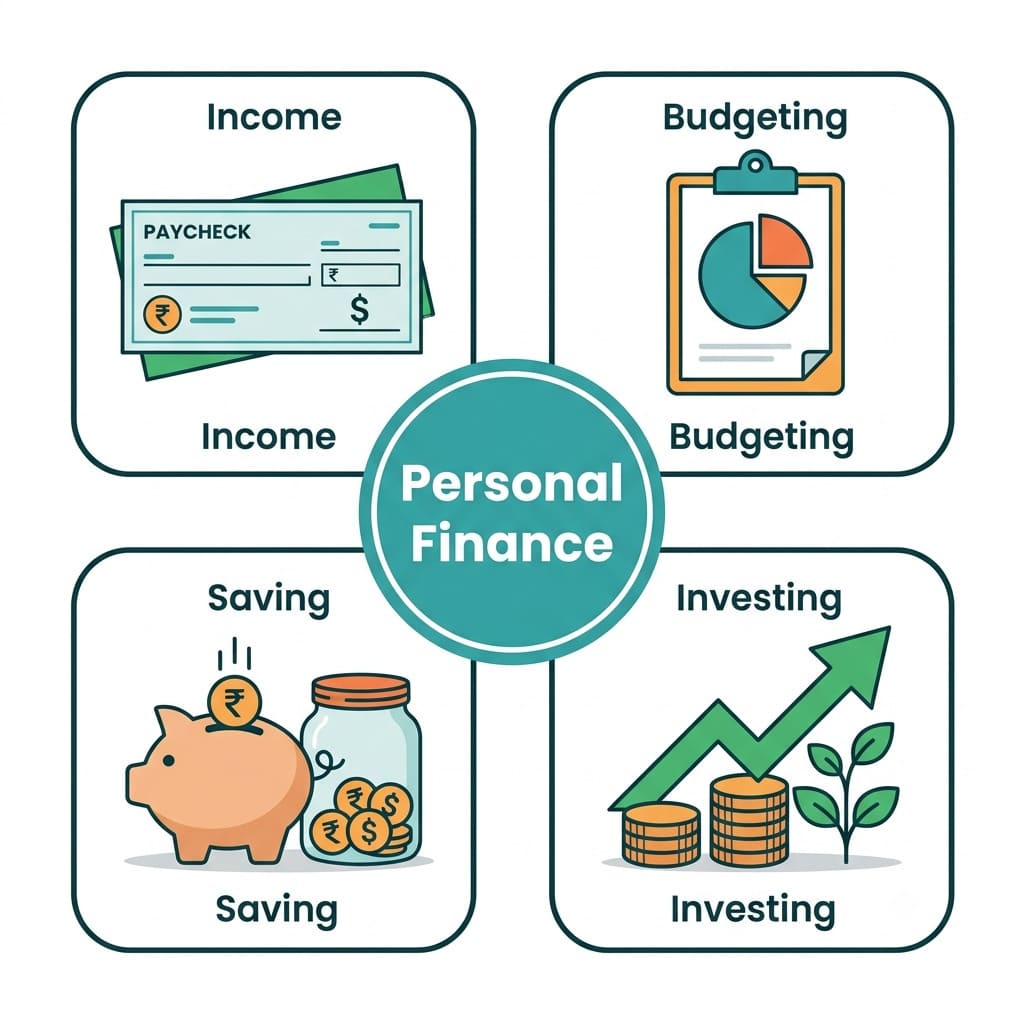
1. Income Management
Everything starts here. Income is any money that flows into your life — your salary, business profits, freelance payments, rental income, dividends, or side-hustle earnings.
The first real step in personal finance is getting brutally clear on exactly how much you earn each month, after taxes and deductions. Many beginners work with a fuzzy, optimistic number in their head rather than their actual take-home pay, and that gap is where budgets quietly fall apart.
Once your real income is clear, you can:
- Build a budget based on facts, not guesses
- Set realistic savings targets
- Identify how much “breathing room” you actually have
Golden rule: Always plan around your guaranteed, current income — not a bonus you’re hoping for or a raise that hasn’t been confirmed yet.
If you have multiple income streams (say, a salary plus freelance work), track them separately at first. It makes it far easier to spot which stream is actually worth your time and which one barely covers its own costs.
2. Budgeting: Giving Every Rupee a Job
Budgeting has a bit of an image problem — many people associate it with restriction and spreadsheets. In reality, a budget is simply a plan for your money before you spend it, so you’re deciding where it goes instead of wondering where it went.
A practical monthly budget usually breaks down into three buckets:
- Fixed expenses — rent, EMIs, insurance premiums, subscriptions
- Variable expenses — groceries, fuel, entertainment, eating out
- Savings and investments — money set aside for goals and the future
One widely used and beginner-friendly framework is the 50-30-20 rule, where 50% of income goes to needs, 30% to wants, and 20% to savings and debt repayment. We’ve broken this down with real salary examples in our detailed guide on the 50-30-20 rule in India, and if you’re specifically working with a smaller starting salary, our post on how to plan a monthly budget on a ₹30,000 salary walks through the exact numbers.
The key isn’t finding a “perfect” budgeting method — it’s picking one simple system and sticking with it long enough to see results. Even a rough budget, followed consistently, outperforms a perfect budget that gets abandoned after two weeks.
3. Saving Money: Paying Yourself First
Saving means deliberately setting aside a portion of your income rather than spending everything you earn. It’s the foundation that every other financial goal — investing, buying a home, retiring comfortably — is built on top of.
The classic personal finance principle here is: save first, spend later. Instead of saving whatever happens to be left over at the end of the month (which is often nothing), you set aside your savings the moment you’re paid, and build your spending around what remains.
A simple way to automate this: set up an auto-debit or standing instruction that moves a fixed amount into a separate savings account on salary day, before you have a chance to spend it.
It’s also worth understanding that saving and investing, while related, are not the same thing — saving keeps your money safe and accessible, while investing aims to grow it, usually with some risk involved. We cover this distinction in detail in Saving vs Investing: Why Saving Money Alone Is Not Enough Today.
4. Building an Emergency Fund
An emergency fund is money set aside specifically for the unexpected — a medical emergency, sudden job loss, urgent car or home repair, or any surprise expense that would otherwise force you into debt.
Most financial planners recommend keeping 3 to 6 months’ worth of essential living expenses in an easily accessible account (like a savings account or liquid fund), separate from your regular spending money. If your income is irregular — say you’re a freelancer or business owner — leaning toward 6–9 months of coverage is often safer.
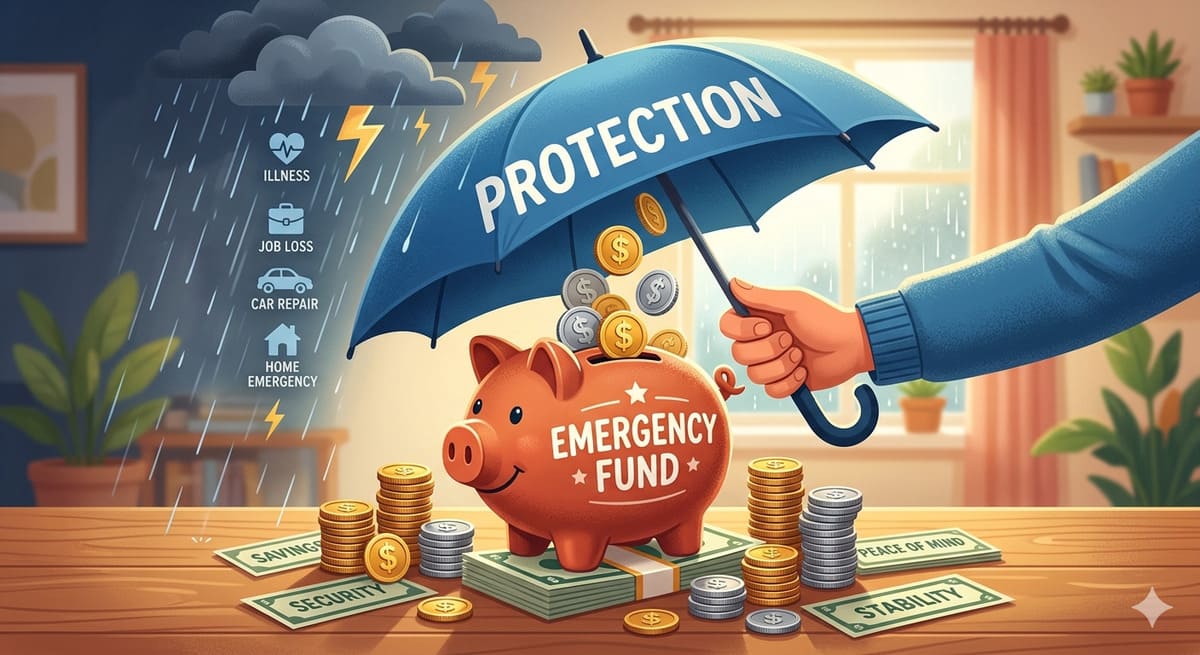
Why does this matter so much? Because without an emergency fund, every unexpected expense becomes a crisis that gets paid for with a credit card or a high-interest loan — and that single decision can set your finances back years. An emergency fund isn’t about earning returns; its entire job is to sit there quietly and protect you from debt when life throws a curveball.
5. Managing Expenses Wisely
Expense management is about spending your money consciously rather than automatically. It doesn’t mean cutting out everything enjoyable — it means knowing the difference between spending that adds real value to your life and spending that’s driven by boredom, habit, or social pressure.
Practical habits that make a real difference:
- Separate needs (rent, groceries, utilities) from wants (dining out, subscriptions, gadgets) before you buy
- Introduce a short waiting period — even 24 hours — before non-essential purchases to reduce impulse buying
- Compare prices, especially for recurring expenses like insurance, phone plans, and subscriptions
- Track expenses weekly rather than only at month-end, so small leaks don’t add up unnoticed
A useful mental trick: before a non-essential purchase, ask “Would I still buy this if I had to pay in cash, right now, from a stack of notes?” It’s surprising how often that question changes the decision.
6. Debt and Credit Management
Debt is borrowed money that must be repaid, usually with interest. Not all debt is bad — a home loan or an education loan, used sensibly, can help you build an asset or increase your earning potential. The real danger lies in high-interest, unproductive debt, like carrying a balance on a credit card.
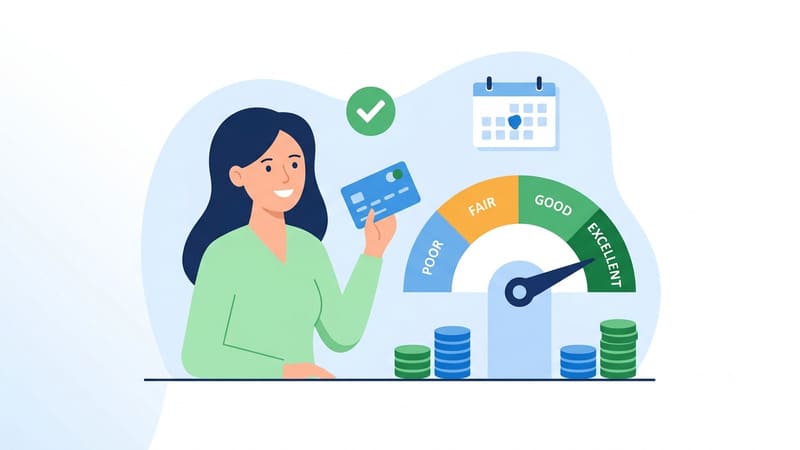
Smart debt management includes:
- Paying bills and EMIs on time, every time — payment history is the single biggest factor in your credit score
- Avoiding high-interest debt like credit card revolving balances or payday-style loans wherever possible
- Borrowing only for genuine needs or appreciating assets, not lifestyle upgrades
- Understanding the true cost of a loan (interest rate + processing fees + tenure) before signing up
Your credit score (CIBIL score in India) plays a huge role here — it determines whether you get approved for loans, and at what interest rate. A poor score can mean paying significantly more interest over a loan’s lifetime, or being denied credit altogether. If your score needs work, our guide on how to improve your CIBIL score from 550 to 750 lays out proven, practical steps.
If you’re ever choosing between a personal loan and putting an expense on a credit card, it’s worth comparing the real costs first — we cover this in Personal Loan vs Credit Card Loan: Which Is Cheaper?
7. Investing: Making Your Money Work for You
Saving keeps your money safe; investing aims to grow it. Investing means putting your money into assets that have the potential to generate returns over time — with the trade-off that returns aren’t guaranteed and values can fluctuate.
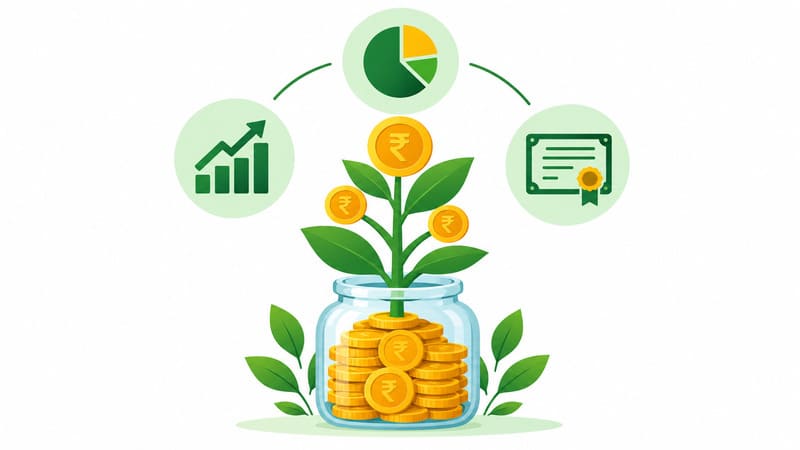
Common investment options for beginners include:
- Stocks — ownership shares in a company
- Mutual funds — pooled investments managed professionally, ideal for beginners who don’t want to pick individual stocks
- Fixed deposits (FDs) — low-risk, fixed-return instruments offered by banks
- Bonds — essentially loans you give to a company or government in exchange for interest
- Exchange-traded funds (ETFs) and index funds — funds that track a market index, offering diversification at a low cost
For beginners, the goal isn’t to pick “the next big stock.” It’s to understand the basics, think in terms of years and decades rather than days, and avoid emotional decisions driven by market noise. You can learn more about investor protection, registered intermediaries, and safe investing practices directly from India’s market regulator, SEBI (Securities and Exchange Board of India).
One of the most powerful (and least understood) forces in investing is compounding — where your returns start generating their own returns. Over long periods, this effect can turn modest, consistent investments into substantial wealth. We’ve explained this with real numbers in How Compounding Works: 5 Real-Life Examples That Grow Wealth Faster.
If you’re deciding how long to stay invested and in what kind of instruments, our comparison of Long-Term vs Short-Term Investing breaks down which approach suits which goal. And if you’re new to funds specifically, start with What Is a Mutual Fund? A Complete Beginner’s Guide before moving on to our curated list of best mutual funds for beginners with low risk.
For many beginners in India, Systematic Investment Plans (SIPs) offer one of the simplest ways to start investing small, fixed amounts regularly. We explore this strategy in depth in SIP Investing: Can It Make You a Millionaire?
8. Setting Clear Financial Goals
Financial goals give your money direction. Without them, saving and investing can feel pointless — like running without knowing where the finish line is. Goals are usually grouped into three timeframes:
Short-term goals (under 1 year): Buying a gadget, funding a small trip, building a starter emergency fund.
Medium-term goals (1–5 years): Buying a car, funding higher education, saving for a wedding, starting a small business.
Long-term goals (5+ years): Buying a home, achieving financial independence, retirement.
A goal like “I want to save money” is vague and easy to abandon. A goal like “I want to save ₹3,00,000 for a home down payment in 3 years” is specific, measurable, and far more motivating — because you can actually calculate how much you need to set aside each month to get there.
9. Retirement and Long-Term Planning
Retirement planning is about ensuring you have enough money to sustain your lifestyle once you stop actively earning. It might feel like a distant concern in your 20s or early 30s, but this is precisely the stage where retirement planning is most powerful — because of how compounding works over long time horizons.
Consider this: someone who starts investing a modest amount in their 20s can, thanks to decades of compounding, end up with significantly more at retirement than someone who starts investing double that amount but begins in their late 30s. Time in the market matters more than timing the market.
In India, common retirement-focused instruments include the Employees’ Provident Fund (EPF), Public Provident Fund (PPF), National Pension System (NPS), and retirement-focused mutual funds. You can explore official details on retirement savings schemes through the Employees’ Provident Fund Organisation (EPFO) website.
Common Personal Finance Mistakes Beginners Make
Almost everyone makes some of these mistakes early on — the goal is to recognize them quickly rather than let them become permanent habits.
- Not tracking expenses at all — you can’t manage what you don’t measure
- Treating savings as an afterthought rather than a fixed, non-negotiable “expense”
- Lifestyle inflation — increasing spending every time income rises, so savings never actually grow
- Overusing credit cards for everyday expenses without a repayment plan
- Delaying investing, waiting for “more money” or “the right time,” which rarely arrives on its own
- Ignoring insurance until after something goes wrong
- Chasing trends — jumping into an investment because it’s popular on social media, without understanding it
- No emergency fund, which turns every surprise expense into a debt problem
If a few of these sound familiar, that’s completely normal — the point of this guide isn’t to make you feel behind, but to help you course-correct starting today.
How to Start Personal Finance as a Complete Beginner: A Step-by-Step Plan
You don’t need to overhaul your entire financial life in one weekend. In fact, trying to do everything at once is one of the fastest ways to give up. Instead, follow this sequence:
- Track your income and expenses for one full month. Use a notebook, spreadsheet, or a budgeting app — the tool matters less than the habit of tracking.
- Build a simple budget based on what you learned, using a framework like the 50-30-20 rule as a starting point.
- Start an emergency fund, even if it’s small at first. Automate a fixed transfer every payday.
- Pay down high-interest debt aggressively while making minimum payments on lower-interest debt.
- Get basic insurance in place — health insurance at minimum, and life insurance if others depend on your income.
- Start investing small amounts consistently, even if it’s a modest SIP, once your emergency fund and high-interest debt are under control.
- Set 1–2 concrete financial goals with a target amount and timeline, and work backward to a monthly savings/investment figure.
- Review your finances monthly, and revisit your goals annually as your income and life circumstances change.
Notice that investing comes after the emergency fund and debt cleanup — not before. Many beginners rush into investing while carrying high-interest debt or with zero safety net, which often backfires when an emergency forces them to withdraw investments at a loss.
Helpful Tools to Manage Your Money
You don’t need expensive software to get started. Some practical, low-cost or free options include:
- Spreadsheets (Google Sheets or Excel) for a fully customizable budget and expense tracker
- Budgeting and expense-tracking apps that automatically categorize your bank transactions
- A separate savings account used purely for your emergency fund, so it’s out of sight from daily spending
- SIP and investment platforms offered by mutual fund houses or registered brokers for starting small, automated investments
Whatever tool you choose, the most important feature isn’t flashiness — it’s whether you’ll actually use it consistently.
Personal Finance Is a Lifelong Skill, Not a One-Time Task
It’s tempting to think of personal finance as something you “figure out” once and then forget about. In reality, it evolves constantly — your income changes, your responsibilities grow, new financial products emerge, and your goals shift as your life does.
The people who build lasting financial security aren’t necessarily the ones who earn the most. They’re the ones who stay engaged with their money over time — reviewing their budget periodically, adjusting their goals, learning continuously, and making small, steady improvements year after year.
Final Thoughts
Personal finance ultimately comes down to three things: awareness, discipline, and consistency. You don’t need a finance degree, a six-figure salary, or complicated spreadsheets to get started — you simply need to know where your money is going, decide intentionally where you want it to go instead, and take small, repeatable actions toward your goals.
Start with one step from this guide today — whether that’s tracking your expenses for the next 30 days, opening a separate savings account for emergencies, or reading up on how SIPs work. Financial security isn’t built overnight, but it is built, one consistent decision at a time.
Q-1 What is personal finance in simple words?
Ans – Personal finance means managing your income, expenses, savings, and investments in a way that helps you meet your everyday needs while working toward your long-term financial goals, such as financial security and independence.
Q-2 Why is personal finance important for beginners?
Ans- It helps beginners build good money habits early, avoid unnecessary debt, prepare for emergencies, and steadily build financial stability — advantages that compound significantly over a lifetime.
Q3. What are the basic elements of personal finance?
Ans- The core elements include income management, budgeting, saving, building an emergency fund, managing expenses, debt and credit management, investing, goal setting, and retirement planning.
Q4. How much should a beginner save each month ?
Ans – A commonly recommended starting point is saving at least 20% of your take-home income, as outlined in the 50-30-20 rule. If that feels out of reach initially, start with whatever percentage is realistic and increase it gradually as your income grows or expenses reduce.
Q5. Should I invest before building an emergency fund?
Ans – Generally, no. It’s safer to build at least a small emergency fund and pay off high-interest debt first, since investments can lose value in the short term and you don’t want to be forced to sell at a loss to cover an emergency.
Q6. Is personal finance only about saving money?
Ans – No. Saving is just one piece. Personal finance also includes budgeting, spending wisely, managing debt, protecting yourself with insurance, investing for growth, and planning for goals like retirement.
Disclaimer: This article is for educational and informational purposes only and does not constitute financial, tax, or investment advice. Readers should consult a qualified, registered financial advisor before making financial decisions.
Related Reading on All Finance Knowledge
- Saving vs Investing: Why Saving Money Alone Is Not Enough Today
- 50-30-20 Rule in India Explained (With ₹50,000 Salary Example)
- How to Plan Monthly Budget on ₹30,000 Salary
- How Compounding Works: 5 Real-Life Examples That Grow Wealth Faster
- Long-Term vs Short-Term Investing: Key Differences Every Beginner Should Know
- What Is a Mutual Fund? A Complete Beginner’s Guide (2026)
- SIP Investing: Can It Make You a Millionaire?
- How to Improve CIBIL Score from 550 to 750: Proven & Safe Steps
- Personal Loan vs Credit Card Loan: Which Is Cheaper?

Shilpesh Rathod is the founder of All Finance Knowledge. He holds a B.Com degree along with JAIIB and CAIIB banking certifications, and brings 19+ years of experience in the banking sector across savings, investments, and financial planning. Read more: https://allfinanceknowledge.com/about-us/
15 thoughts on “What Is Personal Finance? A Complete Beginner’s Guide to Managing Money (2026)”