Personal loan vs credit card loan: which is cheaper? For most borrowers in India, a personal loan is cheaper because it has a lower interest rate, a longer repayment period and fewer penalty traps. A credit card loan can be cheaper only for small, short-term needs. Below, you will see real ₹ examples, hidden charges and a simple way to decide.
Key Takeaways
- A personal loan is usually cheaper, with rates of about 10% to 18% against 18% to 42% on credit card loans.
- On ₹1,00,000 over 2 years, a credit card loan at 24% costs roughly ₹13,900 more than a personal loan at 12%.
- Credit cards can win only for small amounts repaid within a few months, or on a genuine 0% EMI.
- Always compare the total repayment amount, including processing fees and GST, not just the interest rate.
It is the middle of the month. A hospital bill, a repair, or a family function has landed on you, and your savings aren’t enough. Within minutes, your phone shows a message: “Congratulations! You have a pre-approved instant loan on your credit card.” A few days earlier, your bank’s app also showed a personal loan offer.
Both are one tap away, and both promise quick money. So the real question is:
Personal loan vs credit card loan: which one is actually cheaper?
Many people choose in a hurry, based on whichever offer looks easier. But a small difference in the interest rate, plus a few hidden charges, can cost you thousands of rupees over the loan period.
In this guide, I compare both options in plain language, with real rupee examples, honest pros and cons, and a simple way to decide. By the end, you will know which option suits your situation.
Quick Answer
For most borrowers in India, a personal loan is cheaper than a credit card loan. Personal loans generally carry lower interest rates, longer tenures with smaller EMIs, and fewer penalty traps.
A credit card loan can work out cheaper only in specific cases: a small amount, a repayment period of a few months, and a genuine 0% EMI offer or an interest-free period that you fully use.
The rest of this article explains why, with numbers.
What Is a Personal Loan?
A personal loan is an unsecured loan given by banks, NBFCs (non-banking financial companies), and digital lenders. “Unsecured” means you don’t have to pledge any asset such as gold, a house, or a vehicle. The lender decides based on your income, credit score, job stability, and repayment history.
You can use a personal loan for almost any genuine need:
- Medical emergencies
- Wedding or family function expenses
- Travel and relocation
- Higher education or courses
- Home renovation
- Debt consolidation (combining many expensive debts into one)
Key features of a personal loan:
- Interest rate: Typically about 10% to 18% per year for good profiles. It can be higher for lower credit scores or smaller lenders.
- EMI: Fixed monthly instalments, so you always know what you pay.
- Tenure: Usually 1 to 5 years, and sometimes up to 7 years.
- Loan amount: Can be large, depending on your income.
- Processing fee: Usually around 1% to 3% of the loan amount, plus GST.
- Approval time: From a few hours to about 3 days.
Because the rate is fixed and the schedule is clear, a personal loan is easy to plan around.
What Is a Credit Card Loan?
“Credit card loan” is a loose term. It usually means one of three things:
1. EMI conversion on a purchase. You buy something on your card and convert the bill into EMIs over 3 to 24 months.
2. Pre-approved instant loan on a credit card. The bank offers you a loan against your card’s limit or your good record, often credited to your bank account within minutes.
3. Cash advance (withdrawing cash using the card). This is the most expensive form. Fees are charged upfront (often around 2.5% to 3% of the amount), and interest usually starts from the day you withdraw, with no interest-free period.
Key features of credit card loans:
- Interest rate: Often 18% to 42% per year, depending on the product. Revolving credit (when you pay only the minimum due) is often charged around 3% to 3.99% per month, which is roughly 36% to 48% per year.
- Tenure: Short, commonly 3 to 24 months.
- Approval: Often instant.
- Documentation: Minimal.
It looks easy and convenient. But is it cheaper? Let’s compare.
(Note: rates differ by bank, card type, and your profile. Always check the current rates and Most Important Terms & Conditions (MITC) on your bank’s official site or app before applying.)
Personal Loan vs Credit Card Loan: Interest Rate Comparison
| Feature | Personal Loan | Credit Card Loan |
|---|---|---|
| Typical interest rate | 10% – 18% per year | 18% – 42% per year (higher for revolving credit and cash advances) |
| Processing fee | 1% – 3% + GST | Often 0% – 2% + GST (cash advance fee is higher) |
| Tenure | 1 – 5 years (up to 7) | 3 – 24 months |
| Loan size | Medium to high | Usually small to medium (limited by card limit) |
| Approval speed | Hours to 3 days | Often instant |
| EMI type | Fixed | Fixed (EMI) or flexible/revolving |
| Late payment cost | Moderate | Usually high, with extra interest |
| Best for | Planned or larger expenses | Small, short-term needs |
On paper, personal loans clearly win on the interest rate. Now let’s see what this means in real money.
Real Example Comparison: ₹1,00,000 for 2 Years
Assume you need ₹1,00,000 urgently and plan to repay it over 2 years (24 months).
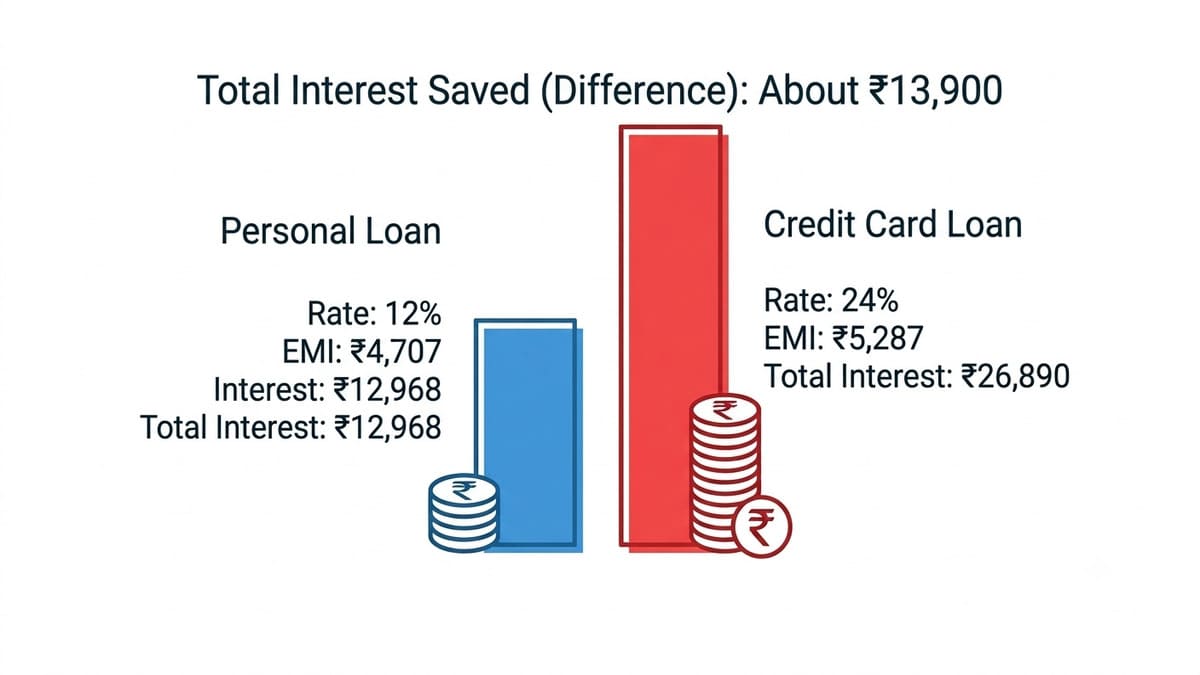
Option 1: Personal Loan
- Loan amount: ₹1,00,000
- Interest rate: 12% per year
- Tenure: 24 months
- EMI ≈ ₹4,707
- Total repayment ≈ ₹1,12,968
- Total interest ≈ ₹12,968
Option 2: Credit Card Loan
- Loan amount: ₹1,00,000
- Interest rate: 24% per year
- Tenure: 24 months
- EMI ≈ ₹5,287
- Total repayment ≈ ₹1,26,890
- Total interest ≈ ₹26,890
🔎 The Difference
The credit card loan costs about ₹13,900 more than the personal loan on the same amount and the same period. That is more than the entire interest on the personal loan.
If the credit card rate is 36% (common for revolving credit), the same ₹1,00,000 over 24 months gives an EMI of about ₹5,905. Your total interest then rises to about ₹41,700, more than three times the personal loan’s interest.
(These figures are approximate and for illustration. Actual EMI depends on the lender’s calculation method, fees, and GST.)
Takeaway: the higher the rate and the longer the tenure, the more painful the gap becomes.
Example 2: A Smaller, Short-Term Loan (The Case Where It’s Close)
Now let’s be fair to credit cards. Suppose you need ₹50,000 and will repay in 6 months.
Personal loan: 13% per year with a 2% processing fee.
- EMI ≈ ₹8,650
- Total repayment ≈ ₹51,900
- Processing fee ≈ ₹1,000 (plus GST)
- Total cost ≈ ₹2,900 or more
Credit card EMI: 18% per year, with a small or zero processing fee.
- EMI ≈ ₹8,777
- Total repayment ≈ ₹52,662
- Total cost ≈ ₹2,660
In this short-term, small-amount case, the credit card EMI can be slightly cheaper or about equal, because the personal loan’s processing fee eats up its interest advantage.
Lesson: the longer you borrow and the larger the amount, the more a personal loan wins. For very short periods and small amounts, always compare the total cost, not just the rate.
How to Calculate the Real Cost of Any Loan
Don’t trust only the advertised rate. Here is how to check it yourself.
The EMI formula:
EMI = P × r × (1 + r)n ÷ [(1 + r)n − 1]
Where:
- P = loan amount
- r = monthly interest rate (annual rate ÷ 12 ÷ 100)
- n = number of months
You don’t need to do this by hand. Any online EMI calculator or your bank’s app will do it in seconds.
Then calculate the true total cost:
Total cost = (EMI × number of months) + processing fee + GST + any other charges − the loan amount
Compare this number for each option. The lower total cost is the cheaper loan, regardless of how attractive the headline rate looks.
Also check the APR (Annual Percentage Rate). Under RBI’s rules on loan disclosure, lenders are expected to give borrowers a Key Fact Statement that states the all-inclusive annualised cost. Use that figure to compare offers fairly. You can read more about RBI’s consumer guidance on the Reserve Bank of India website.
Why Credit Card Loans Feel Cheaper (But Often Aren’t)
Credit card offers are designed to feel painless. Here is why they can mislead you.
1. The “0% EMI” or “No-Cost EMI” label.
These offers can be genuine, but often the cost is hidden elsewhere. The merchant may remove a discount you would have received on a full-price purchase. The bank may charge a processing fee, and GST is charged on the interest component. So “no cost” is not always zero cost. Always ask: what is the price if I pay in full today? and compare it with the EMI total.
2. Small EMIs hide big costs.
A low monthly figure feels affordable, but you may be paying a high rate for many months.
3. “Instant approval” removes thinking time.
When money arrives in minutes, there is little time to compare, and urgency is exactly what lenders rely on.
4. Flexible repayment is a trap.
Paying only the “minimum due” keeps your account active but lets the remaining balance grow at a very high monthly rate. Many people stay in this cycle for months.
5. Penalties stack up.
Late fees, GST, and interest on the outstanding amount all add up quickly.
Hidden Charges You Must Know
Personal Loan Charges
- Processing fee: Usually deducted upfront, so you receive less than the sanctioned amount.
- Prepayment or foreclosure charges: Some lenders charge a percentage if you close early. Rules differ by lender and loan type.
- Late payment fee: Charged if you miss an EMI date.
- Bounce charges: Charged if your auto-debit fails due to low balance.
- GST: Applied on fees.
- Insurance add-ons: Sometimes pushed along with the loan. These are optional in most cases, so check before agreeing.
Credit Card Loan Charges
- Late payment charges: Often tiered by the outstanding amount, and can be significant.
- Interest on the outstanding balance: Often at a very high monthly rate.
- Cash advance fee: A percentage fee on every cash withdrawal, and interest from day one.
- Over-limit fee: If you cross your card limit.
- GST on interest and fees.
- Processing or conversion fee on EMI: Sometimes a flat amount or a percentage.
- Foreclosure fee: Some cards charge a fee if you close an EMI early.
Tip: Open your card’s MITC document and read the “fees and charges” and “interest” sections. It takes five minutes and can save you thousands.
Impact on Your Credit Score
Both types of borrowing are reported to credit bureaus such as CIBIL, and both affect your credit score. However, they affect it differently.
Personal loans:
- Paying every EMI on time builds a positive repayment history.
- Missing EMIs lowers your score.
- A new loan creates a “hard enquiry,” which can cause a small, temporary dip.
Credit card loans:
- Your credit utilisation ratio (how much of your limit you use) matters a lot. Using more than about 30% to 40% of your limit regularly can pull your score down.
- An EMI conversion can reduce your available limit, which raises your utilisation.
- Missing a credit card payment can hurt your score quickly, and the high interest makes it harder to catch up.
Credit score impact summary: responsible use of either option helps, and mismanaging either hurts. But credit cards are easier to overuse, because the limit keeps tempting you to spend.
Related reading: How to improve your CIBIL score fast
When a Personal Loan Is Better
A personal loan is usually the smarter choice if:
- You need a large amount. Higher amounts make the interest gap very visible.
- You need a longer tenure. A personal loan is built for 2 to 5 years.
- You want a lower interest rate. Even 8 to 10 percentage points less saves a lot.
- You prefer a fixed, predictable EMI. It helps with budgeting.
- You’re consolidating debt. Moving multiple credit card balances into one lower-rate personal loan can reduce your total interest.
- It’s a planned expense. Weddings, education, and renovations give you time to compare lenders.
Debt consolidation example: Suppose you owe ₹80,000 on a credit card at 36% a year. If you take a personal loan at 14% to pay it off, you can save a large part of the interest, as long as you stop adding new card debt. This is one of the most practical uses of a personal loan.
When a Credit Card Loan Makes Sense
A credit card loan can be a reasonable option when:
- The need is truly urgent, and a personal loan will take too long.
- The amount is small, so fixed fees on a personal loan would hurt more.
- You can repay within 3 to 6 months with certainty.
- You have a genuine 0% EMI offer where the total payable equals the price you’d pay in cash.
- You can pay in full within the interest-free period (usually up to about 45 to 50 days on regular purchases), so you pay no interest at all.
Important warning: a credit card loan stops being a good idea the moment you start paying only the minimum due. Treat it as a short bridge, not a long-term solution.
Cheaper Alternatives to Consider Before Borrowing
Before you pick either option, check whether there is a cheaper way to raise money.
1. Emergency fund. If you have savings set aside, using them costs nothing in interest. This is exactly what an emergency fund is for.
2. Loan against fixed deposit or mutual funds. If you hold FDs, shares, or mutual fund units, a loan against them is often cheaper than a personal loan, because it is secured.
3. Gold loan. Gold loans typically carry lower rates than unsecured loans and can be disbursed quickly. But your gold is at risk if you fail to repay.
4. Loan against insurance policy. If you have a policy with a surrender or loan value, this can be a low-cost option.
5. Borrowing from family or friends. This can be interest-free, but be clear about the terms to protect the relationship.
6. Employer salary advance. Some employers allow advances at little or no interest.
7. Negotiating with the provider. For medical or education bills, ask about instalment plans or discounts directly. Many hospitals and institutions offer them.
Smart Borrowing Checklist
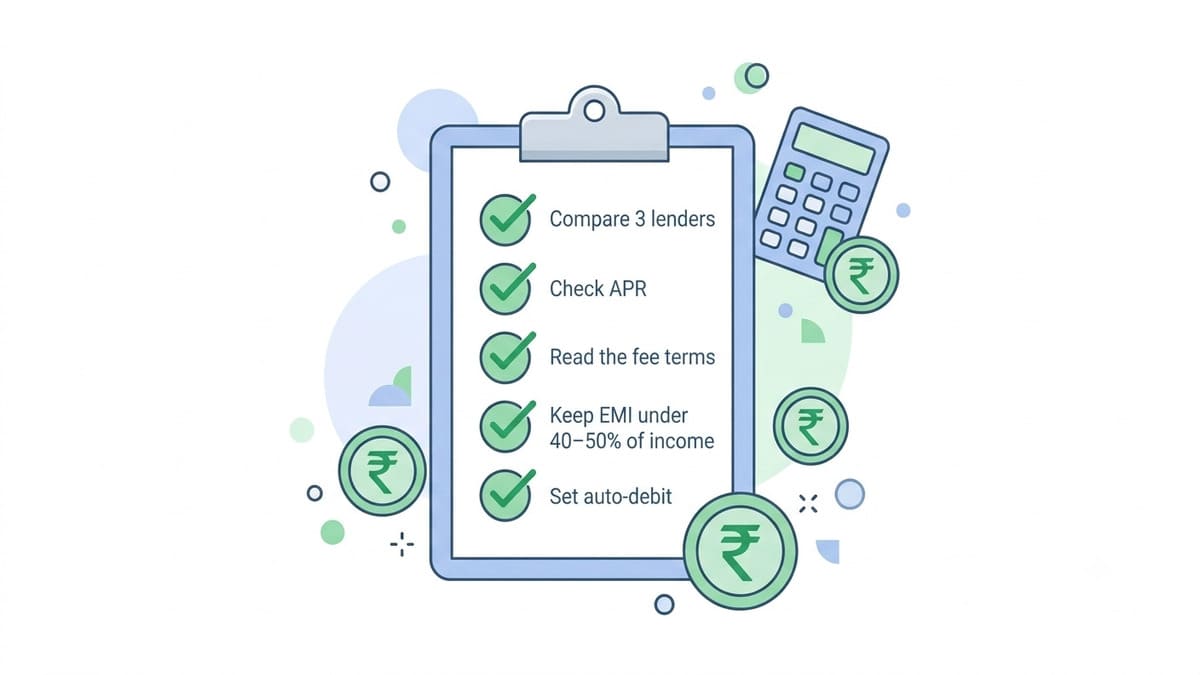
Before you sign or tap “accept,” go through this list:
- Define the exact amount you need. Borrow only that, not the maximum offered.
- Compare at least 3 lenders. Banks, NBFCs, and reputable digital lenders can vary a lot. Existing customers may get better rates.
- Check the APR and total cost, not just the interest rate.
- Read the Key Fact Statement and MITC. Look for fees, penalties, and prepayment rules.
- Confirm the lender is regulated. Check that the bank or NBFC is registered with the RBI. Avoid unknown apps that ask for excessive phone permissions.
- Use an EMI calculator and make sure the EMI fits comfortably within your monthly budget. A common guideline is to keep total EMIs below about 40% to 50% of your monthly income.
- Check your credit score first. A higher score often means a lower rate. You can get a free report from the credit bureaus once a year.
- Avoid long tenure for small amounts. It increases total interest for no real benefit.
- Plan for prepayment. If you get a bonus or extra income, check whether you can close the loan early without a heavy penalty.
- Set up auto-debit or reminders so you never miss a due date.
Common Mistakes to Avoid
Mistake 1: Choosing by EMI size alone. A low EMI over a long period can cost far more in total.
Mistake 2: Ignoring processing fees and GST. These can add 2% to 4% to your cost.
Mistake 3: Paying only the minimum due on a credit card. This is the fastest way to turn a small loan into a big one.
Mistake 4: Taking multiple loans at once. Each new application can trigger an enquiry on your report and increase your total burden.
Mistake 5: Borrowing for lifestyle spending. Loans for gadgets, holidays, or luxury shopping can strain your finances for years.
Mistake 6: Trusting unverified loan apps. Fake or unregulated lenders may charge extreme fees or misuse your data. If something feels wrong, report it to the relevant authority or your bank.
Mistake 7: Not reading the fine print. Many surprises come from clauses that were available to read the whole time.
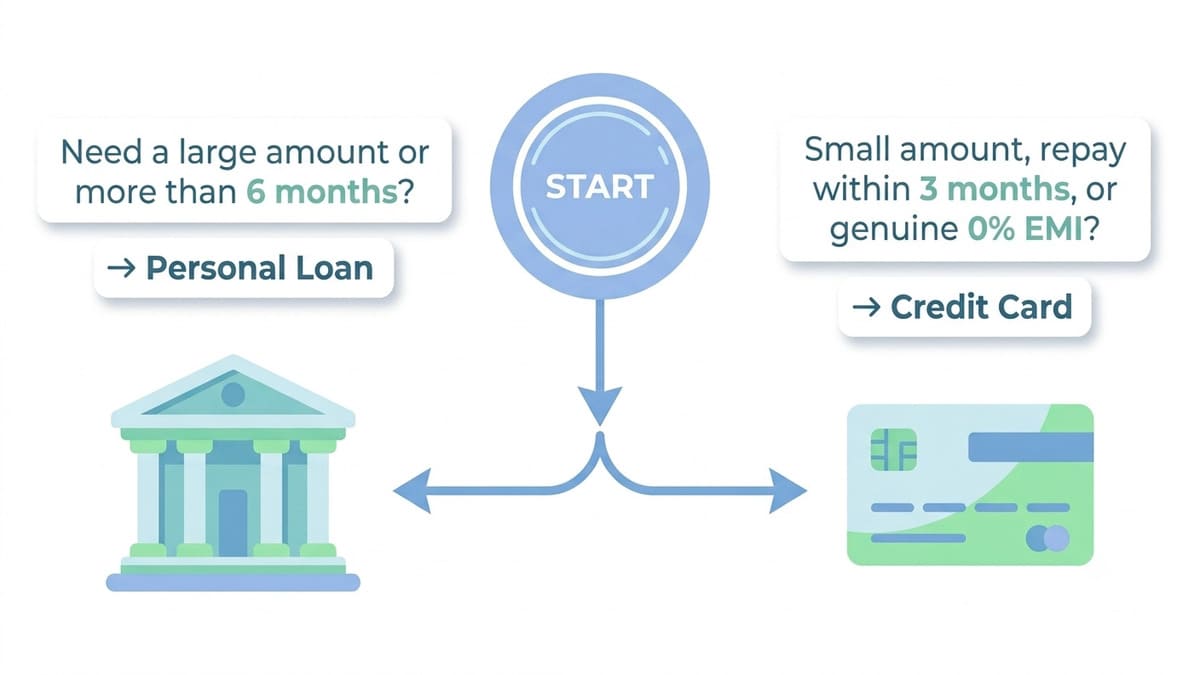
Which Is Cheaper in India? The Verdict by Situation
| Situation | Cheaper option (usually) |
|---|---|
| Large amount (₹1 lakh+), 2–5 years | Personal loan |
| Debt consolidation of credit card dues | Personal loan |
| Small amount, repay in 1–3 months | Credit card (if interest-free or 0% EMI) |
| Genuine 0% EMI with no hidden fees | Credit card EMI |
| Cash withdrawal from credit card | Almost never cheaper |
| Revolving balance, paying only the minimum | Personal loan, by a wide margin |
Personal loans win in most cases because of a lower interest rate, a structured repayment plan, and lower penalty risk. Credit card loans can compete only when the borrowing period is very short or the offer is genuinely interest-free.
Final Verdict: Personal Loan vs Credit Card Loan, Which Is Cheaper?
If you compare properly, the answer is clear:
For most borrowers, a personal loan is cheaper than a credit card loan thanks to its lower interest rate, longer tenure, and predictable repayment.
Credit card loans should be used only for short-term needs that you can repay quickly, ideally within the interest-free period or a short 0% EMI.
Whichever you choose, follow one rule: calculate the total repayment amount before you decide. The right loan is not the one that arrives fastest, but the one that costs the least and fits your budget.
Borrow smartly, not emotionally.
Frequently Asked Questions (FAQ)
1. Personal loan vs credit card loan: which is cheaper?
In most cases, a personal loan is cheaper because its interest rate is usually lower, often 10% to 18% compared with 18% to 42% or more for credit card loans. For very short periods or genuine 0% EMI offers, a credit card can be equal or cheaper.
2. Which loan is better for an emergency?
A credit card loan is usually faster, often instant. A personal loan is usually cheaper but may take a few hours to a few days. If you can wait a day, compare both. If you can’t, use the card but repay quickly.
3. Does credit card EMI affect my credit score?
Yes. A credit card EMI reduces your available credit limit, which raises your utilisation ratio. Missed or late payments can also hurt your score. Paying on time helps build a good record.
4. Can I prepay a personal loan early?
Many lenders allow prepayment, but some charge a fee, often a small percentage of the outstanding amount. Check your loan agreement, because rules vary by lender and by loan type.
5. What is the biggest risk of a credit card loan?
The biggest risk is the high interest rate combined with heavy penalties and compounding if you delay or pay only the minimum due. A small debt can grow quickly.
6. Is a “0% EMI” offer really free?
Not always. Check for processing fees, GST on interest, and whether the product price is higher than the cash price. Compare the EMI total with the full-payment price.
7. Should I use a personal loan to pay off credit card debt?
If the personal loan rate is clearly lower than your card’s rate, and you stop using the card for new debt, it can save money. Always include the processing fee in your calculation.
8. Will applying for a personal loan lower my credit score?
A loan application causes a hard enquiry, which can cause a small, temporary dip. Multiple applications in a short period can add up, so compare offers carefully instead of applying everywhere.
9. How can I get a lower personal loan interest rate?
Maintain a strong credit score, keep a stable income, compare multiple lenders, ask your existing bank for pre-approved offers, and negotiate the processing fee.
Related Articles You May Like
Useful External Resources
- Reserve Bank of India (RBI): official guidance on banking, lending, and consumer protection
- CIBIL (TransUnion CIBIL): check your credit score and credit report
- SEBI Investor Website: investor education on savings and investments
Disclaimer: This article is for educational and informational purposes only and does not constitute financial advice. Interest rates, fees, and rules change often and differ by lender and customer profile. The calculations shown are approximate illustrations. Please check the latest terms with your bank or lender and consult a qualified financial advisor before taking any loan.

Shilpesh Rathod is the founder of All Finance Knowledge. He holds a B.Com degree along with JAIIB and CAIIB banking certifications, and brings 19+ years of experience in the banking sector across savings, investments, and financial planning. Read more: https://allfinanceknowledge.com/about-us/
5 thoughts on “Personal Loan vs Credit Card Loan: Which Is Cheaper in India?”