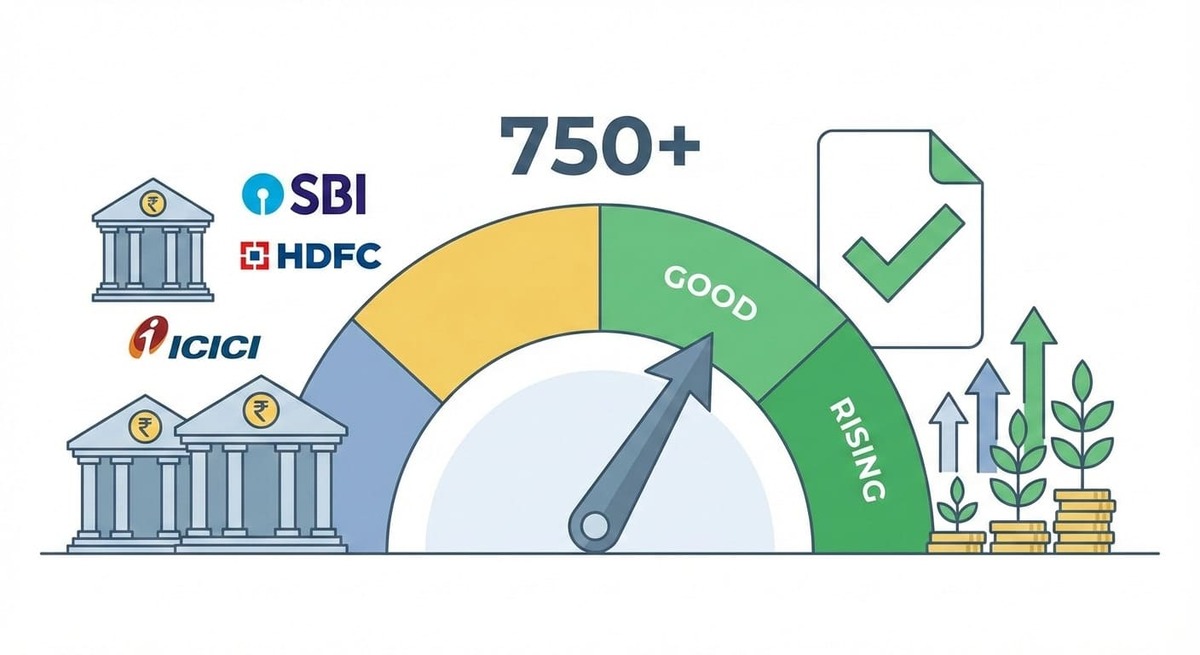
If you’ve ever applied for a loan or a credit card in India, you’ve probably heard a banker ask, “What’s your CIBIL score?” — and if you didn’t have a confident answer, you’re not alone. Most people know the number matters, but very few actually understand what it means, how it’s built, or how to fix it when it’s low.
This guide breaks the entire topic down in plain, everyday language. By the end, you’ll know exactly what a CIBIL score is, how banks read it, what pulls it down, and — most importantly — the practical steps that genuinely move the number upward. No jargon, no confusing banking language, just a clear roadmap you can start using today.
What Is a CIBIL Score?
A CIBIL score is a three-digit number, ranging from 300 to 900, that summarises how reliably you have handled credit in the past. It’s calculated and issued by TransUnion CIBIL, India’s oldest and most widely used credit information company, which is regulated by the Reserve Bank of India under the Credit Information Companies (Regulation) Act, 2005.
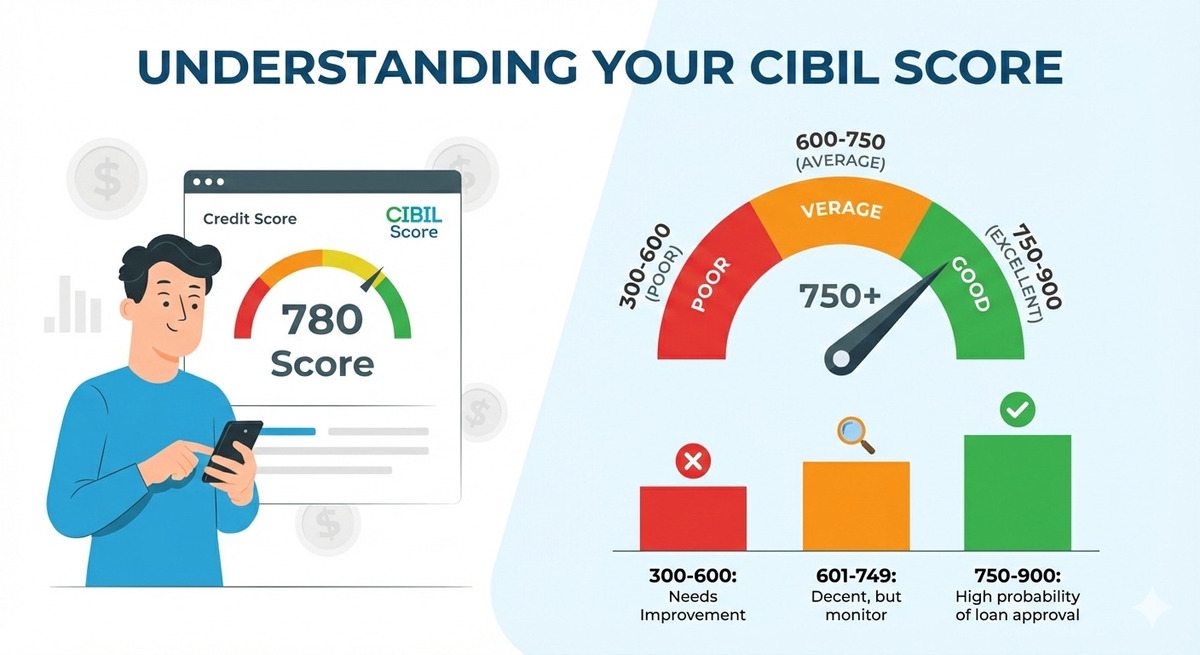
Think of it as your financial report card. Every time you take a loan, use a credit card, or miss an EMI, that activity gets reported by your bank or NBFC to CIBIL. The bureau then studies this history and compresses it into one number that tells any future lender, in seconds, how much of a credit risk you are likely to be.
📊 CIBIL Score Range at a Glance:
| Score Range | Category | What It Means for You |
|---|---|---|
| 300 – 549 | Poor | High risk; loan approval is difficult, and rejections are common |
| 550 – 649 | Fair | Some lenders may approve you, but usually at higher interest rates |
| 650 – 749 | Good | Reasonably safe borrower; decent approval odds and fair rates |
| 750 – 900 | Excellent | Preferred customer; fastest approvals, lowest rates, higher limits |
| NA / NH | No History | Not enough data yet to generate a score |
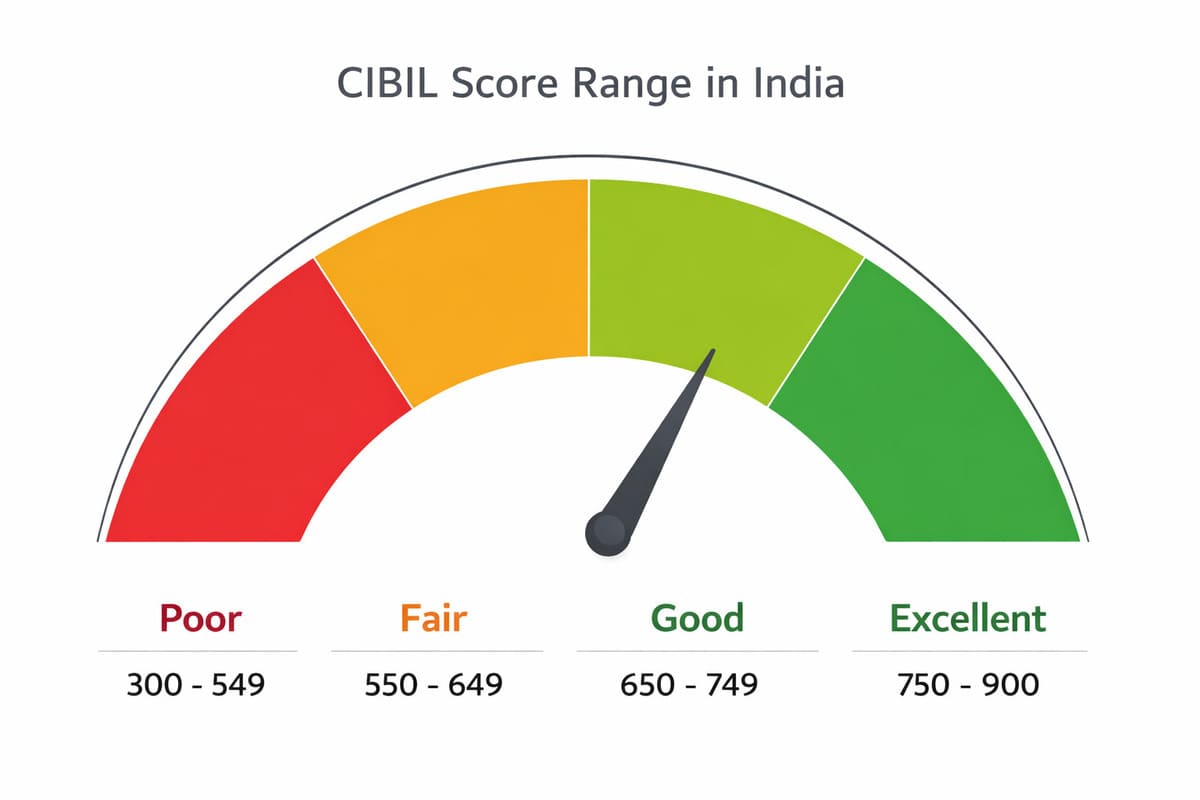
The higher your score, the more confidence a bank has in lending to you — and confidence, in banking, translates directly into cheaper interest rates and bigger loan amounts.
Why Does Your CIBIL Score Matter So Much?
It’s easy to dismiss a three-digit number until you see how much it actually controls. Your CIBIL score quietly influences almost every major credit decision in your life:
- ✔ Faster loan approvals — a strong score can mean the difference between same-day approval and weeks of back-and-forth documentation.
- ✔ Lower interest rates — even a 1–2% rate difference on a large loan like a home loan can add up to lakhs of rupees over the loan tenure.
- ✔ Higher credit card limits — banks are more generous with limits when your repayment history is solid.
- ✔ Better negotiating power — a good score gives you leverage to ask for better terms, lower processing fees, or waived charges.
- ✔ Access to premium products — travel cards, higher-tier credit cards, and pre-approved offers are usually reserved for high-score customers.
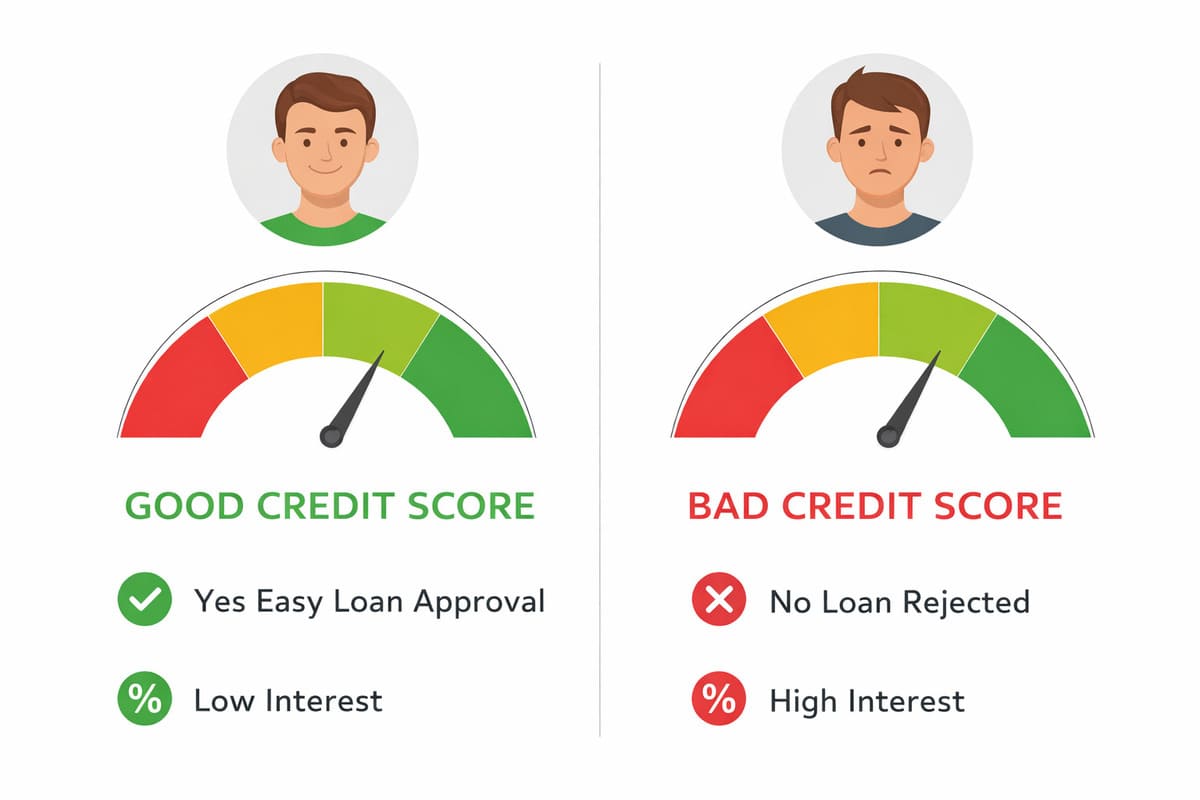
On the flip side, a poor score doesn’t just mean higher interest — it often means outright rejection, which shows up as a “hard enquiry” on your report and can make your next application even harder.
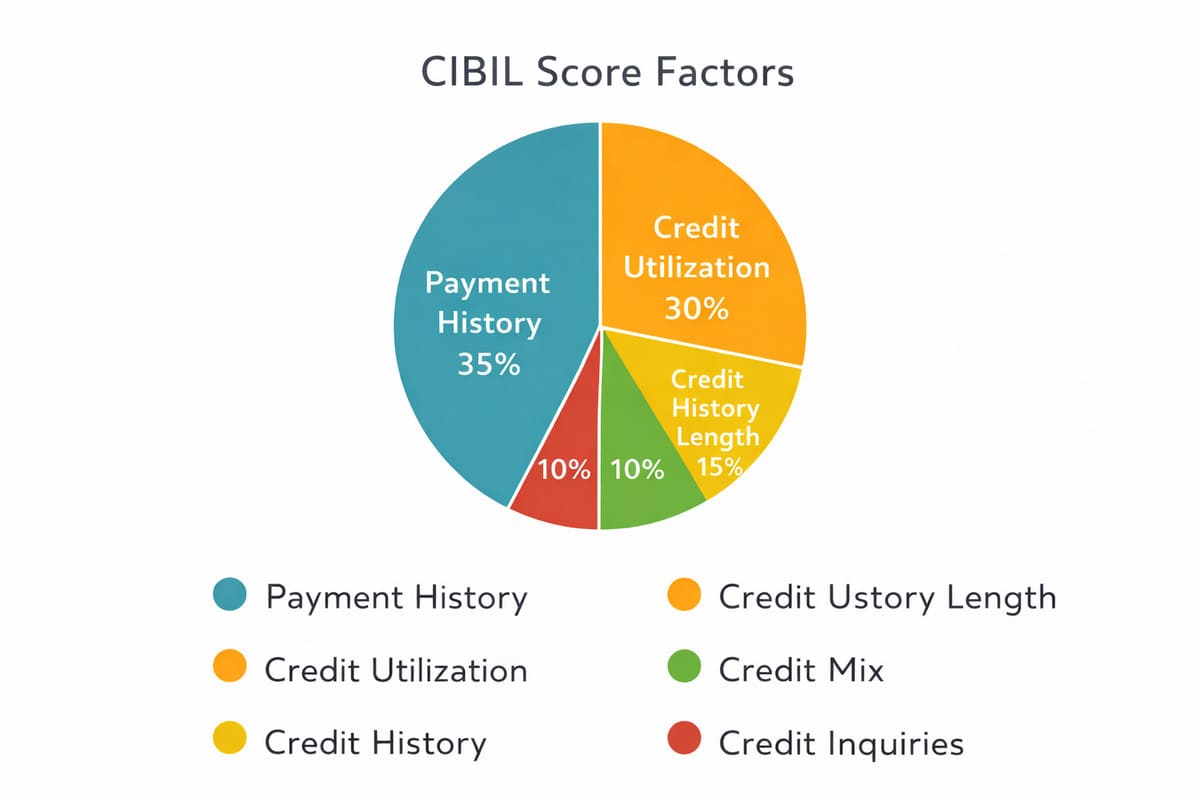
How Is CIBIL Score Calculated? (The 5 Real Factors)
CIBIL doesn’t pull your score out of thin air. It runs a weighted formula based on five core factors reported by your banks and NBFCs. Understanding the actual weightage helps you know exactly where to focus your energy.
1️⃣ Payment History — 35% Weight
This is, by far, the single biggest factor. Every EMI and every credit card bill you pay (or miss) gets logged. A single missed payment can shave off a noticeable chunk of your score, and the damage lingers on your report for years. Lenders read this as the clearest signal of how disciplined you are with money.
2️⃣ Credit Utilisation Ratio — 30% Weight
This is the percentage of your total available credit that you’re actually using at any given time.
- Ideal usage: Below 30% of your limit
- Example: If your credit card limit is ₹1,00,000, try to keep your outstanding balance under ₹30,000 before your statement is generated.
Consistently running close to your limit signals “credit hunger” to lenders, even if you eventually pay it off in full.
3️⃣ Credit History Length — 15% Weight
The age of your oldest and newest credit accounts matters. A longer track record gives CIBIL more data to judge you fairly, which is why closing your very first credit card is often a mistake — it shortens your average account age.
4️⃣ Credit Mix — 10% Weight
Lenders like to see that you can responsibly manage both secured loans (like a home loan or car loan, backed by collateral) and unsecured credit (like credit cards or personal loans, backed by nothing but your promise to pay). A healthy mix shows versatility.
5️⃣ Credit Enquiries — 10% Weight
Every time you apply for a new loan or credit card, the lender runs a “hard enquiry” on your report. Too many enquiries in a short window — even if none of them are rejected — makes you look credit-hungry and can drag your score down.
Real-Life Example: How CIBIL Score Changes Loan Outcomes
Numbers make more sense with a story. Let’s say Rahul and Amit both walk into the same bank on the same day, applying for a personal loan of ₹5,00,000.
| Rahul | Amit | |
|---|---|---|
| CIBIL Score | 780 | 620 |
| Approval Speed | Fast, often same-day | Slow, extra scrutiny |
| Interest Rate | Around 10–12% | Around 15–20% (if approved) |
| Loan Amount Eligibility | Full amount, possibly more | Reduced amount |
| Outcome | Loan approved smoothly | Higher chance of rejection |
Over a 5-year loan tenure, that gap in interest rate alone could cost Amit tens of thousands of rupees more than Rahul pays for the exact same loan amount. This is the real, rupee-and-paise cost of a low CIBIL score.
What Happens If You Have No CIBIL Score?
A large number of young professionals, students, and homemakers in India have zero credit history — which shows up on a report as “NA” or “NH” (No History), not a low score. It’s a different category entirely.
Why Is This a Problem?
Banks aren’t necessarily judging you negatively — they simply have no data to judge you by. That uncertainty makes them cautious, which often means:
- Loan applications get extra scrutiny or outright rejection
- Credit card applications may be declined, or approved with a very low starting limit
- You may be asked for a guarantor or collateral even for small amounts
How to Build a CIBIL Score from Zero
The good news: starting from nothing is easier to fix than starting from a bad score. Here’s a simple path:
- Get a secured credit card — issued against a fixed deposit, this is the easiest entry point since the bank’s risk is covered by your own FD.
- Take a small consumer loan if genuinely needed — for example, financing a phone or appliance — and repay it strictly on time.
- Become an add-on cardholder on a family member’s credit card with a strong repayment history.
- Use “buy now, pay later” services carefully, and always clear the dues before the due date.
Stay consistent for 3–6 months, and CIBIL will typically have enough data to generate your first score.
CIBIL Score vs Credit Report: What’s the Difference?
These two terms are often used interchangeably, but they are not the same thing.
CIBIL Score:
- A single 3-digit number (300–900)
- A quick summary snapshot of your creditworthiness
- What most lenders glance at first
Credit Report:
- A detailed document covering every loan and credit card you’ve ever held
- Full payment history, including delays and defaults
- Personal and employment information as reported by lenders
- Records of every lender who has checked your file (enquiries)
Serious lenders — especially for large loans like a home loan — will study both the score and the full report before approving anything.
How to Check Your CIBIL Score for Free
Checking your own score is completely safe and doesn’t hurt it in any way (more on that myth below). Here’s how to do it:
Step-by-Step:
- Visit the official CIBIL website
- Register using your PAN, date of birth, and contact details
- Verify your identity via OTP sent to your registered mobile number
- View your score and download your report
📌 You’re entitled to one free full credit report per year directly from CIBIL. For more frequent checks, you can also use:
- Your bank’s mobile app (most major banks now display your score for free)
- Financial apps like Paytm, Paisabazaar, or BankBazaar
- The RBI-mandated free annual report from each of the four credit bureaus operating in India
Common Reasons for a Low CIBIL Score
Most people don’t damage their score deliberately — it usually happens through small, repeated habits that quietly add up:
- Missing EMI or credit card due dates
- Paying only the “minimum amount due” instead of the full bill
- Maxing out credit cards regularly
- Closing your oldest credit accounts
- Applying for multiple loans or cards in a short span
- Settling a loan instead of fully closing it
- Standing as a guarantor for someone who later defaults
If any of these sound familiar, don’t panic — every one of them is fixable with time and discipline.
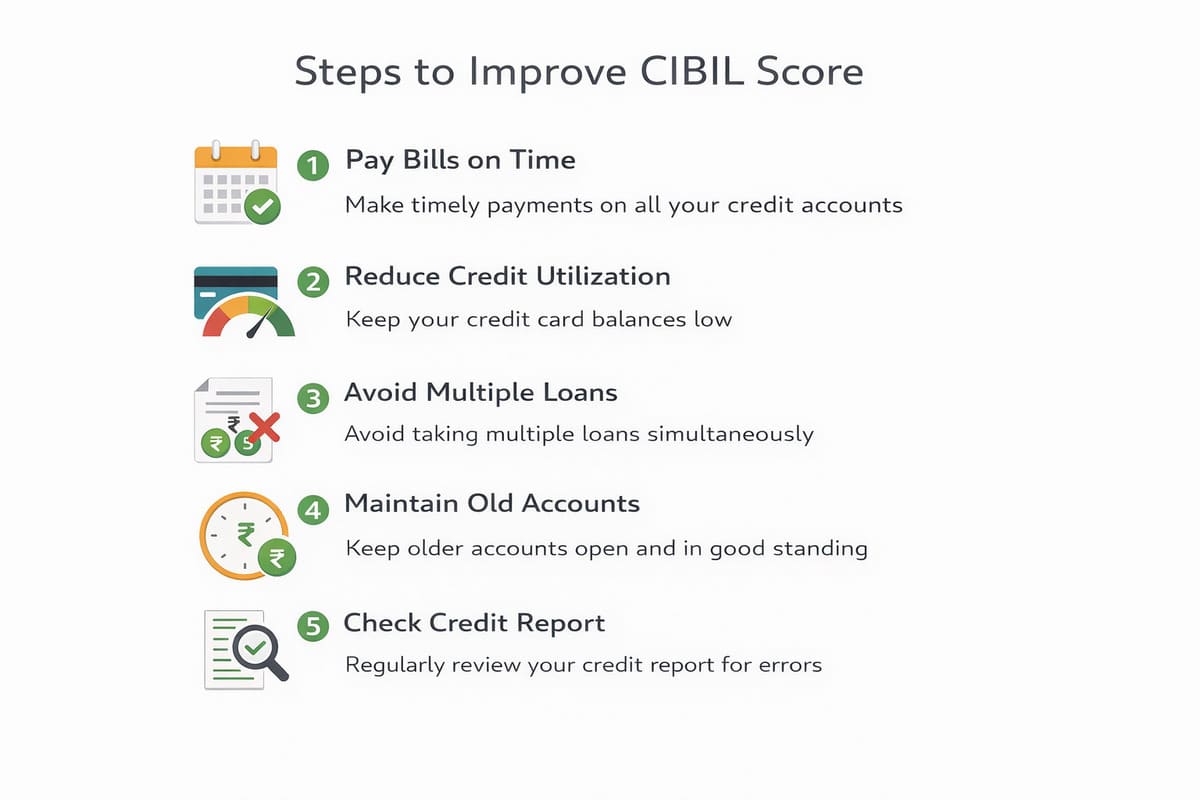
How to Improve CIBIL Score Fast: 10 Proven Tips
✅ 1. Pay All Dues on Time — Every Time
This is, without question, the fastest and most reliable lever you have. Set up auto-debit or calendar reminders for every EMI and credit card bill so a due date never slips your mind.
✅ 2. Reduce Credit Card Utilisation
If your card limit is ₹1,00,000, aim to keep your outstanding balance under ₹30,000 at the time your statement generates. This one change alone can visibly move your score within 2–3 months.
✅ 3. Avoid Unnecessary New Credit Applications
Each new application triggers a hard enquiry. Apply only when you genuinely need the credit, and space out applications by a few months where possible.
✅ 4. Keep Old Credit Accounts Open
Your oldest card is quietly working in your favour by lengthening your average credit history. Unless it charges a high annual fee you can’t justify, keep it active with small, occasional spends.
✅ 5. Check Your CIBIL Report for Errors
Reporting mistakes happen more often than you’d think — a loan marked “active” after you’ve closed it, a duplicate account, or an incorrect late-payment flag. Raise a dispute directly on the CIBIL website the moment you spot one.
✅ 6. Avoid Loan Settlements — Close Them in Full
A “settled” status on your report is a red flag to future lenders, since it signals you didn’t repay the full amount owed. Wherever financially possible, pay off the full outstanding balance instead.
✅ 7. Diversify Your Credit Mix Gradually
If you’ve only ever used credit cards, consider a small secured loan (like a loan against FD) to show lenders you can manage different credit types responsibly. Don’t take on debt purely for this reason, though — it should support a real need.
✅ 8. Set Up Auto-Pay for At Least the Minimum Due
Even on months when cash flow is tight, auto-paying the minimum due prevents a payment from being marked as “missed,” which is far more damaging than carrying a small balance forward.
✅ 9. Space Out Big-Ticket Applications
Avoid applying for a home loan, car loan, and a new credit card all in the same quarter. Multiple enquiries clustered together look riskier than the same applications spread over 6–12 months.
✅ 10. Be Patient and Consistent
There’s no legal shortcut or “hack” that fixes a damaged score overnight. Genuine improvement comes from sustained, boring, consistent good behaviour — and it works every time.
How Long Does It Actually Take to Improve Your CIBIL Score?
| Situation | Approximate Time to Recover |
|---|---|
| Minor issues (high utilisation, few enquiries) | 2–3 months |
| Late payments (a few missed EMIs) | 3–6 months |
| Defaults or loan settlements | 6–12 months, sometimes longer |
| Building a score from zero history | 3–6 months to get your first score |
There are no instant fixes here — anyone promising to “boost your CIBIL score in 7 days” for a fee is almost certainly running a scam. Consistency is the only real strategy that works.
What Is a Good CIBIL Score for Different Types of Loans?
Lenders don’t apply the same cutoff to every product. Here’s a general benchmark used across most Indian banks and NBFCs:
| Loan Type | Typical Minimum Score Needed |
|---|---|
| Home Loan | 750+ |
| Personal Loan | 700+ |
| Credit Card | 700+ |
| Car Loan | 700+ |
| Loan Without Income Proof | 750+ (compensates for missing documentation) |
| Business Loan | 700–750+ |
The higher your score climbs past these thresholds, the better your negotiating position on interest rate, processing fee, and loan tenure.
CIBIL Score Myths You Should Stop Believing
❌ Myth 1: Checking your own score reduces it
Truth: A self-check is a “soft enquiry,” which has zero impact on your score. Only a lender’s hard enquiry, done when you apply for credit, has any effect at all.
❌ Myth 2: Closing all your loans instantly boosts your score
Truth: Fully repaying and closing a loan is good practice, but closing your oldest accounts can actually hurt you by shortening your credit history length.
❌ Myth 3: A high income automatically means a high CIBIL score
Truth: CIBIL doesn’t know your salary at all. Your score is based purely on credit behaviour — a high earner with poor repayment habits can have a worse score than a modest earner who pays on time.
❌ Myth 4: One late payment won’t matter
Truth: Since payment history carries 35% of the weight, even a single missed EMI can leave a visible dent, especially if you have a short credit history to begin with.
❌ Myth 5: You need to carry a balance on your credit card to build a good score
Truth: This is a common misconception. Paying your bill in full every month is better for your score than carrying forward a balance and paying interest.
❌ Myth 6: A poor score is permanent
Truth: Nothing about your CIBIL score is permanent. With consistent, responsible credit use, even a badly damaged score can climb back into “good” or “excellent” territory over time.
CIBIL Score vs Other Credit Bureaus in India
CIBIL isn’t the only credit bureau operating in India — there are four RBI-licensed credit information companies in total:
- TransUnion CIBIL — the oldest and most widely used by Indian banks and NBFCs
- Experian
- Equifax
- CRIF High Mark
While all four calculate scores on broadly similar principles (payment history, utilisation, credit mix, and enquiries), the exact scoring models and the exact number they generate can differ slightly between bureaus. In practice, most Indian lenders still request your CIBIL report first, which is why it remains the most commonly referenced score in everyday banking conversations.
Tools and Habits to Track Your Credit Health Long-Term
Improving your score is only half the job — protecting it is the other half. A few habits worth building into your routine:
- Review your report every 3–6 months, not just once a year, especially if you’ve recently taken a new loan or card.
- Set EMI and bill reminders a few days before the due date, not on the due date itself.
- Track your credit utilisation weekly if you’re close to your limit on any card.
- Read the fine print before settling any loan — ask specifically what will be reported to CIBIL.
- Avoid co-signing or guaranteeing loans casually; a defaulting borrower can drag your own score down too.
Do NBFCs and Fintech Apps Check CIBIL Score the Same Way as Banks?
Not exactly — and this is something most articles skip entirely. While traditional banks like SBI, HDFC, and ICICI rely almost entirely on your CIBIL score and report before approving a loan, NBFCs (Non-Banking Financial Companies) and newer fintech lending apps often use a broader, more flexible risk model.
Here’s how the approach typically differs:
Traditional Banks:
- Heavily weight your CIBIL score as a primary go/no-go filter
- Often have a hard cutoff (e.g., won’t consider applications below 700–750 for certain products)
- Slower approval process, but usually better interest rates for high scorers
NBFCs:
- Still check CIBIL, but may approve borrowers in the 600–700 range that banks would reject outright
- Compensate for lower scores with higher interest rates or shorter tenures
- Faster processing, especially for personal and consumer loans
Fintech Lending Apps:
- Use CIBIL score as one input among several — often combined with your bank statement patterns, UPI transaction history, employment data, and even phone/app usage signals in some cases
- Can approve small-ticket loans even for those with thin or no CIBIL history, though usually at a cost (higher processing fees or interest)
- Best suited for short-term, smaller loan amounts rather than big-ticket borrowing like a home loan
What this means for you: if your CIBIL score is currently in the “fair” range and a traditional bank has turned you down, it doesn’t mean you have no options — it means you may need to look at a different category of lender while you work on rebuilding your score. Just be careful to compare the total cost of borrowing (interest rate + processing fee + any hidden charges) since NBFC and fintech rates can run noticeably higher to offset their added risk.
How Much Money Can a Good CIBIL Score Actually Save You?
It helps to see the score’s impact in pure rupee terms, not just approval odds. Consider a ₹30 lakh home loan over a 20-year tenure:
| CIBIL Score | Typical Interest Rate | Approx. Total Interest Paid |
|---|---|---|
| 750+ | ~8.5% | ~₹32.5 lakh |
| 700–749 | ~9.0% | ~₹35 lakh |
| 650–699 | ~9.75% | ~₹39 lakh |
| Below 650 | Often rejected, or 10.5%+ if approved | ₹43 lakh+ |
The gap between a 750+ score and a sub-650 score on the same loan amount can easily cross ₹10 lakh over the full tenure — money that stays in your pocket simply because of disciplined credit habits maintained years earlier. This is exactly why improving your score before you apply for a big-ticket loan, rather than after, makes such a meaningful financial difference. Pair a strong score with smart budgeting — for example, tracking your monthly expenses against your income the way we break down in our monthly budget guide — and you put yourself in the best possible position when it’s time to borrow.
Final Thoughts
Your CIBIL score isn’t just a banking formality — it’s a running record of your financial reputation, and it quietly follows you into every loan application, credit card request, and even some rental or job screenings. The good news is that it responds directly and predictably to your behaviour. Pay on time, keep your utilisation low, avoid unnecessary credit applications, and give it time.
There’s no shortcut that beats consistency. Start building the right habits today, and by the time you actually need that home loan or personal loan, your score will be working for you instead of against you.
Frequently Asked Questions
Q1. What is a good CIBIL score in India?
Ans– A score of 750 or above is generally considered excellent and gives you access to the best interest rates and fastest approvals.
Q2. Can I improve my CIBIL score in 30 days?
Ans – Minor improvements are possible within a month, but a meaningful jump usually takes 3–6 months of consistent good behaviour.
Q3. Does checking my own CIBIL score reduce it?
Ans- No. Checking your own score is a soft enquiry and has no negative effect on your score whatsoever.
Q4. How many times can I check my CIBIL score for free?
Ans- You’re entitled to one free full report per year directly from CIBIL, though many bank apps offer more frequent free checks.
Q5. Is having zero credit history a bad thing?
Ans- You’re entitled to one free full report per year directly from CIBIL, though many bank apps offer more frequent free checks.
Q6. What is the minimum CIBIL score needed for a personal loan?
Ans – Most lenders look for 700 or above, though some NBFCs may approve applicants around 650 at a higher interest rate.
Q7. Can a low CIBIL score be fixed?
Ans – Yes. With timely payments, reduced utilisation, and responsible credit use over a few months, a low score can be rebuilt.
Q8. Does EMI bounce affect CIBIL score?
Ans – Yes, a bounced EMI is reported as a missed payment and directly impacts your payment history, the single biggest factor in your score.
Q9. Does closing a credit card hurt my CIBIL score ?
Ans – It can, particularly if it’s your oldest card, since it shortens your average credit history length. Consider keeping old cards active with occasional small spends instead.
Q10. Do CIBIL score rules change with each Union Budget?
Ans – Credit bureau regulations are set by the RBI and don’t typically change with the annual budget, but related rules — like income tax slabs — can indirectly affect your overall financial planning and repayment capacity.
Disclaimer: This article is for educational purposes only and does not constitute financial advice. Loan approval, interest rates, and credit score outcomes depend on individual lender policies and personal credit profiles. For personalised guidance, consult your bank or a certified financial advisor.
Related Reads on All Finance Knowledge
- How to Improve CIBIL Score from 550 to 750: Step-by-Step Guide
- CIBIL Score Not Updated: Reasons & Solutions
- Does Checking CIBIL Score Reduce Credit Score?
- Can I Get a Loan Without Income Proof?
- Home Loan EMI Calculation with Real Example
- Personal Loan vs Credit Card Loan: Which Is Cheaper?

Shilpesh Rathod is the founder of All Finance Knowledge. He holds a B.Com degree along with JAIIB and CAIIB banking certifications, and brings 19+ years of experience in the banking sector across savings, investments, and financial planning. Read more: https://allfinanceknowledge.com/about-us/
8 thoughts on “CIBIL Score Explained: The Complete 2026 Guide to Understanding and Improving Your Credit Score Fast”