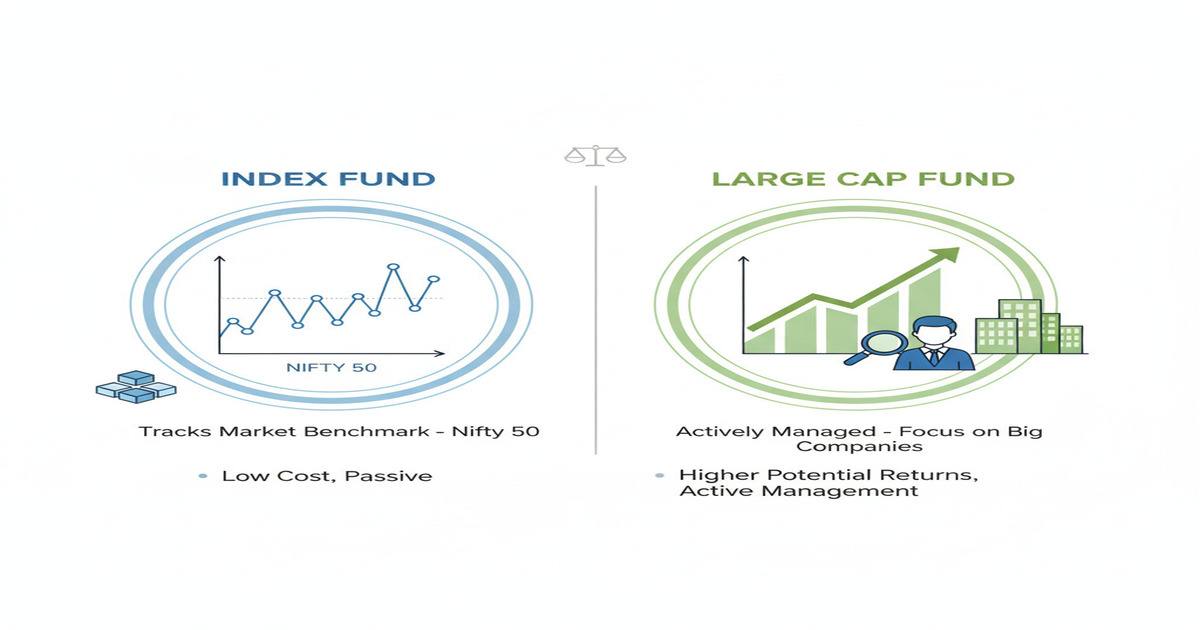
Introduction: Index Fund vs Large Cap Fund — Which Is Safer?
When beginners start investing in mutual funds, one question comes up again and again: should I choose an index fund or a large cap fund?
Both options sit at the “safer” end of the equity mutual fund spectrum, since both invest primarily in large, financially established companies rather than smaller, more volatile ones. That surface-level similarity is exactly why the comparison confuses so many first-time investors — the funds look alike on paper, but the way they’re built, managed, and priced is fundamentally different.
If your goal is long-term wealth creation with a reasonable degree of safety and predictability, understanding this difference isn’t optional — it directly affects how much of your return you actually keep after costs, how much variability you should expect year to year, and how much ongoing attention the investment demands from you.
This guide breaks the comparison down in detail: how each fund type actually works, how their risk profiles differ, what the numbers say about long-term returns, how costs compound over decades, and a practical framework for deciding which one — or what combination of both — fits your situation.
What Is an Index Fund?
An index fund is a mutual fund that doesn’t try to beat the market — it tries to become the market, or at least a defined slice of it. It does this by holding the same stocks, in the same proportion, as a market index such as the Nifty 50 or the Sensex.
If the Nifty 50 index has a certain company at 9% weight, the index fund tracking it holds roughly 9% of its portfolio in that same company. When the index is rebalanced (companies added or removed based on published rules), the fund adjusts its holdings to match — with no human judgment call involved in stock selection.
This approach is called passive management, in contrast to actively managed funds where a fund manager and research team make ongoing decisions about which stocks to buy, hold, or sell.
How an Index Fund Actually Works, Step by Step
- The index provider (like NSE for Nifty 50) defines the rules — for example, the 50 largest companies by free-float market capitalization.
- The index fund’s mandate is to replicate this basket as closely as possible.
- As money flows into the fund via SIP or lump sum, the fund manager buys the underlying stocks in the same weights as the index — not based on opinion, but based on the index’s published composition.
- When the index rebalances (typically semi-annually), the fund does too.
- The fund’s NAV moves in near lockstep with the index’s value, minus a small tracking difference (explained below).
Key Features of Index Funds
- Holds the same stocks as the underlying index, in the same proportion
- Passive management — no active stock-picking or market-timing decisions
- Very low expense ratio, since there’s no expensive research team driving strategy
- High transparency — you always know exactly what you own, because the index composition is public
- Returns that closely mirror the index, for better or worse
Tracking Error: The One Metric Unique to Index Funds
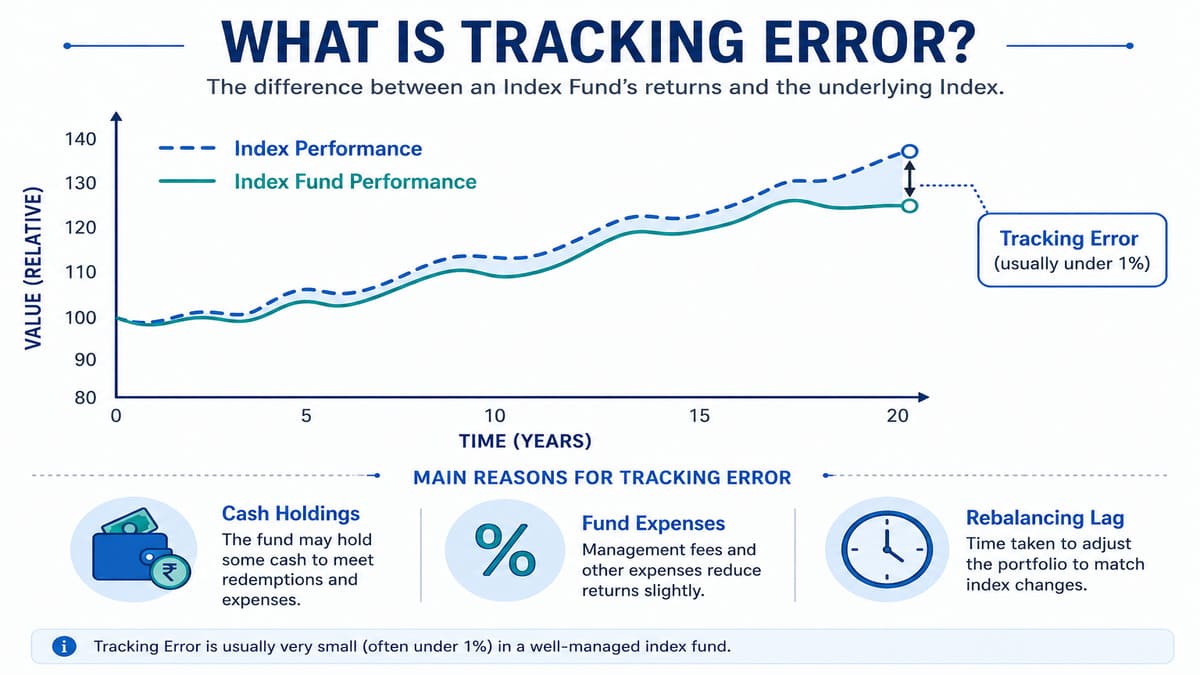
Index funds aren’t perfect copies of their benchmark. The small gap between an index fund’s return and its underlying index’s return is called tracking error. It arises from a few small frictions:
- Cash held for redemptions, which doesn’t earn the same return as being fully invested
- The fund’s own (small) expense ratio, which the index itself doesn’t pay
- Minor timing lags when the index rebalances
A well-run index fund typically has a tracking error of well under 1% annually. When comparing two index funds tracking the same benchmark, tracking error — not past returns — is often the more meaningful thing to check, since a lower tracking error means the fund is doing its one job more precisely.
Risk Level of Index Funds
Index funds still carry market risk — if the overall market falls, the fund falls with it, since it’s holding the same companies as the index. There’s no cushion or hedge built in. However, several structural features work in the investor’s favor:
- They automatically hold a basket of the largest, most liquid, most scrutinized companies in the market
- They are inherently diversified across sectors and companies, in the same proportion as the broader economy
- They carry no fund manager risk — there’s no individual whose judgment calls could go wrong
This combination is why index funds are widely considered one of the more structurally safe categories of equity mutual funds for long-term investors — not because they avoid market ups and downs, but because they remove several avoidable sources of underperformance.
What Is a Large Cap Fund?
A large cap fund is an actively managed equity mutual fund that, under SEBI’s mutual fund categorization rules, must invest at least 80% of its assets in large-cap companies — defined as the top 100 listed companies in India by market capitalization.
Unlike an index fund, a large cap fund’s manager has discretion. Within that top-100 universe, the fund manager and research team actively decide which companies to overweight, underweight, or avoid entirely, with the explicit goal of generating returns better than a benchmark index like the Nifty 100 or Nifty 50.
How a Large Cap Fund Actually Works, Step by Step
- The fund manager and research team analyze companies within the top-100 large-cap universe — studying financials, growth prospects, valuations, and competitive positioning.
- Based on this research, the fund builds a portfolio that deviates from the index — holding more of some stocks, less of others, and sometimes skipping index constituents entirely.
- The manager continuously monitors the portfolio and can rebalance based on changing views, not just on a fixed schedule.
- Performance is typically benchmarked against an index like the Nifty 100, and the fund’s success is judged by whether it beats that benchmark, after costs.
Key Features of Large Cap Funds
- Actively managed by a professional fund manager and research team
- Invests in established, financially strong, well-researched companies
- Higher expense ratio than an index fund, reflecting the cost of active research and management
- Flexible strategy — the manager can adjust holdings based on market views
- Genuine potential to outperform the index, though this isn’t guaranteed and depends entirely on the manager’s skill and decisions
Risk Level of Large Cap Funds
Large cap funds sit in an interesting middle position:
- They are generally less risky than mid-cap or small-cap funds, since they’re still anchored to large, established companies
- They carry slightly more risk than index funds tracking the same universe, because their returns depend on an added variable: the fund manager’s decisions
If the fund manager’s calls go well, the fund can outperform its benchmark. If the calls go poorly — through bad stock selection, poor timing, or a strategy that’s out of step with the market for a period — the fund can also underperform its own benchmark, something an index fund is structurally unable to do (beyond its small tracking error).
Index Fund vs Large Cap Fund: Key Differences
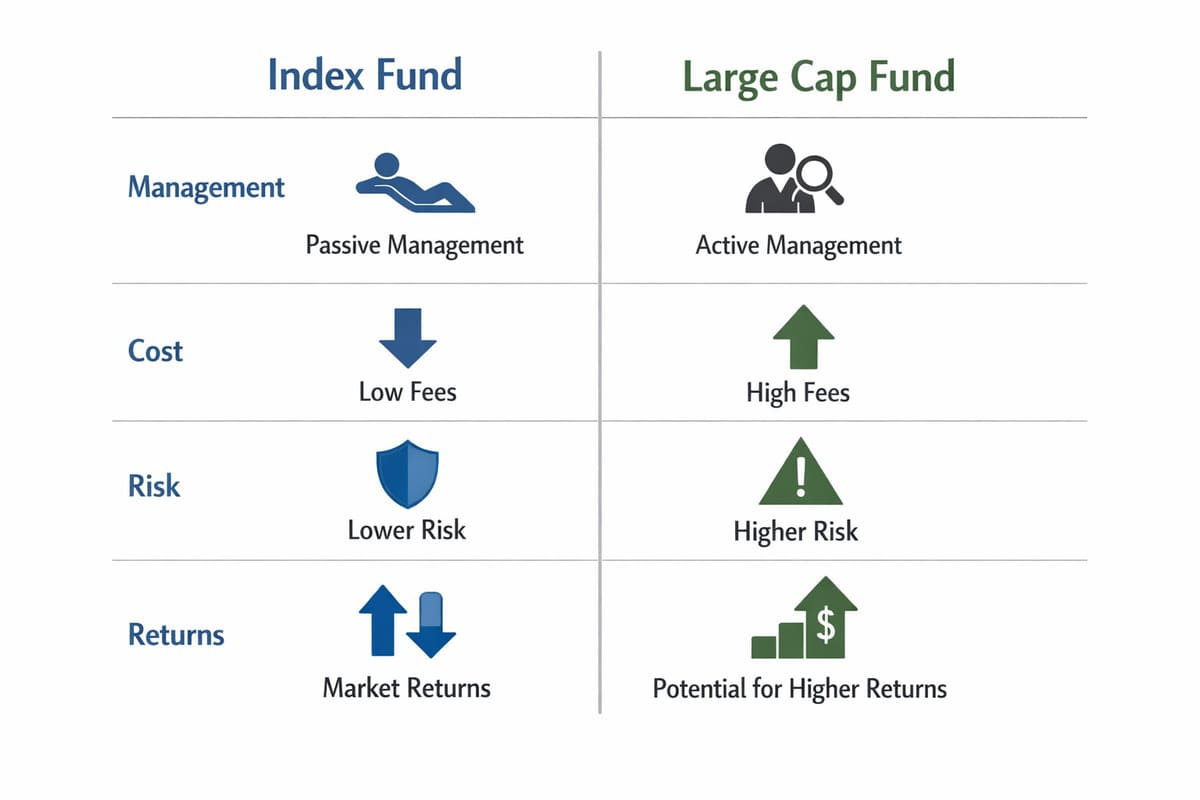
| Feature | Index Fund | Large Cap Fund |
| Fund Management | Passive (rules-based) | Active (manager-driven) |
| Expense Ratio | Very low (~0.1%–0.3%) | Higher (~1%–2%) |
| Risk Type | Market risk only | Market risk + fund manager risk |
| Return Consistency | Closely tracks the index | Can outperform or underperform the index |
| Transparency | Very high — holdings match a public index | Moderate — holdings can shift based on manager discretion |
| Underlying Universe | Fixed by index rules (e.g., top 50) | Broader (top 100), manager chooses within it |
| Best Suited For | Beginners, hands-off long-term investors | Investors comfortable with some manager-dependent variability |
Which Is Safer: Index Fund or Large Cap Fund?
From a pure structural-safety standpoint — meaning the number of things that could realistically go wrong beyond ordinary market movement — index funds have the edge.
Why Index Funds Are Considered Safer
- No dependency on a fund manager’s judgment. There’s no risk of a wrong sector call, a mistimed exit, or a concentrated bet going badly.
- Lower costs compound in your favor. A lower expense ratio means more of the market’s return actually reaches you, year after year.
- No risk of meaningfully lagging the benchmark. An index fund can only underperform its index by roughly its tracking error — typically a fraction of a percent. An actively managed fund has no such ceiling on underperformance.
- Full portfolio transparency. You know exactly what you hold at any time, since it mirrors a published index.
When Large Cap Funds Can Also Be a Reasonable Choice
Large cap funds aren’t inherently unsafe — they can be a sound choice in specific circumstances:
- When managed by a fund house and manager with a genuinely long, consistent track record of navigating different market cycles
- During periods where active stock selection has a real opportunity to add value (for instance, markets where valuations are dispersed and mispricing exists)
- For investors who are comfortable with some year-to-year variability relative to a plain index, in exchange for the possibility of outperformance
In short: if safety, predictability, and simplicity matter most to you, index funds are the more structurally sound choice. If you’re willing to accept manager-dependent variability for the possibility of higher returns, large cap funds can be a reasonable, though not guaranteed, way to pursue that.
Returns Comparison: Index Fund vs Large Cap Fund
Historically, the return pattern between these two categories tends to follow a fairly consistent logic:
- Index funds deliver close to the market-average return of their benchmark, minus a very small tracking error and expense drag.
- Large cap funds aim to beat that average, and some individual funds, in some periods, do.
However, a well-documented pattern across many markets globally — not just India — is that a large share of actively managed large-cap funds fail to consistently beat their benchmark index over long periods (10+ years), once costs are factored in. This doesn’t mean every large cap fund underperforms every year; it means that consistently beating a benchmark, year after year, over a full decade or more, turns out to be genuinely difficult even for skilled professional managers — largely because:
- Higher costs create a real, ongoing performance hurdle the fund must clear just to match the index
- Markets are highly efficient at pricing large, well-covered companies, leaving less room for a manager’s research to uncover mispricing
- Manager performance tends to be cyclical — a fund that outperforms in one market phase may lag in another
Over shorter periods (1–3 years), it’s far more common to see meaningful divergence between individual large cap funds and the index — some ahead, some behind. Over longer periods (10–15 years), the gap between the median large cap fund and the index tends to narrow, and after accounting for the higher expense ratio, many large cap funds end up close to, or behind, what a low-cost index fund would have delivered.
This is not a claim that active management never works — it’s a reminder that outperformance is not the default outcome; it’s the exception that requires genuine, sustained manager skill.
Expense Ratio: Why Cost Matters More Than Investors Realize
The expense ratio is often the single most underestimated factor in long-term fund selection, because its effect is invisible day-to-day but massive over decades.
Typical Expense Ratios
- Index Funds: roughly 0.10% – 0.30% per year
- Large Cap Funds: roughly 1% – 2% per year
That 1–1.5 percentage point gap sounds small. It isn’t.
A Concrete Compounding Example
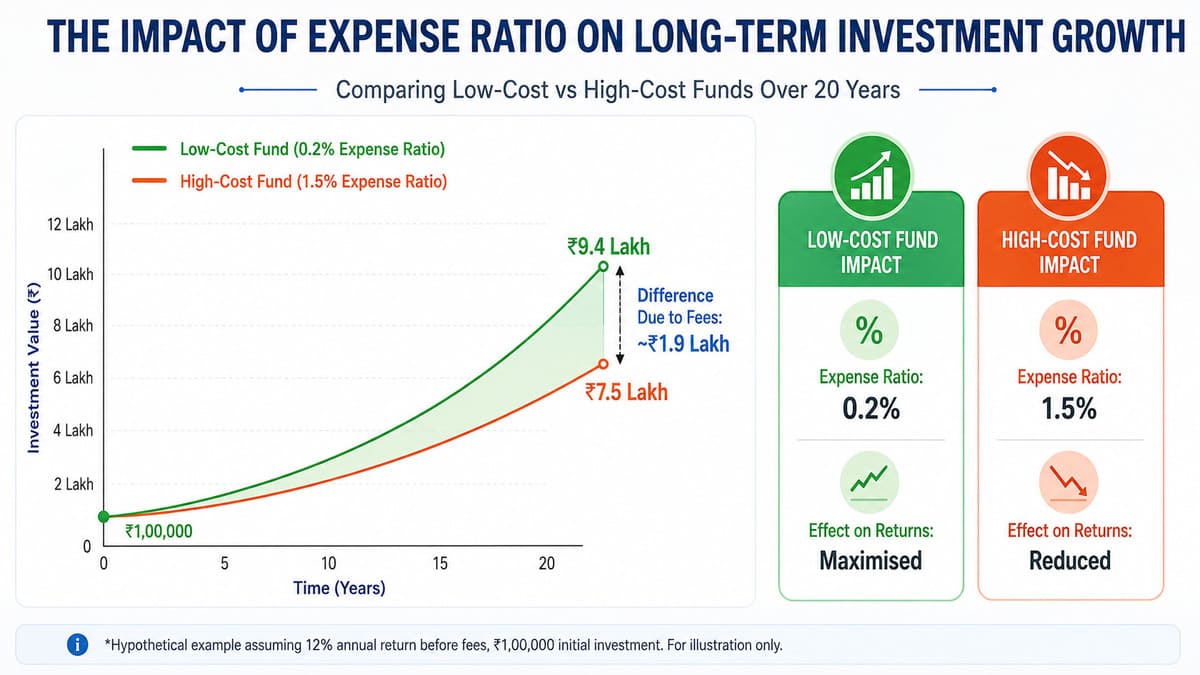
Imagine ₹1,00,000 invested for 20 years, assuming the underlying market itself grows at 12% annually before costs.
- Index Fund (0.2% expense ratio, net return ≈ 11.8%): grows to roughly ₹9.4 lakh
- Large Cap Fund (1.5% expense ratio, net return ≈ 10.5%, even before accounting for whether the manager beats or lags the market): grows to roughly ₹7.5 lakh
That’s a difference of nearly ₹1.9 lakh on a single ₹1 lakh investment, purely from the expense ratio gap — before even asking whether the large cap fund’s manager successfully beat the index. For a large cap fund to be genuinely worth its higher cost, its manager needs to generate enough extra return, after fees, to close this gap and then some. That’s a real, quantifiable bar to clear — not a marginal one.
(These figures are illustrative, assuming a constant 12% gross market return for simplicity; real markets don’t grow in a straight line, and actual results will vary.)
Why Lower Cost Effectively Means Higher Safety
- A lower expense ratio means more of the market’s actual return reaches your account
- It reduces the “performance hurdle” the fund must clear just to match a benchmark
- Over long horizons, cost differences compound just as powerfully as returns do — working against you in a high-cost fund, and for you in a low-cost one
You can learn more about how expense ratios work directly from AMFI’s investor education resources.
Index Fund vs Large Cap Fund for SIP Investors
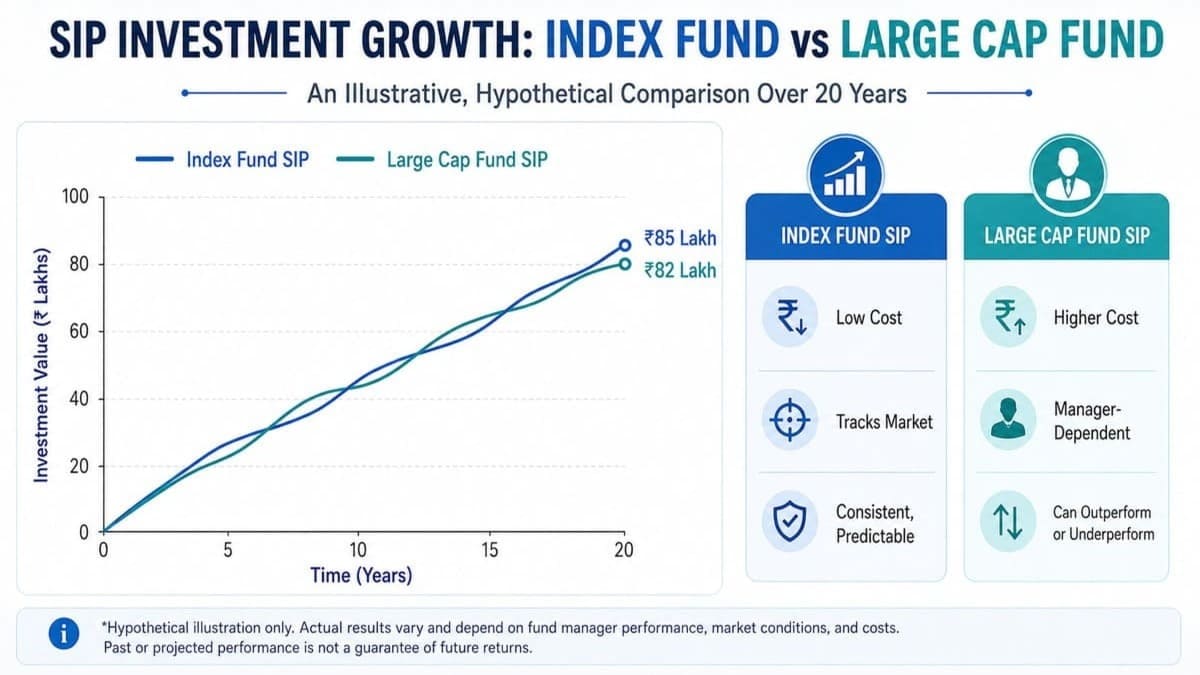
If you invest through an SIP (Systematic Investment Plan), the choice between these two fund types matters even more, because SIP is inherently a long-horizon strategy — and cost, consistency, and manager-dependency all compound differently over a 10–20 year SIP than over a single lump-sum investment.
Index Funds for SIP
- Stable, predictable growth pattern that closely mirrors the broader market
- Lower volatility relative to individual large cap fund performance swings
- Well suited to beginners who want a simple, low-maintenance, “set and continue” approach
- The low cost structure specifically benefits long SIP horizons, since fee drag compounds over every single monthly instalment
Large Cap Funds for SIP
- Slightly higher volatility, since returns are shaped by both the market and the manager’s active calls
- Requires a degree of ongoing monitoring — checking whether the fund is still keeping pace with its benchmark over multi-year windows
- Can offer higher upside if the fund manager’s strategy consistently adds value over the SIP period
For most SIP investors — particularly those investing for retirement, a child’s education, or other multi-decade goals — index funds tend to offer more predictability and require less ongoing decision-making, which itself has value: less second-guessing, less temptation to switch funds based on short-term noise.
Who Should Choose Index Funds?
Index funds tend to be the better fit for:
- Beginners taking their first steps into equity mutual funds
- Long-term investors with a horizon of 10+ years
- Salaried individuals running a disciplined, ongoing SIP
- Investors who prioritize low cost and minimal ongoing maintenance
- People who don’t want to track markets, fund manager changes, or quarterly performance reports
Who Should Choose Large Cap Funds?
Large cap funds tend to suit:
- Investors with a moderate risk tolerance who are comfortable with some manager-driven variability
- Those who have researched a specific fund house and manager’s long-term track record and trust their process
- Investors specifically seeking the possibility of returns above the index, and willing to accept the possibility of returns below it too
- People who are willing to periodically review whether the fund is still earning its higher cost through genuine outperformance
Can You Invest in Both?
Yes — and for many investors, this is actually the most balanced approach. Combining both fund types lets you capture the low-cost stability of an index fund while keeping some exposure to the possibility of manager-driven outperformance.
Example Allocations by Risk Comfort
- Conservative approach: 80% Index Fund / 20% Large Cap Fund — prioritizes low cost and predictability, with a small allocation to active management
- Balanced approach: 70% Index Fund / 30% Large Cap Fund — a commonly used starting split for investors who want some active exposure without over-relying on it
- Growth-oriented approach: 50% Index Fund / 50% Large Cap Fund — for investors more comfortable with manager-driven variability in pursuit of higher potential returns
There’s no single “correct” ratio — the right split depends on your own risk comfort, how much you trust a specific fund manager’s track record, and how much ongoing monitoring you’re willing to do. What matters more than the exact percentage is having a clear, written-down reason for whatever split you choose, so you’re not tempted to shuffle the allocation every time short-term performance shifts.
Taxation: Index Fund vs Large Cap Fund
Both index funds and large cap funds are classified as equity mutual funds under Indian tax law (since both invest at least 65% in domestic equities), so they are taxed identically — the fund type itself doesn’t change your tax treatment.
Tax Rules (General Framework)
- Short-Term Capital Gains (units held ≤ 12 months): taxed at a flat short-term rate
- Long-Term Capital Gains (units held > 12 months): taxed at a long-term rate, with an exemption on gains up to a specified threshold each financial year
Capital gains tax rates and exemption thresholds for equity mutual funds have been revised in recent Union Budgets, so rather than quoting a specific percentage that could be outdated by the time you’re reading this, it’s worth confirming the current applicable rates on the Income Tax Department’s official website or with a tax professional before making investment decisions.
The key takeaway: since both fund types are taxed the same way, taxation isn’t a differentiating factor in the index-fund-vs-large-cap-fund decision — cost, risk profile, and manager dependency are what actually separate them.
Common Mistakes to Avoid
- Choosing a fund based only on trailing 1-year or 3-year returns, without checking whether that performance was consistent across multiple market cycles
- Ignoring the expense ratio, treating a 1–1.5% annual difference as negligible when it compounds into a significant amount over decades
- Frequently switching funds based on short-term underperformance, which locks in losses and disrupts long-term compounding
- Investing without a clear time horizon, leading to panic-selling during a downturn that a longer horizon would have absorbed
- Over-diversifying across too many similar large cap or index funds, which doesn’t meaningfully reduce risk and just adds complexity to track
- Comparing a large cap fund’s returns to the wrong benchmark, or not checking a benchmark at all
Advanced Tips for Smart Investors
1. Focus on the Long-Term Horizon
Equity investments — whether index or large cap — tend to work best when given a runway of 10+ years to smooth out short-term volatility and allow compounding to do its work.
2. Stay Consistent with SIP
Avoid pausing or stopping SIPs during market downturns. This is precisely when rupee cost averaging works in your favor, since you’re buying more units at lower prices.
3. Review Annually, Not Constantly
Checking your portfolio’s performance once or twice a year, against your actual goals rather than daily headlines, tends to lead to better decisions than frequent monitoring, which often triggers emotionally-driven changes.
4. Avoid Trying to Time the Market
Attempting to predict short-term market movements is difficult even for professionals. A consistent, disciplined investment approach has historically outperformed attempts at timing entries and exits.
5. If You Hold a Large Cap Fund, Track It Against Its Benchmark
Don’t just look at whether the fund’s NAV went up — check whether it beat its stated benchmark (like the Nifty 100) over a 3–5 year rolling window. A fund that consistently tracks its benchmark or falls slightly behind it, while charging active-management fees, may not be earning its higher cost.
Final Verdict: Index Fund vs Large Cap Fund — Which Is Safer?
When comparing index funds and large cap funds on structural safety, index funds have a clear, defensible edge — particularly for beginners and investors who prioritize predictability over the chance of outperformance.
Their combination of:
- Very low cost
- High transparency
- No fund manager risk
- Return behavior that closely mirrors the broader market
makes index funds a genuinely low-maintenance, low-friction way to build long-term equity exposure.
Large cap funds can deliver higher returns in specific periods, under specific managers, but that potential comes bundled with a real possibility of underperformance too — a trade-off index funds are structurally designed to avoid.
A practical framework:
- New to investing, or want simplicity and low cost → Index Funds
- Comfortable with some variability, want a blend of stability and upside → A mix of both
- Actively engaged, willing to research and monitor fund managers → Large Cap Funds, ideally alongside a core index holding
FAQs: Index Fund vs Large Cap Fund
Q1. Is an index fund safer than a large cap fund?
Ans – Generally, yes — index funds are considered structurally safer because they carry no fund manager risk and have very low costs, both of which reduce sources of underperformance beyond ordinary market movement.
Q2. Can large cap funds give higher returns than index funds?
Ans- Yes, it’s possible — some large cap funds do outperform their benchmark index in certain periods. However, consistently beating the index over long periods (10+ years), after costs, is genuinely difficult, and many large cap funds fail to do so.
Q3. Index fund vs large cap fund — which is better for beginners?
Ans – Index funds are generally better suited to beginners, due to their simplicity, low cost, transparency, and the fact that they don’t require ongoing evaluation of a fund manager’s performance.
Q4. Are index funds risk-free?
Ans – No. Index funds carry full market risk — if the underlying index falls, the fund falls with it. They are not risk-free; they simply avoid the additional layer of risk that comes from active fund manager decisions.
Q5. Can I invest in both an index fund and a large cap fund?
Ans – Yes, and many investors do exactly this — combining the low-cost stability of an index fund with some allocation to an actively managed large cap fund for potential outperformance.
Q6. What is tracking error, and why does it matter for index funds?
Ans – Tracking error is the small difference between an index fund’s return and its underlying index’s return, caused by costs, cash holdings, and minor rebalancing lags. A lower tracking error means the fund is replicating its benchmark more precisely.
Q7. Do large cap funds always underperform index funds?
Ans – No — this isn’t universally true. Individual large cap funds, especially those with strong, consistent management, can and do outperform their benchmark in various periods. The broader pattern is that consistent outperformance over long periods is uncommon, not that it never happens.
Q8. How much difference does expense ratio actually make over time?
Ans – A significant one. A 1–1.5% annual expense ratio gap between an index fund and a large cap fund can result in a difference of tens of thousands of rupees on even a modest investment over a 15–20 year horizon, purely due to compounding
Q9. Which index does an index fund typically track in India?
Ans – Common benchmarks include the Nifty 50, Sensex, and Nifty Next 50, among others — the fund’s name and offer document will specify exactly which index it tracks.
Q10. Is a large cap fund the same as a large cap index fund?
Ans – No — a “large cap fund” typically refers to an actively managed fund investing in the top 100 companies, while a “large cap index fund” is a passive fund tracking a specific large-cap index like the Nifty 100. The word “large cap” describes the company universe; “index” or “active” describes the management style.
Final Thoughts
Choosing between an index fund and a large cap fund ultimately comes down to your risk tolerance, investment horizon, and how much ongoing involvement you want in monitoring your investments. If your priority is safety, simplicity, and steady, low-cost growth, index funds are the stronger structural choice.
If you’re comfortable with some manager-dependent variability and want the possibility of returns above the market average, a large cap fund — ideally one with a genuinely strong, consistent track record — can be a worthwhile addition to your portfolio, especially alongside a core index fund holding.
Whichever path you choose, the fundamentals that matter most are staying consistent, thinking in decades rather than months, and avoiding emotionally-driven decisions during short-term market swings. For a broader foundation on how mutual funds fit into your overall financial plan, see our complete beginner’s guide to mutual funds.
Disclaimer: This article is for educational purposes only and does not constitute financial advice. Mutual fund investments are subject to market risks; please read all scheme-related documents carefully and consult a qualified financial advisor before investing.

Shilpesh Rathod is the founder of All Finance Knowledge. He holds a B.Com degree along with JAIIB and CAIIB banking certifications, and brings 19+ years of experience in the banking sector across savings, investments, and financial planning. Read more: https://allfinanceknowledge.com/about-us/
7 thoughts on “Index Fund vs Large Cap Fund: Which Is Safer for Long-Term Investors?”