
Introduction
A lot of people put off investing because they think it’s complicated, risky, or only for people who already have money. Because of that fear, most beginners just leave their savings sitting in a bank account or a fixed deposit, year after year. Saving is a great habit, but on its own it isn’t enough — inflation quietly eats into the value of money that isn’t growing, which means the same ₹10,000 buys less five years from now than it does today. That’s the real reason investing matters, even for someone who’s just starting out with a small, steady income.
Mutual funds exist to solve exactly this problem, and they’re one of the building blocks of personal finance basics that every new investor eventually runs into. They give ordinary people — students, salaried employees, small business owners, homemakers — a way to participate in the stock and bond markets without needing to track share prices every day, read balance sheets, or have a finance degree.
This guide walks through what a mutual fund actually is, how it works behind the scenes, the different types available, how SIPs fit in, what it costs, how it’s taxed, the risks involved, and a practical step-by-step path to making your first investment. It’s written in plain language on purpose, so if you’ve never invested a rupee in your life, you should be able to follow every part of it.
What Is a Mutual Fund?
A mutual fund is a pool of money collected from many different investors, which is then invested — on their behalf — into a mix of financial instruments such as:
- Company shares (equities)
- Government and corporate bonds
- Money market instruments like treasury bills and commercial paper
- Gold, in the case of specialised gold funds
Instead of each person picking individual stocks and managing a portfolio alone, everyone’s money is combined into one large fund. A qualified fund manager, backed by a research team, decides where that combined pool should be invested, based on the fund’s stated objective (growth, income, safety, tax-saving, and so on).
Every investor who puts money into the fund receives units proportional to their contribution. If the fund’s total value grows, the value of each unit grows too, and every unitholder benefits in proportion to how much they invested — not based on when they joined or how experienced they are.
A Simple Example
Imagine a small mutual fund scheme where:
- 100 investors each put in ₹1,000
- The total pool collected is ₹1,00,000
- The fund manager invests this ₹1,00,000 across the shares of 20 different companies
If those companies perform well over the next year and the total value of the fund grows to ₹1,20,000, every investor’s share grows by the same 20%. Someone who invested ₹1,000 now has an investment worth ₹1,200. If the market falls instead and the fund’s value drops to ₹90,000, that same investor’s holding is now worth ₹900.
This is the core idea of a mutual fund: shared investment, shared risk, and shared reward, all managed professionally on your behalf.
How Does a Mutual Fund Work, Step by Step?
Mutual funds in India operate under a well-defined, SEBI-regulated structure. Here’s the practical flow of what happens when you invest:
- You invest money — either as a one-time lump sum or through a Systematic Investment Plan (SIP).
- Your money joins a common pool along with money from thousands, sometimes millions, of other investors in the same scheme.
- The Asset Management Company (AMC) — the business that runs the mutual fund — assigns a fund manager to this scheme. The fund manager researches and selects specific stocks, bonds, or other instruments to buy, based on the fund’s objective.
- You are allotted units of the scheme, priced at the fund’s current NAV (explained below), in proportion to how much you invested.
- The fund’s underlying investments generate returns in the form of price appreciation, dividends, or interest income over time.
- Gains or losses are reflected in the NAV, which is updated daily. Your investment’s value rises and falls with it.
- You can redeem (sell) your units whenever you choose, subject to any lock-in period or exit load that applies to that particular scheme.
A trustee company and custodian also sit behind every mutual fund to make sure investor money is held safely and used only for the purposes stated in the scheme’s offer document — this is one of the reasons mutual funds are considered a fairly transparent and accountable way to invest, compared to informal investment schemes.
What Is NAV (Net Asset Value)?
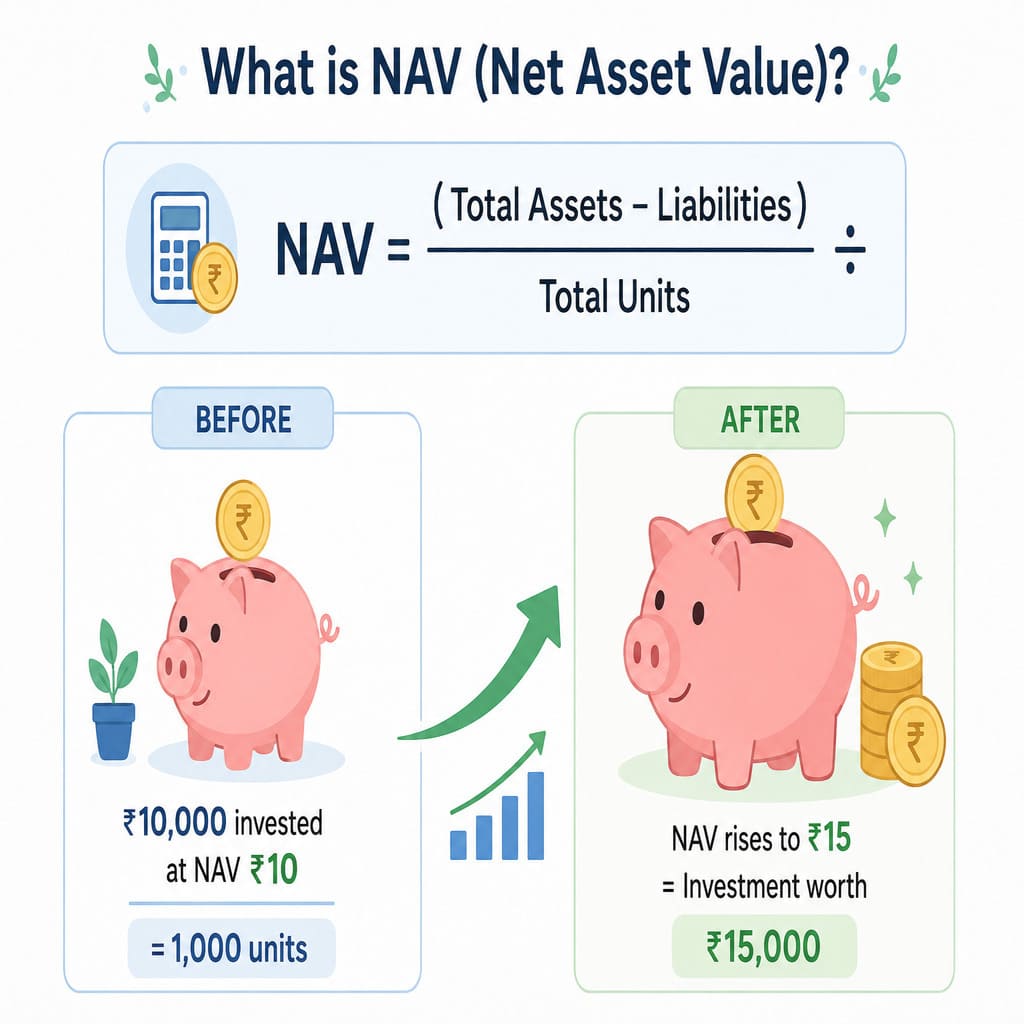
NAV, or Net Asset Value, is simply the price of one unit of a mutual fund scheme on a given day.
It’s calculated using this formula:
NAV = (Total value of the fund’s assets − liabilities and expenses) ÷ Total number of units outstanding
- When the market value of the fund’s underlying investments rises, NAV goes up.
- When the market value falls, NAV goes down.
Example
Suppose you invest ₹10,000 in a fund when its NAV is ₹10 per unit.
- Units allotted to you = ₹10,000 ÷ ₹10 = 1,000 units
A year later, if the fund has performed well and the NAV has risen to ₹15:
- Your investment value = 1,000 units × ₹15 = ₹15,000
If instead the NAV had fallen to ₹8:
- Your investment value = 1,000 units × ₹8 = ₹8,000
NAV for most open-ended mutual funds in India is calculated once a day, after the stock markets close, and published the same evening. It is not something you can “trade” throughout the day like a stock price — this is one key difference between mutual funds and shares or ETFs.
Types of Mutual Funds for Beginners
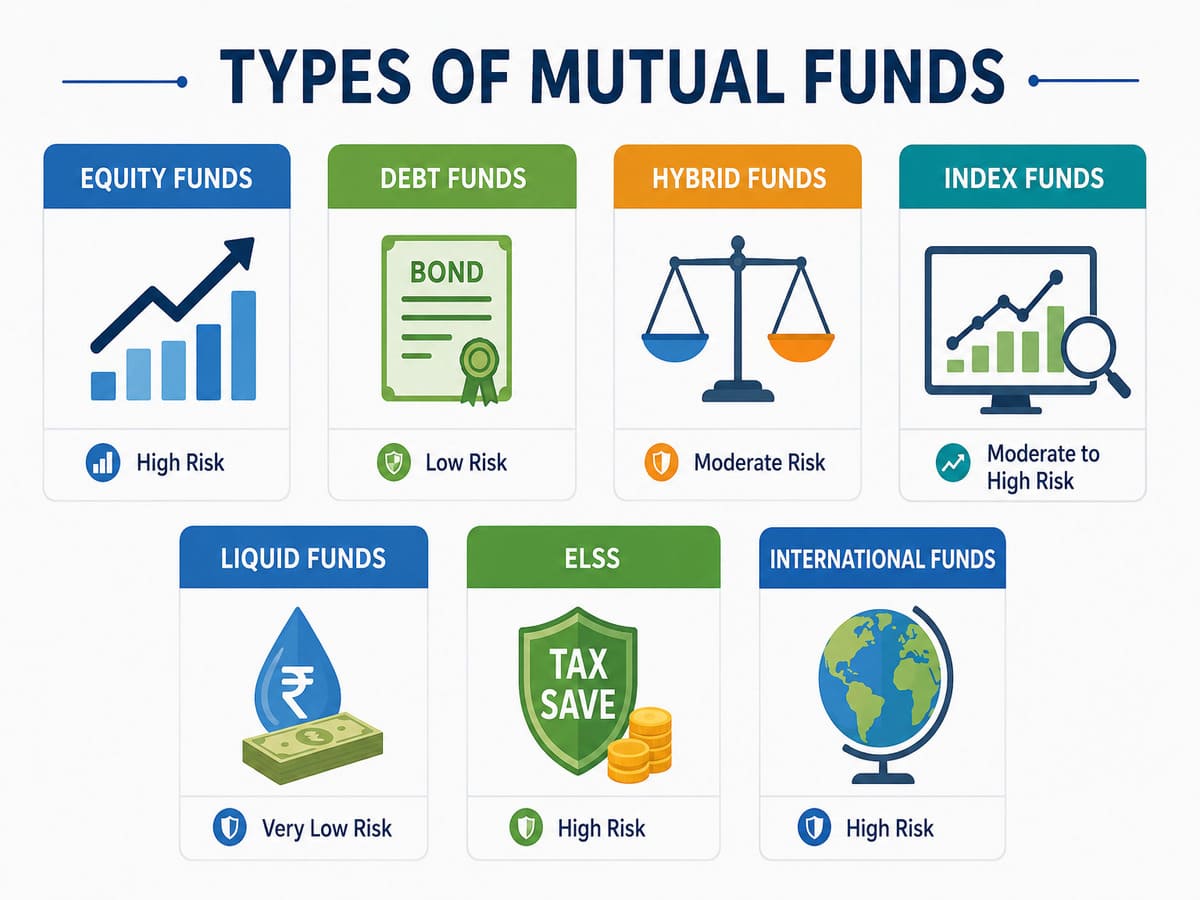
Mutual funds aren’t a single product — they’re a category that covers dozens of different strategies. Here are the ones a beginner is most likely to encounter.
1. Equity Mutual Funds
Equity funds invest the bulk of their money in company shares.
- Higher long-term return potential compared to debt-based options
- Higher short-term volatility — prices can swing significantly
- Suitable mainly for goals that are 5 years or more away
Within equity funds, you’ll also see sub-categories like large-cap funds (investing in established, well-known companies), mid-cap and small-cap funds (investing in smaller, faster-growing but riskier companies), and sectoral or thematic funds (focused on a specific industry like banking, IT, or pharma).
Best for: Long-term wealth creation, such as retirement or a child’s future education.
2. Debt Funds
Debt funds invest in fixed-income instruments such as government securities, corporate bonds, and money market instruments. It’s a low-risk mutual fund for beginners.
- Generally lower risk than equity funds
- More predictable, stable returns
- Still carry interest rate risk and some credit risk
Best for: Conservative investors, or money needed within 1–3 years.
3. Hybrid Funds
Hybrid (or “balanced”) funds invest in a mix of equity and debt in varying proportions, depending on the specific scheme.
- Aim to balance growth potential with relative stability
- Generally less volatile than pure equity funds
Best for: Beginners who want some equity exposure without full market volatility.
4. Index Funds
Index funds don’t try to beat the market — they simply track a market index like the Nifty 50 or Sensex by holding the same stocks in the same proportion.
- Passive investment strategy, so there’s less dependence on a fund manager’s stock-picking skill
- Typically have a lower expense ratio than actively managed funds
- Returns closely mirror the index they track
Best for: Beginners and long-term investors who prefer a low-cost, hands-off approach.
5. Liquid and Money Market Funds
These funds invest in very short-term, low-risk instruments.
- Among the lowest-risk mutual fund categories
- Meant for short-term parking of money, not long-term growth
- Typically offer easier and faster withdrawal than other categories
Best for: Parking an emergency fund or surplus cash for a short period, instead of leaving it idle in a savings account.
6. ELSS (Equity Linked Savings Scheme)
ELSS funds are equity funds with a twist: investments made in them qualify for a tax deduction under Section 80C of the Income Tax Act (up to the applicable limit), and they come with a mandatory 3-year lock-in period — the shortest lock-in among all 80C tax-saving instruments.
Best for: Investors who want to save tax and are comfortable with equity-level risk for at least 3 years.
7. International / Global Funds
These funds invest in companies or funds listed outside India, giving investors exposure to foreign markets and currencies.
Best for: Investors who already have a domestic portfolio and want geographic diversification.
Direct Plans vs Regular Plans
This is a detail beginners often miss, but it can meaningfully affect long-term returns.
Every mutual fund scheme is usually available in two versions:
- Regular Plan — bought through a distributor, agent, or bank, who earns a commission built into the fund’s expense ratio.
- Direct Plan — bought directly from the AMC (or via a direct investment platform), with no distributor commission.
Because a direct plan has a lower expense ratio, it produces a slightly higher NAV and slightly higher long-term returns than the regular plan of the exact same scheme — the difference compounds meaningfully over 10–20 years. The trade-off is that with a direct plan, you don’t get personalised guidance from a distributor, so you’re relying on your own research or a fee-based advisor.
Understanding Expense Ratio and Exit Load
Two costs every beginner should know before investing:
- Expense Ratio — the annual fee the AMC charges to manage the fund, expressed as a percentage of your investment. It’s deducted automatically from the fund’s NAV, so you never see a separate bill, but it directly reduces your returns. Index funds tend to have the lowest expense ratios; actively managed equity funds tend to have higher ones.
- Exit Load — a fee charged if you redeem (sell) your units before a specified holding period, usually a small percentage like 1%. It exists to discourage very short-term, in-and-out trading in what is meant to be a long-term investment vehicle.
Both are disclosed clearly in every scheme’s offer document and fact sheet, and checking them is a simple habit that helps you avoid unpleasant surprises.
What Is SIP in Mutual Funds?
A Systematic Investment Plan (SIP) lets you invest a fixed amount at regular intervals — usually monthly — instead of investing a large sum all at once.
Benefits of SIP
- You can start with as little as ₹500 a month
- You don’t need to time the market or guess whether prices will rise or fall
- It builds a disciplined, automatic investing habit
- It allows you to benefit from rupee cost averaging — you automatically buy more units when prices are low and fewer units when prices are high, which smooths out the impact of market ups and downs over time
- It harnesses the power of long-term compounding, where your returns start generating their own returns
Example
Investing ₹2,000 every month through an SIP for 20 years means you would have invested a total of ₹4,80,000 out of your own pocket. Depending on how the market performs over those two decades, the final corpus could be significantly higher than the amount invested, thanks to compounding — though the exact figure isn’t guaranteed and depends entirely on actual fund performance.
SIP vs Lump Sum
- SIP works well for salaried individuals investing out of monthly income, and it naturally reduces the risk of investing a large amount right before a market downturn.
- Lump sum investing can work well when you already have a large sum available (like a bonus or maturity payout) and markets are reasonably valued, but it carries more timing risk since the entire amount is exposed to the market from day one.

Many beginners use a combination: a lump sum for money they already have, and an ongoing SIP for their regular monthly savings. You can read more in our detailed guide on How SIP Investing Can Help You Build Long-Term Wealth.
Why Mutual Funds Are Good for Beginners
1. Professional Management
You don’t need to analyse company financials or track markets daily — a qualified fund manager and research team do that on your behalf.
2. Diversification
Your money is spread across many companies or instruments instead of being concentrated in one place, which reduces the impact if any single investment performs poorly.
3. Low Entry Barrier
You can start investing with as little as ₹500 through an SIP — there’s no need for a large starting amount.
4. Transparency
Mutual funds are required to disclose their holdings, performance, and expenses regularly, so you always know what you own and what it costs.
5. Liquidity
Most open-ended mutual funds allow you to redeem your units on any business day, with the money typically credited to your bank account within a few days.
6. Regulatory Oversight
Every mutual fund in India operates under SEBI’s regulatory framework, which sets rules around disclosures, valuations, and investor protection.
7. Flexibility Across Goals
Because there are so many types of funds — equity, debt, hybrid, tax-saving, liquid — you can match a fund to nearly any goal, whether it’s 6 months away or 20 years away.
How to Start Investing in Mutual Funds (Step-by-Step)
Step 1: Define Your Goal
Ask yourself what you’re investing for and when you’ll need the money. Please decide whether it is for the short term or the long term. A goal 1 year away needs a very different fund than a goal 15 years away.
Step 2: Assess Your Risk Appetite
Be honest about how you’d react if your investment temporarily dropped 15–20% in value. This, combined with your time horizon, should guide whether you lean toward equity, debt, or hybrid funds.
Step 3: Choose the Right Fund
Beginners often start with index funds or hybrid funds because of their relative simplicity and moderate risk profile, though the right choice always depends on your specific goal and risk appetite.
Step 4: Complete KYC
Know Your Customer (KYC) is a one-time regulatory requirement. You’ll typically need:
- PAN card
- Aadhaar card
- A cancelled cheque or bank statement for bank account verification
- A recent photograph and signature (often collected digitally now)
Step 5: Choose a Platform
You can invest directly through an AMC’s website or app, through a registered mutual fund distributor, or through one of the many mutual fund investment apps and platforms available today — each with different fee structures (see Direct vs Regular Plans above).
Step 6: Start SIP or Lump Sum
Decide whether you’re investing a lump sum, starting a recurring SIP, or both.
Step 7: Review Periodically — Don’t Obsess Daily
Check your portfolio’s performance once or twice a year against your goals, rather than watching the NAV move every single day. Short-term market noise is normal and rarely worth reacting to.
Risk Involved in Mutual Funds
Mutual funds are beginner-friendly, but “beginner-friendly” doesn’t mean risk-free. Understanding the risks helps you invest with realistic expectations.
- Market Risk — The value of equity and, to some extent, debt investments can fall when markets decline, and there’s no guarantee against loss.
- Interest Rate Risk — Debt fund values can fall when interest rates rise, since bond prices move inversely to interest rates.
- Credit Risk — In debt funds, there’s a risk that a bond issuer could default or have its credit rating downgraded.
- Fund Manager Risk — A fund’s performance depends partly on the fund manager’s decisions and strategy, which can underperform the broader market.
- Liquidity Risk — Some schemes, particularly those investing in less-traded securities, may have restrictions or delays on withdrawals.
- Concentration Risk — Sectoral or thematic funds that focus heavily on one industry can be more volatile than diversified funds.
Diversifying across fund types, staying invested for the recommended time horizon, and avoiding panic-driven decisions during short-term market dips are the most practical ways to manage these risks.
How Mutual Fund Returns Are Taxed
Taxation is one of the most-asked questions by beginners, and the rules depend on the type of fund and how long you stay invested.
- Equity-oriented funds (funds with at least 65% invested in domestic equities): Gains from units held for more than 12 months are treated as Long-Term Capital Gains (LTCG), taxed at applicable rates above a specified exemption threshold. Gains on units held for 12 months or less are Short-Term Capital Gains (STCG), taxed at a separate flat rate.
- Debt-oriented funds: Taxation rules for debt funds have changed in recent years, and gains are generally taxed based on the investor’s applicable income tax slab, regardless of holding period, under current rules.
- ELSS funds: Enjoy a tax deduction on the invested amount under Section 80C (subject to the overall limit), in addition to being taxed like other equity funds on redemption after the 3-year lock-in.
Tax rules on mutual funds are revised periodically in the Union Budget, so it’s worth confirming the latest applicable rates before making a decision, or checking with a tax professional for your specific situation.
Common Mistakes Beginners Make
- Chasing past returns — picking a fund purely because it topped last year’s return charts, without checking if it fits your goal and risk appetite.
- Stopping SIPs during a market fall — this is exactly when rupee cost averaging works in your favor, since you’re buying more units at lower prices.
- Ignoring the expense ratio — a small difference in fees compounds into a large difference over 15–20 years.
- Investing without a clear goal — leads to withdrawing money too early or holding the wrong type of fund for the timeline.
- Over-diversifying — holding 15–20 similar funds doesn’t add meaningful diversification; it often just adds complexity.
- Not reviewing KYC and nominee details — an easy administrative step that’s often overlooked until it causes a problem later.
Common Mutual Fund Myths
Myth: Mutual funds are risky. Risk depends entirely on the type of fund and how long you stay invested — a liquid fund and a small-cap equity fund carry very different risk levels.
Myth: Only experts can invest in mutual funds. Anyone with basic KYC documents can invest, and many platforms are designed specifically for first-time investors.
Myth: You need a lot of money to start. SIPs let you begin with as little as ₹500 a month.
Myth: Mutual funds guarantee returns. No mutual fund can guarantee returns — all of them, including debt funds, are subject to market-related risks to varying degrees.
Myth: Once invested, you can’t withdraw your money. Most open-ended funds are highly liquid, though some (like ELSS) have a mandatory lock-in period.
How to Choose the Right Mutual Fund
There’s no single “best” mutual fund — the right choice depends on matching a fund’s characteristics to your own situation. A few practical filters:
- Match the fund category to your time horizon. Money needed within a year shouldn’t sit in an equity fund; money you won’t touch for 10+ years doesn’t need to be parked in a liquid fund.
- Check the expense ratio, especially when comparing similar funds within the same category.
- Look at consistency, not just recent returns. A fund that has performed reasonably well across multiple market cycles (both up and down markets) tends to be a more reliable indicator than one that had one exceptional year.
- Check the fund’s portfolio concentration — how spread out its holdings are across companies and sectors.
- Consider the fund house’s track record and the fund manager’s tenure, since manager changes can sometimes affect a fund’s strategy and consistency.
- Read the scheme’s offer document or fact sheet before investing — it’s not exciting reading, but it tells you exactly what you’re buying.
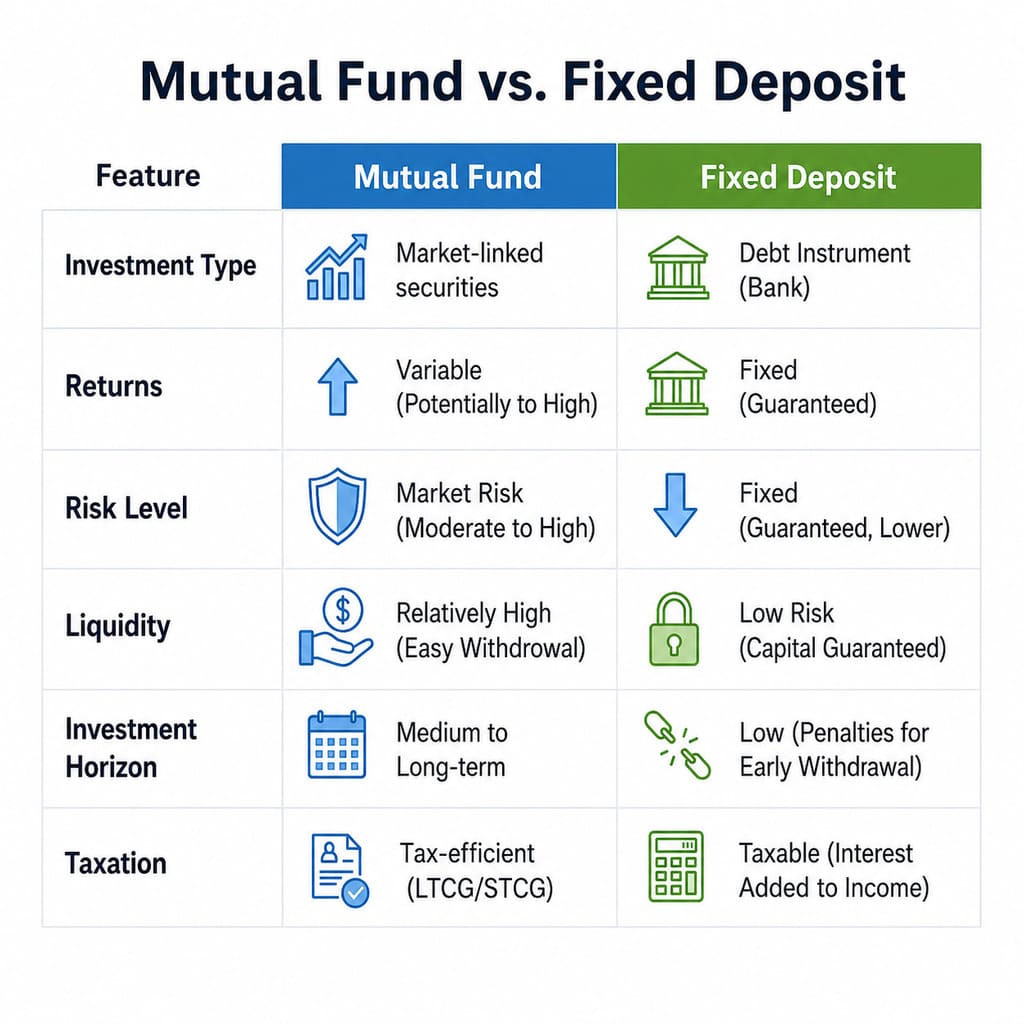
Mutual Funds vs Fixed Deposits
| Feature | Mutual Fund | Fixed Deposit |
| Returns | Market-linked, variable | Fixed, pre-decided |
| Risk | Low to high, depending on type | Low |
| Inflation Protection | Generally better over the long term | Often struggles to beat inflation |
| Liquidity | High for most open-ended funds | Medium (penalty for early withdrawal) |
| Taxation | Varies by fund type and holding period | Interest taxed at income slab rate |
| Minimum Investment | As low as ₹500 via SIP | Usually higher lump sum requirement |
Neither option is universally “better” — a mutual fund suits long-term growth goals, while a fixed deposit suits short-term safety and predictability. Many well-planned portfolios use both, depending on the goal.
Who Regulates Mutual Funds in India?
Mutual funds in India are regulated by the Securities and Exchange Board of India (SEBI), with industry-level coordination from AMFI (the Association of Mutual Funds in India).
SEBI’s regulations ensure that:
- Mutual funds follow strict operational and disclosure rules
- Investor interests are protected through defined governance structures (trustees, custodians, and independent oversight)
- Fund performance, holdings, and expenses remain publicly disclosed on a regular basis
- Distributors and advisors meet defined qualification and conduct standards
Because of this regulatory framework, mutual funds are considered one of the most structured and transparent investment options available to retail investors in India, compared to many unregulated investment schemes.
Conclusion
Mutual funds offer a genuinely practical, beginner-friendly path into investing. You get access to professional fund management, built-in diversification, and the flexibility to start small through SIPs — without needing to become a market expert overnight. At the same time, they’re not risk-free or guaranteed, which is why understanding fund types, costs, taxation, and your own goals matters just as much as picking a fund with a good track record.
If you start early, choose funds that genuinely match your goals and risk appetite, keep your costs in check, and stay invested through market ups and downs rather than reacting to short-term noise, mutual funds can be a disciplined and effective way to work toward long-term financial goals.
Disclaimer: This article is for educational purposes only and does not constitute financial or investment advice. Mutual fund investments are subject to market risks; please read all scheme-related documents carefully and consult a qualified financial advisor before making investment decisions.
Frequently Asked Questions (FAQs)
FAQ 1: What is a mutual fund in simple words?
Ans – A mutual fund is an investment vehicle where money from many investors is pooled together and invested in stocks, bonds, or other assets by a professional fund manager, with gains or losses shared proportionately among all investors.
FAQ 2: How does a mutual fund work?
Ans – When you invest, your money joins a common pool with other investors’ money. A fund manager invests this pool according to the scheme’s stated objective, and you’re allotted units whose value moves up or down with the fund’s daily NAV.
FAQ 3: Is mutual fund good for beginners?
Ans – Yes — mutual funds offer diversification, professional management, regulatory oversight, and the ability to start with a small amount through SIP, which makes them accessible even for first-time investors.
FAQ 4: What is SIP in mutual funds?
Ans – SIP (Systematic Investment Plan) lets you invest a fixed amount at regular intervals, usually monthly, instead of a lump sum — building a disciplined investing habit and smoothing out the impact of market volatility over time.
FAQ 5: How much money is needed to start investing in mutual funds?
Ans – Many funds allow SIPs starting from as little as ₹500 per month, though the exact minimum varies by scheme and platform.
FAQ 6: Are mutual funds safe?
Ans – Mutual funds are regulated by SEBI, which enforces strict transparency and governance standards, but they still carry market-related risks. Choosing funds that match your risk appetite and time horizon is the best way to manage that risk.
FAQ 7: What are the main types of mutual funds?
Ans – The main categories include equity funds, debt funds, hybrid funds, index funds, liquid/money market funds, and ELSS (tax-saving) funds, along with sub-categories like large-cap, mid-cap, small-cap, and sectoral funds.
FAQ 8: Can I lose money in mutual funds?
Ans – Yes, mutual fund returns aren’t guaranteed, and the value of your investment can fall along with market movements. Diversification and a long-term horizon help manage — but don’t eliminate — this risk.
FAQ 9: How long should I stay invested in a mutual fund?
Ans – For equity funds, a minimum horizon of 5 years or more is generally recommended to smooth out short-term volatility, while debt or liquid funds may suit shorter timeframes of a few months to a couple of years.
FAQ 10: Is a mutual fund better than a fixed deposit?
Ans – Mutual funds have historically offered higher long-term return potential than fixed deposits, but they also carry more risk and less certainty. The right choice depends on your specific goal, time horizon, and comfort with market fluctuations.
FAQ 11: What is the difference between a direct plan and a regular plan?
Ans – A direct plan is bought straight from the fund house with no distributor commission, resulting in a lower expense ratio and marginally higher returns; a regular plan is bought through a distributor who earns a commission, which is built into a slightly higher expense ratio.
FAQ 12: What is an expense ratio?
Ans – It’s the annual fee an Asset Management Company charges to manage a fund, expressed as a percentage of your investment and deducted automatically from the fund’s NAV.
FAQ 13: Can I withdraw my mutual fund investment anytime?
Ans – Most open-ended mutual funds allow redemption on any business day, though some schemes have an exit load for early withdrawal, and tax-saving ELSS funds have a mandatory 3-year lock-in.
FAQ 14: Do mutual funds pay dividends?
Ans – Some mutual fund schemes offer an “IDCW” (Income Distribution cum Capital Withdrawal) option that pays out a portion of gains periodically, while “growth” options reinvest gains back into the fund instead of paying them out — the choice affects both your cash flow and taxation
FAQ 15: How are mutual fund gains taxed?
Ans – Taxation depends on the fund type (equity-oriented vs debt-oriented) and how long you hold the units — equity funds get favorable long-term capital gains treatment after 12 months, while debt fund taxation currently follows the investor’s income tax slab. Tax rules are revised periodically, so it’s best to verify the latest applicable rates.
Related reading: What Is Personal Finance? A Beginner’s Guide| Sip Vs Rd Comparison| Mutual Funds vs Fixed Deposits

Shilpesh Rathod is the founder of All Finance Knowledge. He holds a B.Com degree along with JAIIB and CAIIB banking certifications, and brings 19+ years of experience in the banking sector across savings, investments, and financial planning. Read more: https://allfinanceknowledge.com/about-us/
13 thoughts on “What Is a Mutual Fund? A Complete Beginner’s Guide (2026)”