
Building wealth is not about earning a very high salary or becoming a stock market expert. In reality, most financially successful people follow a simple formula: start early, invest regularly, and stay consistent.
One of the easiest and most powerful ways to do this is through SIP investing.
In India, millions of investors are using SIPs (Systematic Investment Plans) to gradually build wealth over time. SIP is not a shortcut to overnight success, but it is a proven long-term strategy that can help you achieve financial stability — and, for many disciplined investors, even build a genuinely large investment corpus.
In this guide, you’ll learn:
- What SIP investing actually is
- How SIP works, step by step
- Why SIP is so powerful for long-term wealth creation
- Whether SIP can realistically help you become a millionaire
- The risks and common mistakes to avoid
- A simple, practical process to get started
If you’re completely new to money management, it’s worth starting with our guide on personal finance for beginners before diving into SIPs specifically — it’ll give you the foundation everything else in this article builds on.
Table of Contents
What Is SIP Investing?
SIP stands for Systematic Investment Plan. It’s a method of investing a fixed amount of money at regular intervals — usually monthly — into mutual funds.
Instead of trying to save up a large lump sum and invest it all at once, SIP lets you:
- Invest small amounts regularly, without needing a big pile of savings first
- Build financial discipline automatically, since the process runs on autopilot
- Reduce market timing risk, because you’re not betting everything on one day’s price
- Benefit from long-term compounding growth, which rewards patience over guesswork
You can start a SIP with as little as ₹500 a month, which is exactly why it works so well for beginners, students, and salaried individuals who don’t have large capital sitting around but do have a predictable monthly income.
To understand where your SIP money actually goes once it leaves your bank account, it helps to read our companion guide on mutual funds for beginners, since SIP is just the delivery mechanism — the mutual fund itself is what determines your actual returns.
How SIP Investing Works
SIP works in a simple, largely automated way:
- You choose a mutual fund that matches your goal and risk appetite
- You select a fixed investment amount — ₹500, ₹2,000, ₹10,000, whatever fits your budget
- You choose a date (say, the 5th of every month) that lines up conveniently with your salary credit
- Money is automatically deducted from your bank account on that date via a standing instruction (called a NACH mandate)
- You receive mutual fund units in return, based on that day’s Net Asset Value (NAV)
That’s the entire mechanical process. Once it’s set up, there’s genuinely nothing left for you to actively “do” each month — which is precisely the point.
Rupee Cost Averaging: SIP’s Quiet Superpower
One of the biggest advantages of SIP investing is something called rupee cost averaging:
- When the market is low, your fixed monthly amount buys more units
- When the market is high, the same amount buys fewer units
Over time, this evens out your overall purchase cost and removes the stressful — and usually futile — job of trying to predict whether today is a “good day” to invest. You simply invest on schedule, every month, regardless of what the market is doing, and let the averaging effect work quietly in the background.
Why SIP Investing Is So Powerful for Wealth Creation
The real strength of SIP investing doesn’t come from any single clever trick. It comes from three things working together: time, consistency, and compounding.
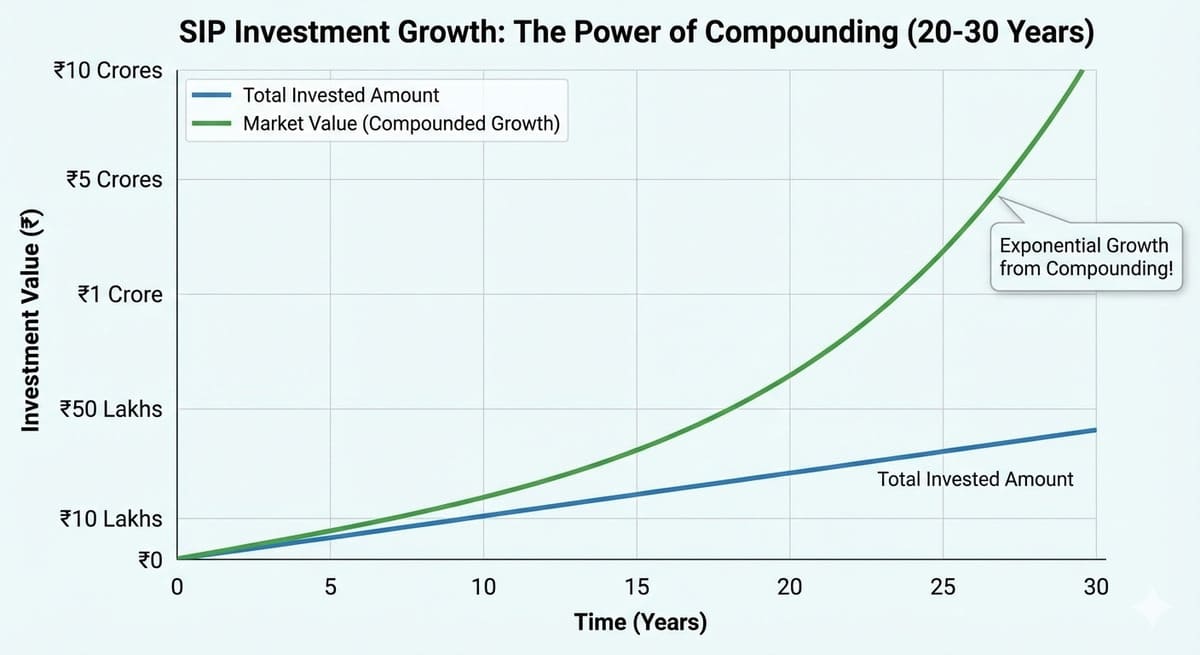
1. The Power of Compounding
Compounding means earning returns not only on your original investment, but also on the returns that investment has already generated. In other words, your money starts making money on its own money.
Example:
- You invest ₹5,000 every month
- Returns begin accumulating on top of your contributions
- Those returns then start generating their own returns
- Over a long enough period, this snowballs into exponential — not linear — growth
This is why SIP growth charts almost always look the same shape: a long, gentle slope in the early years, followed by a noticeably steeper climb in the later years.
👉 Early years: Growth feels slow, almost disappointingly so
👉 Later years: Wealth creation accelerates rapidly
This single pattern is exactly why every financial advisor repeats the same advice: start as early as possible. The extra 5 or 10 years at the start of your investing journey often contribute more to your final corpus than an equivalent stretch of years added at the end.
2. Consistency Beats High Income
Many people assume they need a high salary to build real wealth. That assumption is simply false, and SIP investing is one of the clearest ways to demonstrate why.
Consider two people over the same 25–30 year period:
Person A (Disciplined Investor)
- Invests ₹5,000 every month into a SIP
- Continues without interruption for 25–30 years
- Doesn’t panic-sell during market dips
Person B (Non-Investor)
- Spends the same ₹5,000 every month
- Never builds an investing habit
- Relies on savings alone, if any
👉 After 25–30 years, Person A has built meaningful long-term wealth through compounding, while Person B has little to no financial cushion — despite potentially earning the exact same income throughout.
The difference here isn’t income. It’s discipline, consistency, and time in the market.

Can SIP Investing Really Make You a Millionaire?
Yes — but with an important qualifier: with time and patience, not overnight.
Let’s look at what the numbers actually suggest. If you invest:
- ₹5,000 per month
- For 25–30 years
- With average long-term market returns
👉 You could realistically build a corpus in the range of ₹50 lakh to ₹1 crore or more, depending on actual fund performance over that period.
However, a few honest caveats matter here:
- Returns are never guaranteed. Mutual funds are market-linked, and past averages don’t promise future results.
- Market performance varies across different time periods and economic cycles.
- Long-term discipline is required — the numbers above assume you stay invested the whole time, without stopping during downturns.
SIP investing isn’t magic, and anyone promising guaranteed millionaire status by a specific date should be treated with healthy skepticism. What SIP genuinely offers is one of the most reliable, well-tested wealth-building tools available to ordinary investors — provided you give it the time it needs to work.
Key Benefits of SIP Investing
✅ 1. Affordable for Everyone
You can start with a genuinely small amount — sometimes as low as ₹500 — and increase your contribution gradually as your income grows. There’s no barrier to entry that excludes students, early-career professionals, or anyone just starting to build financial habits.
✅ 2. Disciplined Investing, Built In
Because the monthly investment happens automatically, SIP removes the need for willpower or monthly decision-making. You’re not choosing whether to invest each month — the system already made that decision for you the day you set it up.
✅ 3. Ideal for Long-Term Goals
SIP investing suits a wide range of long-term financial goals, including:
- Retirement planning
- Children’s education
- Buying a house
- General long-term wealth creation
✅ 4. Reduces Market Stress
You don’t need to track daily price movements, follow financial news obsessively, or try to time your entry perfectly. Rupee cost averaging does that emotional heavy lifting for you.
✅ 5. Flexible and Convenient
SIP investing isn’t a rigid, locked-in commitment. You can:
- Switch funds if your goals or fund performance change
- Increase or decrease your SIP amount as your income evolves
- Pause or stop your SIP anytime, without penalty in most cases
Who Should Invest Through SIP?
SIP investing is particularly well suited for:
- Beginners taking their first step into investing
- Salaried individuals with predictable monthly income
- Business owners looking to build wealth outside their business
- Long-term investors focused on goals 10+ years away
- Anyone who wants financial discipline built into their routine, rather than relying on willpower alone
If your goal is long-term wealth creation rather than quick gains, SIP is one of the simplest and safest starting points available — regardless of your current income level.
Risks Involved in SIP Investing
SIP is beginner-friendly, but it’s important to be honest about the risks involved, since no investment is risk-free:
- Market Risk – The value of your investment can go up or down depending on market conditions.
- Return Uncertainty – Unlike a fixed deposit, there is no guaranteed rate of return.
- Short-Term Volatility – Markets can swing significantly over weeks or months, even if the long-term trend is upward.
That said, staying invested for the long term — rather than reacting to short-term noise — significantly reduces the practical impact of these risks. In India, mutual funds are regulated by the Securities and Exchange Board of India (SEBI), which enforces transparency requirements and investor protection standards across all registered fund houses.
Common Mistakes to Avoid in SIP Investing
Beyond the market risks themselves, a lot of SIP underperformance actually comes down to investor behavior rather than the fund itself. Here are the mistakes worth watching out for
- Stopping your SIP during a market downturn. This is the single most damaging mistake. A falling market is exactly when rupee cost averaging works hardest in your favor, since you’re buying more units at lower prices.
- Chasing last year’s best-performing fund. Past performance doesn’t predict future results, and jumping between funds based on short-term rankings usually does more harm than good.
- Ignoring the expense ratio. Small annual fee differences compound over decades just like returns do, quietly eating into your final corpus.
- Mismatching fund type to goal horizon. Putting a 2-year goal’s money into a volatile equity fund — or a 25-year goal’s money into an overly conservative option — both work against you.
- Withdrawing early without a real reason. SIP’s biggest advantage is time. Breaking that compounding chain early often costs far more than people realize.
- Expecting guaranteed outcomes. SIP amounts and illustrative return percentages are educational assumptions, not promises.
How to Start SIP Investing (Simple Steps)
Getting started is far less complicated than most beginners expect.
Step 1: Define Your Goal
Decide whether your goal is:
- Short-term (under 3 years)
- Medium-term (3–7 years)
- Long-term (7+ years)
Your time horizon should directly shape which type of fund you choose next.
Step 2: Choose the Right Fund
Beginners often find it easier to start with:
- Index funds – low-cost, passively track a market index
- Hybrid funds – a mix of equity and debt for a gentler risk profile
Step 3: Complete Your KYC
You’ll need:
- PAN card
- Aadhaar
- Bank account details
Most fund houses and investment apps now let you complete this entirely online in a matter of minutes.
Step 4: Start Your SIP
Choose your:
- Investment amount
- Preferred date
- Fund
Step 5: Stay Invested
Review your investment once or twice a year — not daily. Frequent checking tends to trigger emotional decisions that work against the very discipline SIP is designed to build.
SIP vs. Other Saving Options
Many beginners naturally compare SIP with more traditional options like a Recurring Deposit (RD). Here’s how they stack up:
| Feature | SIP | RD |
|---|---|---|
| Returns | Market-linked | Fixed |
| Risk | Moderate | Low |
| Growth Potential | High | Low |
| Inflation Protection | Yes | No |
👉 SIP is generally better suited for long-term wealth creation
👉 RD is generally better suited for short-term, low-risk savings
Neither option is universally “better” — the right choice depends on your goal’s time horizon and how much volatility you’re comfortable with along the way.
Is SIP Investing Safe?
SIP invests in mutual funds, which are regulated by SEBI (Securities and Exchange Board of India). While market-related risks do exist, long-term SIP investing meaningfully reduces those risks through two mechanisms: diversification across many securities within the fund, and time, which smooths out short-term volatility.
That said, “safe” is relative. Always invest according to your own risk tolerance, financial goals, and time horizon — not simply because a SIP is convenient to set up.
SIP Investing Tips for Beginners
- ✔ Start as early as possible, even with a small amount
- ✔ Increase your SIP amount gradually as your income grows
- ✔ Stay invested for the long term rather than chasing short-term gains
- ✔ Review your portfolio once a year, not obsessively
- ✔ Avoid panic-selling during market volatility — it’s usually the worst possible time to stop
Final Thoughts: The Millionaire Mindset
SIP investing is not about getting rich quickly. It’s about building wealth slowly, steadily, and predictably.
The real “millionaire mindset” isn’t a secret formula or a lucky stock pick — it’s simply:
- Discipline
- Patience
- Long-term thinking
Even small monthly investments can grow into a genuinely large corpus if you stay consistent for many years. There’s no shortcut hiding underneath the process — just time, doing what it does best.
The formula really is this simple:
👉 Start early
👉 Invest regularly
👉 Stay invested
Frequently Asked Questions (FAQs)
1. What is SIP investing?
Ans – SIP (Systematic Investment Plan) is a method of investing a fixed amount regularly in mutual funds to build wealth over the long term.
2. Can SIP build wealth?
Ans – Yes. Long-term SIP investing can help build significant wealth through the combined effect of compounding, disciplined contributions, and rupee cost averaging.
3. How much should I invest in SIP?
Ans – The right amount depends on your income, goals, and time horizon. Even small monthly amounts can grow significantly if invested consistently over long periods.
4. Is SIP suitable for beginners?
Ans – Yes — SIP is considered especially beginner-friendly because it builds disciplined investing habits automatically and reduces the pressure of market timing.
5. What is the best duration for SIP investing?
Ans – For meaningful wealth creation, SIP tends to work best when continued for 10–20 years or longer, since compounding accelerates significantly in later years.
6. Can I stop SIP anytime?
Ans – Yes. SIPs are flexible and can generally be stopped, paused, or modified at any time without penalty, though it’s worth checking your specific fund’s terms.
7. Is SIP better than a lump sum investment?
Ans – For most beginners, yes — SIP tends to be the more practical choice, since it reduces market timing risk and builds an investing habit, whereas lump sum investing works better for those who already have a significant amount of idle capital.
Disclaimer: This article is for educational purposes only and does not constitute financial or investment advice. Mutual fund investments are subject to market risks. Please consult a qualified financial advisor before investing.
Shilpesh Rathod
Shilpesh Rathod is the founder of All Finance Knowledge. He holds a B.Com degree along with JAIIB and CAIIB banking certifications, and brings 19+ years of experience in the banking sector across savings, investments, and financial planning. Read more: About Us

Shilpesh Rathod is the founder of All Finance Knowledge. He holds a B.Com degree along with JAIIB and CAIIB banking certifications, and brings 19+ years of experience in the banking sector across savings, investments, and financial planning. Read more: https://allfinanceknowledge.com/about-us/
13 thoughts on “SIP Investing: Can It Really Make You a Millionaire?”