By Shilpesh Rathod | Investing Basics
⚠️ This article is for educational purposes only and does not provide financial or investment advice. Please consult a SEBI-registered financial advisor before making investment decisions.
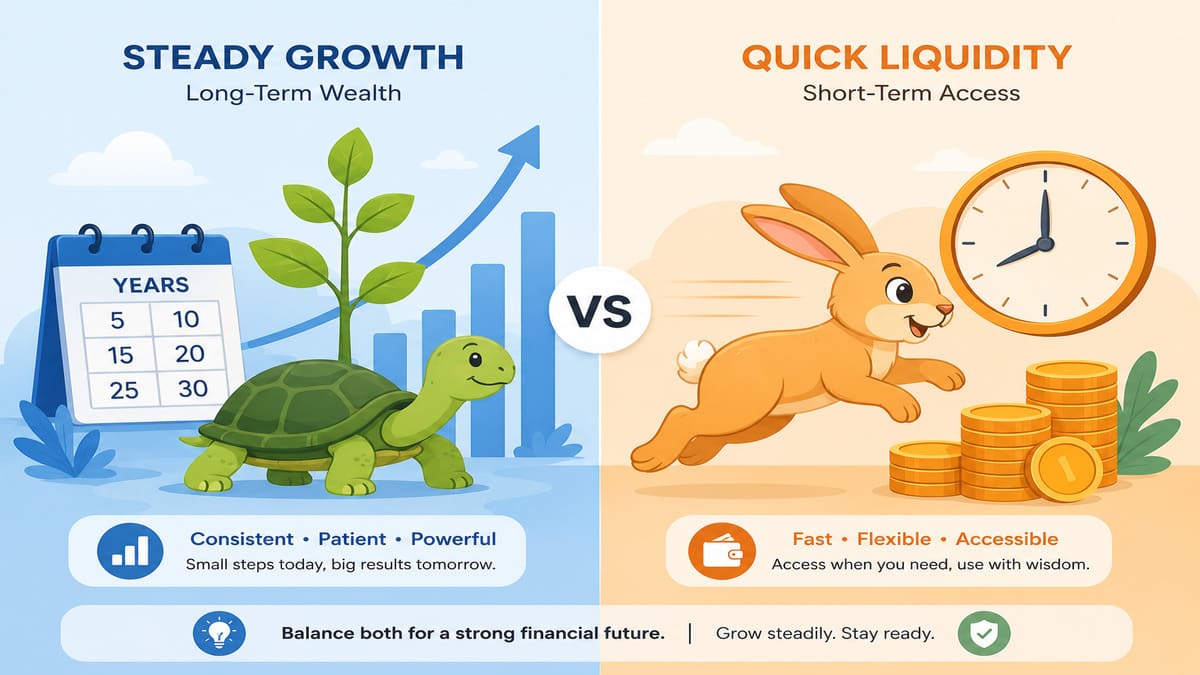
Investing is not only about how much money you put in — it is equally about how long you stay invested. The duration you choose changes almost everything: the type of assets suited to you, the risk you’re exposed to, the taxes you pay, and ultimately, the returns you can realistically expect.
One of the most common questions beginners ask is:
“Should I invest for the long term or the short term?”
The honest answer is: it depends on what the money is for. A rupee you’ll need in eight months and a rupee you’ll need in twenty years should almost never sit in the same type of investment. In this guide, we’ll break down long-term and short-term investing in plain language, walk through real numbers, cover the tax angle most beginner guides skip, and help you figure out which mix of the two actually fits your life.
- What Is Investing?
- Understanding Investment Time Horizon
- What Is Long-Term Investing?
- Popular Long-Term Investment Options
- Benefits of Long-Term Investing
- A Real Compounding Example: ₹5,000/Month Over 10, 20, and 30 Years
- Risks of Long-Term Investing
- What Is Short-Term Investing?
- Popular Short-Term Investment Options
- Benefits of Short-Term Investing
- Risks of Short-Term Investing
- Taxation: LTCG vs STCG (Often Ignored, But Critical)
- Long-Term vs Short-Term Investing: Key Differences
- How to Match Your Money to a Time Horizon (Simple Framework)
- Which Is Better: Long-Term or Short-Term Investing?
- A Sample Case Study: Priya’s Investment Plan
- Common Mistakes Beginners Make
- Importance of Financial Discipline
- Frequently Asked Questions (FAQs)
- Final Thoughts
What Is Investing?
Investing means putting your money into financial assets with the goal of growing your wealth over time — through interest, dividends, or capital appreciation — instead of letting it sit idle in a savings account, where inflation quietly erodes its purchasing power.
Common investment options include:
- Stocks — ownership shares in a company
- Mutual funds — pooled money professionally managed across many securities
- Fixed deposits (FDs) — bank deposits with a fixed interest rate and tenure
- Bonds — loans you give to a company or government in exchange for interest
- Exchange-Traded Funds (ETFs) — a basket of securities that trades like a stock
Each of these carries a different combination of risk, expected return, and appropriate holding period. That holding period is what we call your investment time horizon — and it’s the single biggest factor in choosing the right instrument.
If you’re brand new to money management, it may help to start with our guide on What Is Personal Finance? A Beginner’s Guide before diving deeper here.
Understanding Investment Time Horizon
Your investment time horizon is simply the length of time you plan to keep your money invested before you’ll need to use it.
- Saving for retirement 25 years away? That’s a long-term horizon.
- Saving for a wedding next year? That’s a short-term horizon.
- Building a house down payment in 4–5 years? That sits in a medium-term zone, which usually borrows rules from both categories.
Your horizon determines:
- How much risk you can afford to take — a longer horizon gives market downturns more time to recover before you need the money.
- Which asset classes make sense — equity needs time to smooth out volatility; debt instruments are built for shorter, more predictable needs.
- What return you can realistically expect — higher potential returns almost always come bundled with higher short-term volatility.
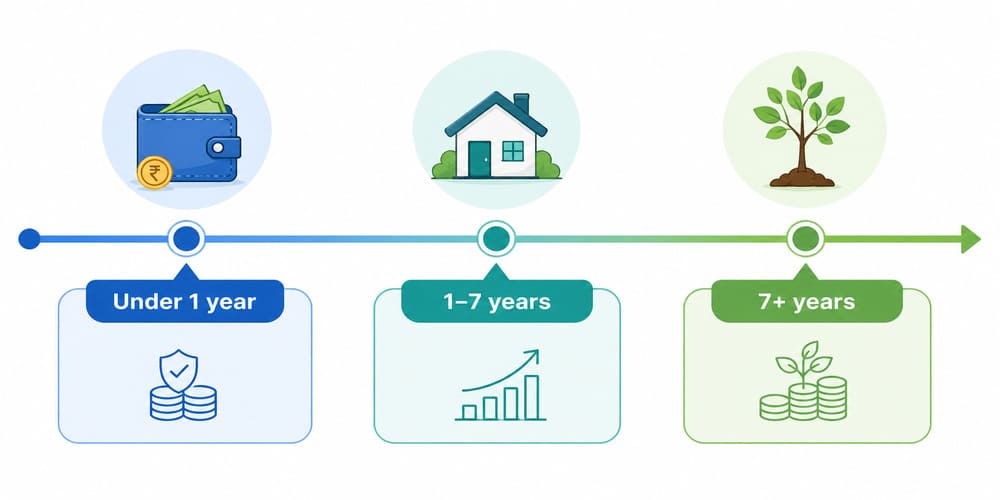
As a rule of thumb: long-term investing prioritizes growth, while short-term investing prioritizes safety and liquidity. Neither approach is “better” in isolation — they solve different problems.
What Is Long-Term Investing?
Long-term investing means staying invested for roughly five years or more, with the specific aim of benefiting from compounding, economic growth, and the general upward trend of well-diversified markets over extended periods.
Long-term investors typically ride out market volatility rather than reacting to every dip or rally. This is often the hardest part psychologically — watching your portfolio fall 15–20% during a correction and choosing to do nothing (or even invest more) requires discipline.
A popular way to build long-term wealth without needing to time the market is through SIP investing — investing a fixed amount at regular intervals regardless of market conditions.
For deeper regulatory reading on safe investing practices in India, the Securities and Exchange Board of India (SEBI) publishes free investor-education material.
Common Long-Term Financial Goals
- Retirement planning
- Children’s higher education
- Long-term wealth creation
- Buying a house in the future
- Financial independence / early retirement (FIRE)
Popular Long-Term Investment Options
| Instrument | Typical Horizon | Risk Level |
| Equity mutual funds | 5–10+ years | Moderate–High |
| Index funds | 7–15+ years | Moderate |
| Direct stocks | 5–20+ years | High |
| Public Provident Fund (PPF) | 15 years | Low |
| National Pension System (NPS) | Till retirement | Moderate |
| ULIPs / retirement plans | 10+ years | Moderate |
If you’re deciding between an index fund and an actively managed large-cap fund for your long-term equity allocation, our Index Fund vs Large Cap Fund comparison breaks down which is safer and more cost-efficient over time.
Benefits of Long-Term Investing
1. The Power of Compounding
Compounding means your returns start earning their own returns. The longer your money stays invested, the more dramatic this effect becomes — most of the growth happens in the final years, not the first ones.
We cover the mechanics in detail in How Compounding Works (With Real Examples), but here’s a quick illustration using a monthly SIP.
2. Reduced Impact of Market Volatility
Markets swing constantly in the short term due to news, elections, global events, or interest rate changes. But historically, broad equity markets have trended upward over multi-decade periods. A long horizon lets you treat short-term noise as just that — noise.
3. Lower Stress, Less Monitoring
Unlike short-term trading, which often demands daily price-watching, long-term investing can be largely “set and review” — invest regularly, check in quarterly or annually, and avoid emotional decision-making.
4. Higher Return Potential
Equity-oriented long-term investments have historically outperformed most short-term instruments over extended periods, driven by economic growth, corporate earnings, and reinvested dividends. Past performance is never a guarantee, but the historical pattern is consistent enough that most financial planners recommend equity exposure for goals more than 7 years away.
You can verify long-term index performance yourself using historical data published by the National Stock Exchange (NSE), rather than relying on assumed averages.
A Real Compounding Example: ₹5,000/Month Over 10, 20, and 30 Years
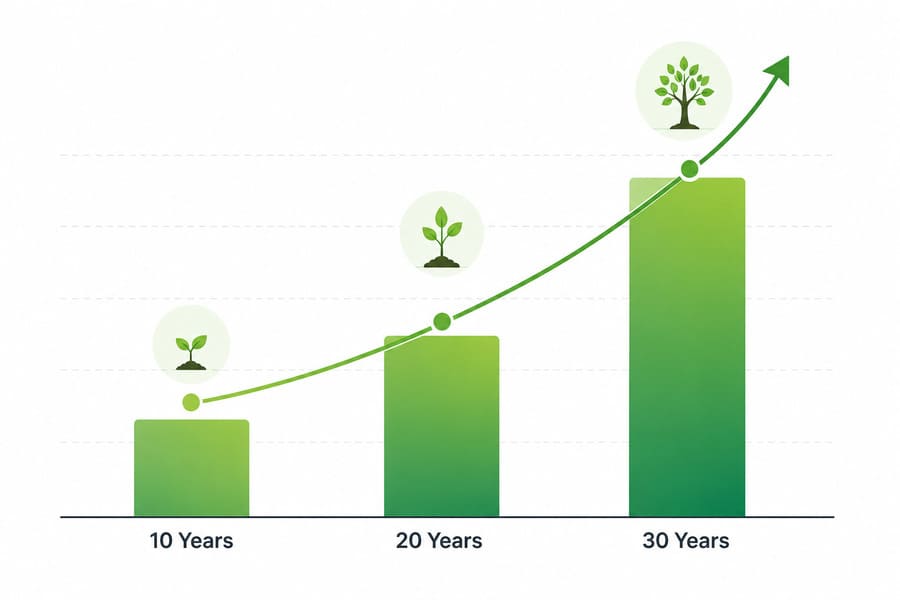
Numbers make this concept concrete. Assume a monthly SIP of ₹5,000 at an estimated 12% annual return (a commonly used long-term equity mutual fund assumption in India — not guaranteed):
| Duration | Total Invested | Estimated Value | Growth from Compounding |
| 10 years | ₹6,00,000 | ~₹11.6 lakh | ~₹5.6 lakh |
| 20 years | ₹12,00,000 | ~₹49.9 lakh | ~₹37.9 lakh |
| 30 years | ₹18,00,000 | ~₹1.76 crore | ~₹1.58 crore |
This 12% figure is illustrative, not a promise — for actual historical scheme-wise returns, you can check verified data on the Association of Mutual Funds in India (AMFI) website before making assumptions for your own plan.
Notice what happens: your contribution only triples from 10 to 30 years, but your estimated corpus grows over 15x. This is the entire argument for starting early — time in the market does more heavy lifting than the amount you invest.
(These figures are illustrative projections based on a constant assumed return and do not represent guaranteed or historical returns of any specific fund.)
Risks of Long-Term Investing
Long-term investing is not risk-free. Key risks include:
- Market downturns near your goal date, which can shrink your corpus right when you need it
- Economic or policy changes that affect specific sectors or the broader market
- Poor fund/stock selection — not every long-term investment performs well
- Lack of diversification, which concentrates risk in one asset, sector, or company
- Inflation risk on the debt portion of a long-term portfolio, if too conservative
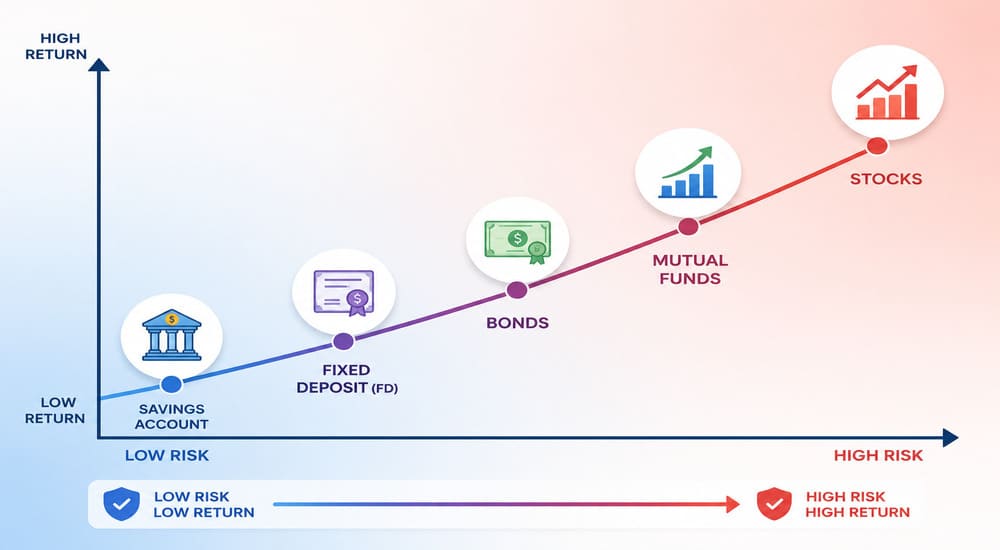
These risks are manageable through proper asset allocation, periodic rebalancing, and diversification — but they don’t disappear simply because the horizon is long.
What Is Short-Term Investing?
Short-term investing means keeping money invested for roughly one to three years, prioritizing capital safety and liquidity over aggressive growth.
This is money you can’t afford to see shrink — because you’ll need it soon, and there’s no long runway to recover from a downturn.
Common Short-Term Financial Needs
- Emergency fund (typically 3–6 months of expenses)
- Travel or vacation planning
- Buying a vehicle or gadget
- A planned short-term purchase
- Temporarily parking surplus funds before redeploying them
Popular Short-Term Investment Options
| Instrument | Typical Horizon | Liquidity |
| Savings account | Anytime | Instant |
| Liquid mutual funds | Days–months | High (T+1) |
| Short-term fixed deposits | 6 months–2 years | Moderate (penalty on early exit) |
| Recurring deposits | 1–3 years | Moderate |
| Treasury bills | 91/182/364 days | High |
| Money market instruments | Under 1 year | High |
Interest rates on fixed deposits, treasury bills, and other short-term instruments are influenced by the Reserve Bank of India’s monetary policy decisions, so it’s worth checking current rates before locking in any short-term investment.
If you’re weighing recurring deposits against a systematic investment plan for a medium-term goal, our detailed SIP vs RD comparison breaks down which one wins for different time horizons.
Benefits of Short-Term Investing
1. High Liquidity
Short-term instruments let you access your money quickly — critical for emergencies or near-term expenses that can’t wait for a market recovery.
2. Lower Risk
Most short-term instruments prioritize capital preservation. You’re far less likely to see the actual invested amount drop, unlike equity.
3. Suitable for Immediate, Defined Goals
If you know you’ll need ₹2 lakh in 14 months for a specific purpose, short-term instruments help ensure that exact amount (plus modest interest) is available exactly when you need it — without market-timing risk.
Risks of Short-Term Investing
Short-term investing feels “safe,” but it isn’t risk-free either:
- Lower absolute returns — often barely above (or even below) inflation
- Inflation risk — if returns don’t outpace inflation, your real purchasing power can shrink even as the nominal number grows. You can track current CPI inflation data on the Ministry of Statistics and Programme Implementation (MOSPI) website to see how it compares with your short-term returns.
- Reinvestment risk — when an FD or bond matures, you may have to reinvest at a lower prevailing interest rate
- Limited wealth creation — short-term instruments alone are rarely enough to fund large, distant goals like retirement
Taxation: LTCG vs STCG (Often Ignored, But Critical)
Most beginner articles skip this, but taxes materially affect your real returns — and taxation is one of the clearest lines separating long-term and short-term investing in India.
For equity and equity mutual funds (holding period matters):
Short-Term Capital Gains (STCG): If you sell equity mutual fund units or listed shares within 12 months of purchase, the gains are classified as short-term and taxed at a flat 20% under Section 111A (revised from 15% in the July 2024 Budget). This applies regardless of your income tax slab.
Long-Term Capital Gains (LTCG): If you hold equity mutual fund units or listed shares for more than 12 months, gains are classified as long-term and taxed at 12.5% under Section 112A — but only on gains exceeding ₹1.25 lakh in a financial year. Gains up to ₹1.25 lakh are completely tax-free.
Note: These are the current rates for equity-oriented investments (funds with 65%+ allocation to domestic equity) as of FY 2025–26. Debt mutual funds are taxed differently — gains are added to your income and taxed at your slab rate, regardless of holding period. Tax rules are revised periodically in the Union Budget, so verify current rates on the Income Tax Department website before filing.
For debt mutual funds, FDs, and bonds:
- Interest income from FDs and bonds is typically added to your total income and taxed at your applicable income tax slab rate, regardless of holding period.
- Debt mutual fund taxation was overhauled in April 2023 — for units purchased on or after April 1, 2023, all gains (regardless of how long you hold them) are treated as short-term and taxed at your income tax slab rate, with no separate long-term benefit. Units purchased before this date still qualify for long-term treatment if held over 24 months. Since this is an area with frequent regulatory updates, always verify the latest treatment on the Income Tax Department website before investing.
The practical takeaway: the same investment can produce very different after-tax returns depending purely on how long you hold it. This is one more reason short-term trading in equity can be less efficient than it first appears — frequent buying and selling not only invites STCG tax but also transaction costs.
Tax rules change periodically. This section is for general awareness only — verify current rates with a tax professional or the official Income Tax Department portal before filing.
Long-Term vs Short-Term Investing: Key Differences
| Feature | Long-Term Investing | Short-Term Investing |
| Time period | 5+ years | Up to 1–3 years |
| Primary goal | Wealth creation | Capital protection & liquidity |
| Risk level | Moderate to high | Low |
| Return potential | Higher (not guaranteed) | Lower, often near inflation |
| Market volatility | Can be tolerated, even useful | Should generally be avoided |
| Typical tax treatment | Often lower LTCG rates | Higher STCG / slab-rate taxation |
| Monitoring needed | Low to moderate | Low, but frequent reinvestment |
| Best suited for | Retirement, education, wealth building | Emergencies, near-term purchases |
How to Match Your Money to a Time Horizon (Simple Framework)
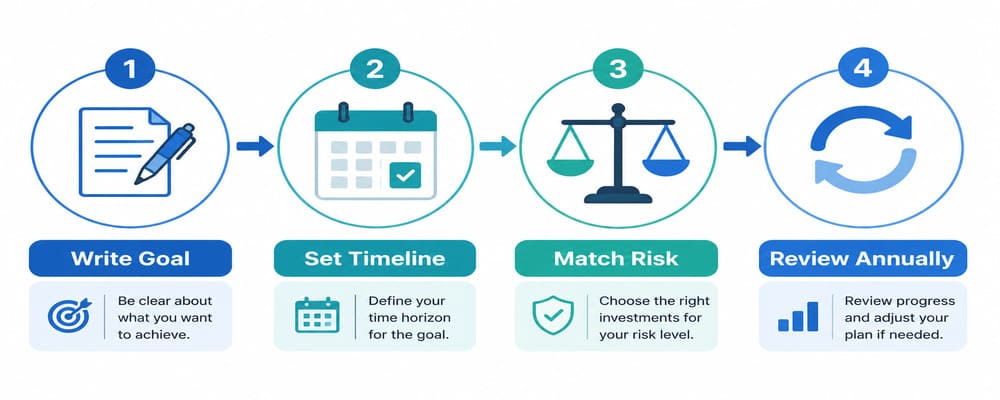
A practical way to decide where each rupee should go:
- Write down the goal and its date. “New car in 18 months” is specific; “grow my money” is not.
- Bucket the goal by horizon:
- Under 1 year → savings account, liquid funds, short FDs
- 1–3 years → short-term FDs, recurring deposits, conservative debt funds
- 3–7 years → a mix of debt and equity (hybrid/balanced funds)
- 7+ years → equity mutual funds, index funds, direct stocks, PPF/NPS
- Match risk to horizon, not to greed or fear. Don’t put a 6-month goal in equity because returns “look better” — a downturn right before you need the money can be devastating. Equally, don’t park a 20-year goal entirely in an FD — inflation will quietly eat your real returns.
- Revisit annually. As goals get closer, gradually shift money from higher-risk to lower-risk instruments (a process sometimes called “de-risking” or a glide path).
Which Is Better: Long-Term or Short-Term Investing?
There’s no universal winner — it depends on:
- Your financial goals and their timelines
- Your risk tolerance
- Income stability
- Existing savings and emergency fund status
In practice, most financially disciplined investors use both, assigning each rupee a job:
- Short-term instruments for emergency funds and near-term expenses
- Long-term instruments for retirement and wealth creation
This “bucket approach” lets you pursue growth with your long-term money while keeping near-term needs fully protected from market swings.
A Sample Case Study: Priya’s Investment Plan
Priya, 28, earns ₹60,000/month. Here’s how she might structure a horizon-based plan:
- Emergency fund (short-term): 6 months of expenses (~₹1.8 lakh) parked in a liquid fund and savings account — fully accessible, low risk.
- Goal: Foreign trip in 2 years (short-term): ₹1,00,000 target via a recurring deposit, since she cannot risk equity volatility this close to the goal date.
- Goal: Home down payment in 6 years (medium-term): SIP into a balanced/hybrid mutual fund, blending debt stability with some equity growth.
- Goal: Retirement in 30 years (long-term): SIP into equity index funds plus NPS, maximizing compounding time and accepting short-term volatility along the way. This is exactly the kind of long-horizon discipline that can turn small, regular SIPs into a seven-figure retirement corpus over time
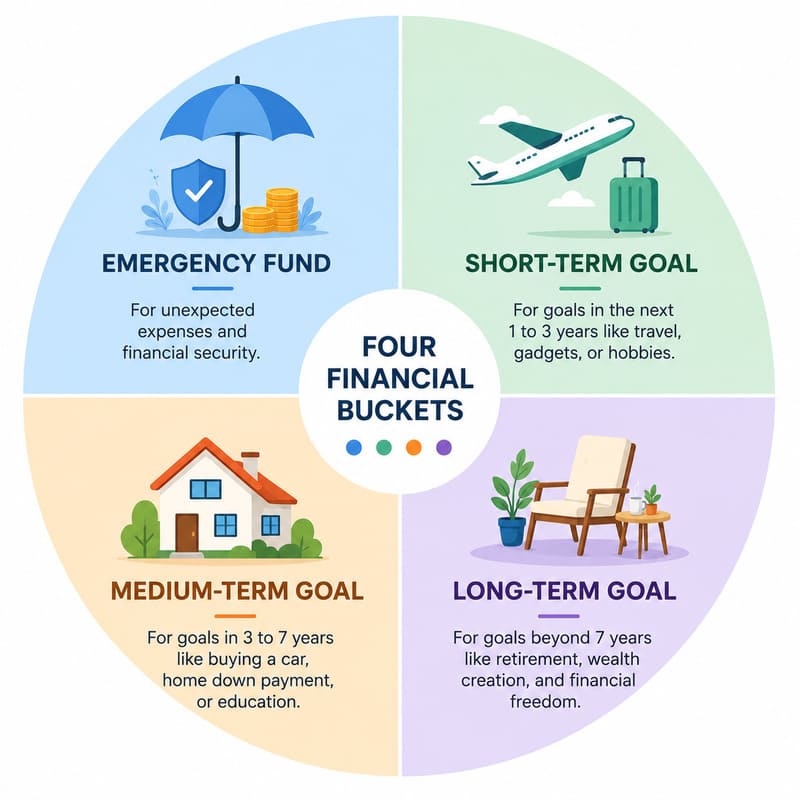
Notice Priya isn’t choosing “long-term investing” or “short-term investing” — she’s assigning the right horizon to each goal individually. This is how most real financial plans actually work.
Common Mistakes Beginners Make
- Chasing short-term returns with long-term money — trying to time the market with retirement savings instead of staying invested.
- Putting emergency funds into equity — because “returns look better,” only to be forced to sell at a loss during a market dip when cash is urgently needed.
- Ignoring inflation on “safe” instruments — a 6% FD return may still be a real loss once 5–6% inflation is subtracted.
- Panic-selling long-term investments during a downturn — locking in losses instead of allowing time to work in your favor.
- Not accounting for taxes — comparing pre-tax returns across instruments instead of what you’ll actually keep after tax.
- No written goals — investing without a defined amount, date, or purpose, which makes it impossible to choose the right horizon in the first place.

Importance of Financial Discipline
Financial discipline starts with knowing where your income is going each month. If you’re working with a fixed salary, our guide on planning a monthly budget walks through a practical income-allocation approach before you even start investing.
Regardless of your chosen strategy, financial discipline determines whether it actually works:
- Invest regularly, ideally through automated SIPs or standing instructions
- Avoid emotional decisions driven by market headlines
- Diversify across asset classes and instruments
- Review your goals and allocations periodically (at least annually)
- Keep learning — financial products and tax rules evolve
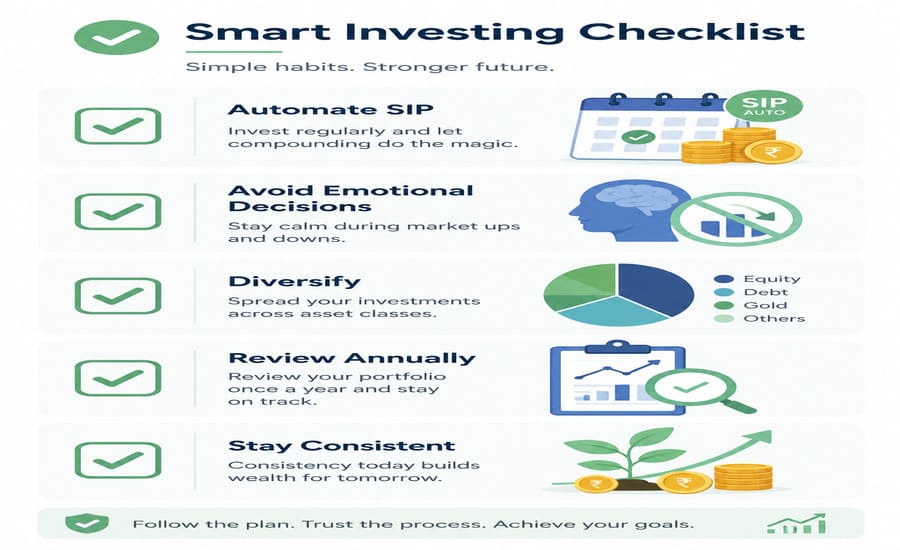
Consistency, far more than any single “smart” investment choice, is what compounds into real financial outcomes over time.
Frequently Asked Questions (FAQs).
Q1. Is long-term investing suitable for beginners?
Yes. Long-term investing requires less frequent decision-making than active trading and gives compounding time to work, making it a practical starting point for most beginners — especially through SIPs.
Q2. Can I do both long-term and short-term investing?
Yes, and most financially disciplined investors do exactly this — short-term instruments for liquidity and near-term goals, long-term instruments for wealth creation.
Q3. Is short-term investing completely safe?
No investment is completely risk-free. Short-term instruments carry lower market risk, but they’re still exposed to inflation risk and, in some cases, credit or reinvestment risk.
Q4. How long is considered long-term investing?
Generally, five years or more is considered long-term for equity-oriented investments, though this can vary by financial goal and investor context.
Q5. Should my emergency fund be invested in equity for higher returns?
Generally no. Emergency funds should prioritize liquidity and stability over returns, since you may need to withdraw them on short notice, potentially during a market downturn.
Q6. What happens if I need long-term money earlier than planned?
This is a key risk of long-term investing — an early, unplanned withdrawal during a market dip can lock in losses. It’s why many investors gradually shift long-term goals into safer instruments as the goal date approaches.
Final Thoughts
Understanding the difference between long-term and short-term investing isn’t just a theoretical exercise — it directly shapes which instruments you should use, how much risk you can take, and how much of your money you’ll actually keep after taxes and inflation.
Short-term investments protect what you’ll need soon. Long-term investments grow what you won’t need for years. Most sound financial plans use both, matched carefully to specific, written-down goals — not chosen based on which sounds more exciting.
Start by listing your goals and their timelines, bucket each one by horizon, and let that guide your instrument choice — rather than choosing an investment first and hoping it fits.
To understand why investing (in either horizon) beats simply saving, read our guide on Saving vs Investing: Why Saving Money Alone Is Not Enough Today.
Disclaimer — This article is for educational and informational purposes only. It does not constitute financial, tax, or investment advice. Tax rates and rules mentioned are subject to change; verify current figures with the Income Tax Department or a qualified professional. Readers should consult a qualified financial advisor before making any investment decisions.
About the Author
Shilpesh Rathod is the founder of All Finance Knowledge. He holds a B.Com degree along with JAIIB and CAIIB banking certifications, and brings 19+ years of experience in the banking sector across savings, investments, and financial planning.

Shilpesh Rathod is the founder of All Finance Knowledge. He holds a B.Com degree along with JAIIB and CAIIB banking certifications, and brings 19+ years of experience in the banking sector across savings, investments, and financial planning. Read more: https://allfinanceknowledge.com/about-us/
7 thoughts on “Long-Term vs Short-Term Investing: Key Differences Every Beginner Should Know”