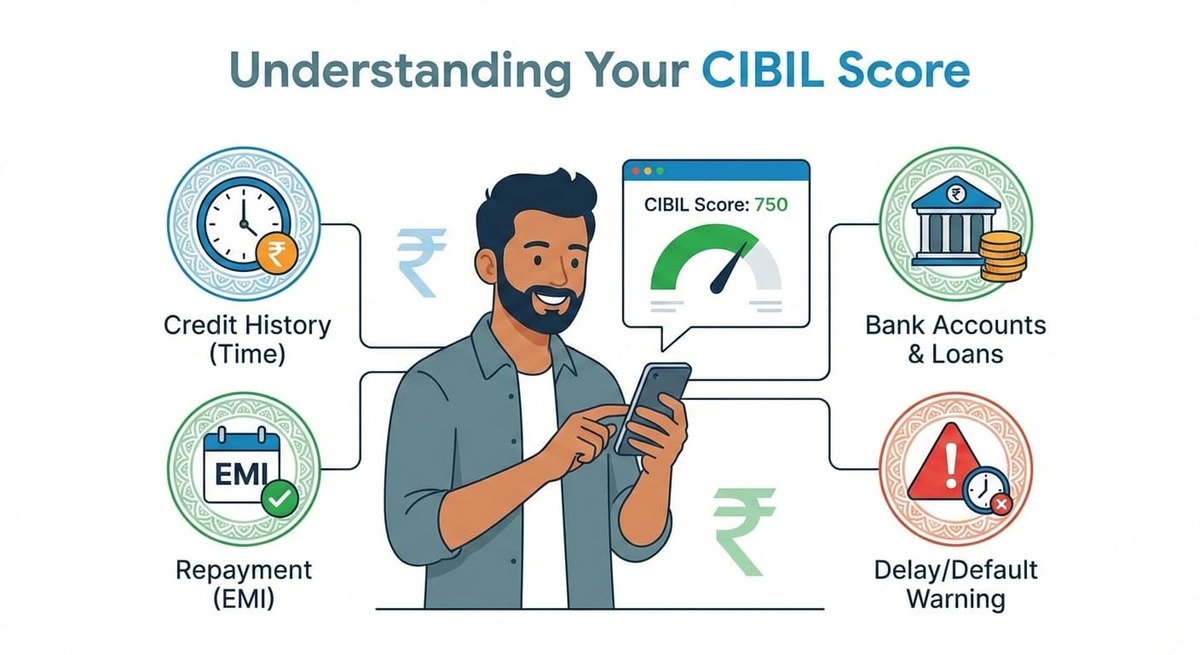
You did everything right. You paid your EMIs on time, cleared your credit card dues, maybe even closed an old loan — and yet, when you log in to check your CIBIL score, the number hasn’t moved. Not one point.
If that sounds familiar, you’re not alone. It’s one of the most common frustrations Indian borrowers write to us about, and honestly, it’s completely understandable. You did the hard part — paying money on time — so why isn’t the system giving you credit for it (literally)?
The good news is that a CIBIL score not updated situation is rarely a sign that something is broken. In almost every case, there’s a simple, explainable reason behind it — usually tied to when your lender reports data, not whether your payment was received. In this guide, we’ll walk through exactly how the CIBIL reporting system works, the most common reasons your score might be stuck, how long updates genuinely take, and the exact steps to fix things when there really is an error.
This article is written to be practical and beginner-friendly — no jargon, no scare tactics, just what you need to know.
1. What Is a CIBIL Score, and Why Does It Matter?
A CIBIL score is a three-digit number, ranging from 300 to 900, generated by TransUnion CIBIL — one of India’s licensed credit information companies. It’s essentially a snapshot of how reliably you’ve handled borrowed money in the past: credit cards, personal loans, home loans, vehicle loans, and even some types of utility credit.
Lenders use this number as a quick, standardized way to judge how risky it might be to lend to you. A higher score generally means:
- Faster loan approvals
- Better chances of approval even with a modest income
- Lower interest rates, since you’re seen as a lower-risk borrower
- Higher credit card limits
- Fewer document hassles during underwriting
As a general rule of thumb, most banks and NBFCs in India consider a score of 750 and above to be “good,” though the exact cutoff varies by lender and by the type of loan you’re applying for. Scores below 650 usually attract higher interest rates or stricter conditions, and very low scores can lead to outright rejection.
Because so much rides on this single number, it’s natural to check it often — and it’s exactly this habit that leads many people to notice, with some alarm, that the score simply isn’t moving.
2. How CIBIL Actually Updates Your Score (The Part Nobody Explains)
Here’s the single most important thing to understand about CIBIL, and the one piece of information that resolves most of the confusion in this article: CIBIL does not track your bank account in real time.
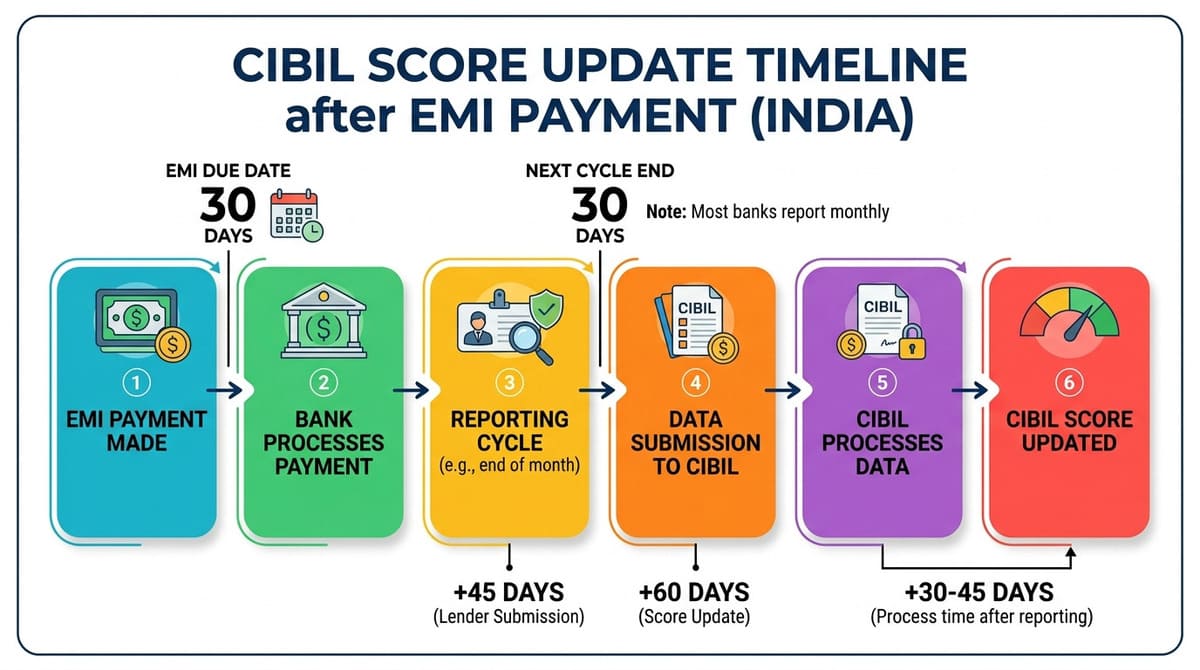
CIBIL doesn’t sit inside your bank’s servers watching every EMI debit happen. Instead, here’s what actually occurs behind the scenes:
- You pay your EMI or credit card bill to your bank or NBFC.
- Your lender internally updates its own records (usually within a few days).
- At a scheduled interval — almost always once a month, tied to the lender’s own reporting cycle — the lender compiles all customer account data and submits it to CIBIL (and often to other bureaus too).
- CIBIL receives this batch of data, processes it, and recalculates the scores of everyone whose data was included.
- Your updated score becomes visible to you and to any lender who pulls your report.
This entire chain typically takes 30 to 45 days from the date of your actual payment. Some lenders report weekly, but the vast majority — particularly larger public and private sector banks — still work on a monthly cycle.
So if you paid your EMI on the 5th of the month and checked your score on the 15th, there’s a very good chance your bank hasn’t even sent that month’s data to CIBIL yet. Your payment isn’t lost. It simply hasn’t been reported.
This single fact explains the majority of “why hasn’t my CIBIL score changed” questions we receive.
3. A Real-Life Example: Amit’s 735 Score Journey
Let’s make this concrete with a simple, realistic example.
Amit had a CIBIL score of 680. In January, he made a deliberate effort to clean up his credit profile — he paid off all his pending EMIs and cleared his credit card dues in full. Naturally, he expected his score to jump almost immediately.
Ten days later, he checked again. No change. Same 680.
Frustrated, he assumed something had gone wrong — maybe his payment hadn’t been recorded, or maybe CIBIL had made an error. In reality, neither was true. His bank’s reporting cycle simply hadn’t caught up yet. His lender reports to CIBIL only once a month, and his payment fell just after that month’s data submission window had already closed.
Amit checked again after 35 days. This time, his score had moved — up to 735.
The lesson here is simple: a stagnant score in the first few weeks after a payment is not a red flag. It’s the normal, expected behavior of a system that runs on monthly batches, not live updates.
4. Data Update vs. Score Change — They’re Not the Same Thing
One subtle but important distinction trips up a lot of people: a data update and a score change are two different events, and one doesn’t automatically guarantee the other.
A CIBIL data update happens when your lender sends fresh information to CIBIL — your latest outstanding balance, whether an EMI was paid on time, whether an account was closed, your current credit limit, and so on.
A score change happens only after that data has been processed through CIBIL’s scoring model, which weighs multiple factors together — payment history, credit utilization, the age and mix of your credit accounts, and how much new credit you’ve recently taken on.
This means it’s entirely possible for your data to be updated (your report shows the correct, current balance) while your score itself barely moves, especially if the change was small relative to your overall credit profile. A single EMI payment on a large home loan, for instance, might update your report instantly but shift your score by only a point or two.
Understanding this difference helps set realistic expectations — an updated report doesn’t always mean a dramatically different score.
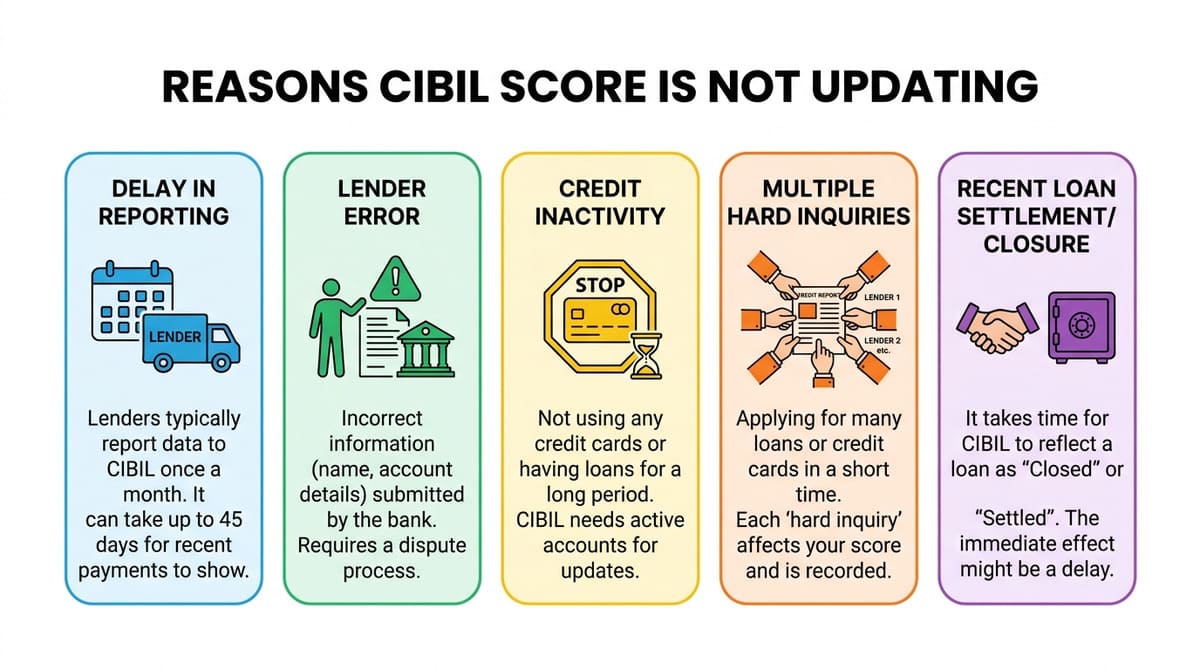
5. 10 Common Reasons Your CIBIL Score Isn’t Updating
Let’s go through the most frequent explanations in detail, along with what you can actually do about each one.
Reason 1: Your Lender Hasn’t Reported Yet
What’s happening: As explained above, most banks and NBFCs report to CIBIL on a monthly cycle, not in real time.
What to do: Simply wait. Give it 30–45 days from your payment date before assuming something is wrong. Mark your calendar and recheck after that window.
Reason 2: You Recently Closed a Loan or Credit Card
Why this happens: Closing an account triggers a chain of internal steps at your lender — issuing a closure letter, updating their core banking system, and then including that closure in the next data submission to CIBIL. This entire process can take 30 to 60 days.
What to do: Request a formal loan closure letter / No Dues Certificate from your lender immediately after closure. Keep it safely — you may need it as proof if a new lender still sees the account as “active” during the transition period.
Reason 3: EMI Paid but Still Shown as Overdue
Possible causes: This can happen due to a technical glitch at the lender’s end, a payment that was credited a day or two after the due date (even if you initiated it on time), or a mismatch between the payment gateway and the lender’s loan management system.
What to do: Always retain your payment receipt or SMS/email confirmation. If the overdue status doesn’t clear after 30–45 days, raise a dispute with supporting proof.
Reason 4: Too Many Loan or Credit Card Applications in a Short Span
Impact: Every time you apply for credit, the lender typically pulls a “hard inquiry” on your credit report. Multiple hard inquiries within a short window signal “credit hungry” behavior to the scoring model, which can cause your score to stagnate or even dip slightly — separate from any reporting delay.
What to do: Space out credit applications. As a general guideline, wait at least 3–6 months between applications unless absolutely necessary.
Reason 5: Genuine Errors in Your Credit Report
Common errors include: incorrect personal details (like a misspelled name or wrong date of birth), duplicate loan accounts appearing twice, an account that isn’t actually yours (sometimes due to identity mix-ups), or an incorrect overdue amount.
What to do: Download your full credit report and go through it line by line at least once a year. If you spot an error, raise an online dispute (we’ll cover exactly how below).
Reason 6: Credit Utilization Changes Take Time to Reflect
Why: Even if you paid down your credit card balance and your utilization ratio genuinely dropped, that change has to pass through the same monthly reporting cycle before your score model recalculates.
What to do: Be patient, and aim to keep your utilization consistently under 30% of your total credit limit — not just occasionally, but as an ongoing habit.
Reason 7: No New Credit Activity at All
Why this stalls your score: If you haven’t used any credit product recently, there’s simply no fresh data for CIBIL to process. A completely dormant credit profile doesn’t actively hurt you, but it also won’t show improvement, since there’s nothing new to reward.
What to do: Use a credit card lightly for routine expenses and pay the full bill on time each month. This generates fresh, positive data points.
Reason 8: You Recently Settled a Loan Instead of Paying in Full
Why this matters: A “settlement” (where you pay less than the full outstanding amount, and the lender agrees to close the account) is recorded very differently from a full closure. It’s flagged in your report and can weigh down your score for years, and lenders view it far more cautiously than a properly closed account.
What to do: Avoid settlements wherever financially possible. If you’ve already settled a loan in the past, the impact fades gradually as you build a strong repayment track record afterward — there’s no shortcut to reverse it quickly.
Reason 9: A Co-Applicant or Guarantor Loan Is Affecting Your Report
Why this happens: If you’re a co-applicant or guarantor on someone else’s loan, that account appears on your credit report too — and any missed payment on their end can drag your score down, even though you didn’t take the loan for yourself.
What to do: Periodically check your full report for any joint or guaranteed accounts you may have forgotten about, and follow up directly with the primary borrower if you notice missed payments.
Reason 10: You’re Checking Too Frequently and Comparing Different Bureaus
Why this creates confusion: Checking your score through different apps or bureaus (CIBIL, Experian, Equifax, CRIF High Mark) on the same day can show slightly different numbers, since each bureau uses a somewhat different scoring model and may receive data from lenders on a different schedule.
What to do: Pick one reliable source and track your trend over months, rather than comparing snapshot numbers across platforms.
6. What RBI Rules Say About Delayed Credit Reporting
It’s worth knowing that this isn’t an unregulated grey area — the Reserve Bank of India has specific rules governing how quickly credit institutions (banks and NBFCs) and credit information companies (like CIBIL, Experian, Equifax, and CRIF High Mark) must act on your requests to correct or update your data.
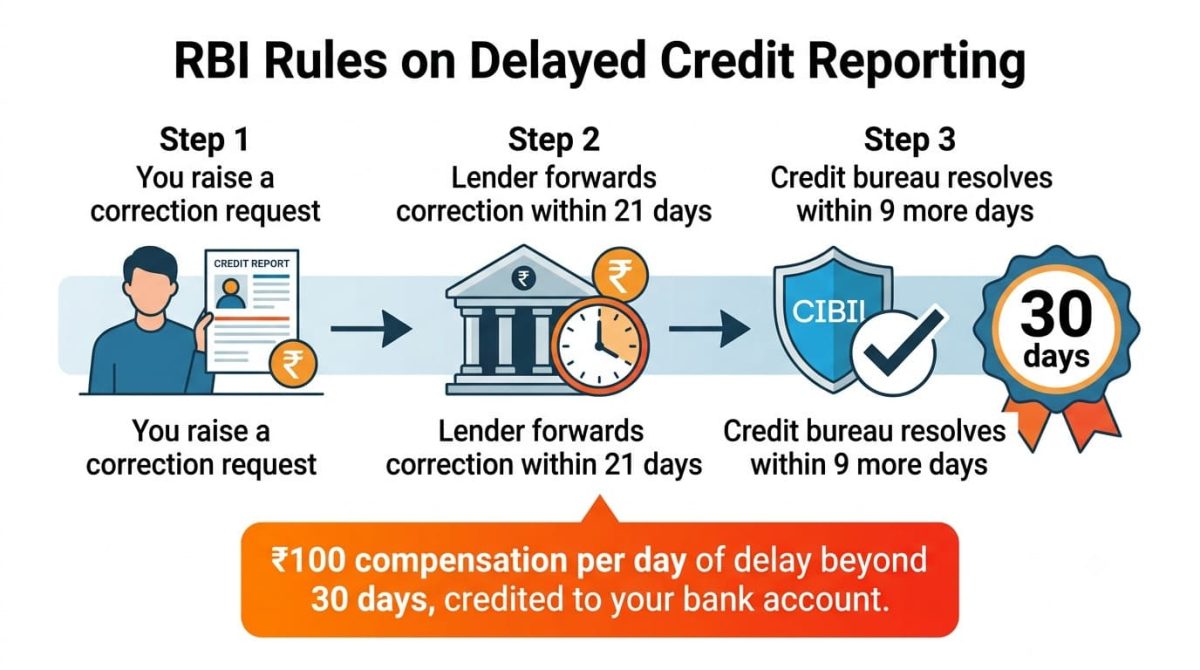
Under an RBI framework that took effect in 2024, if you formally raise a request to correct your credit information, your lender is required to forward the correction to the credit bureau within 21 calendar days, and the bureau then has a further 9 calendar days to complete the resolution — adding up to a total window of 30 calendar days.
If the issue isn’t resolved within that 30-day window, you’re actually entitled to compensation of ₹100 for every day of delay, split proportionately between the lender and the credit bureau, credited directly to your bank account. This rule exists specifically to discourage institutions from sitting on legitimate correction requests.
This is genuinely useful to know, because it means you have a real, time-bound right to a resolution — not just an informal request that a bank can ignore indefinitely. You can read the official framework directly on CIBIL’s compensation policy page or check RBI’s official notifications on the Reserve Bank of India website for the latest regulatory updates.
7. How Long Should You Actually Wait?
Here’s a quick reference table so you know what’s normal and what might need follow-up.
| Activity | Typical Update Time | When to Start Worrying |
|---|---|---|
| EMI payment reflecting on report | 30–45 days | After 45–60 days |
| Loan account closure | 30–60 days | After 60 days |
| Credit card bill payment | Around 30 days | After 45 days |
| Credit utilization drop | 30–45 days | After 60 days |
| Formal dispute resolution | 15–30 days | After 30 days (compensation applies) |
If you’re still within these windows, the healthiest approach is simply to wait and recheck later. If you’ve genuinely crossed these timeframes, it’s time to look at the dispute process.
8. What to Do the Moment You Pay an EMI
A little discipline right after payment can save you a lot of stress later.
- Confirm the deduction. Check your bank statement or app to make sure the EMI was actually debited, not just initiated.
- Save proof immediately. Screenshot the SMS or email confirmation and store it in a dedicated folder — you’ll thank yourself later if a dispute becomes necessary.
- Check your loan account status directly with the lender, not just CIBIL, to confirm there’s no overdue flag on their end.
- Mark your calendar for 30–45 days later and check your CIBIL report again at that point, rather than daily.
These small habits mean that if something does go wrong, you’ll have the documentation ready to resolve it quickly instead of scrambling.
9. When (and When Not) to Raise a CIBIL Dispute
Raising a dispute is a legitimate right, but it’s meant for genuine errors — not for the normal reporting lag we’ve discussed throughout this article. Filing disputes prematurely can actually slow things down, since it adds your case to a queue where lenders and bureaus have to investigate something that would have resolved itself naturally.
Raise a dispute only if:
- The delay has crossed 45–60 days with no change at all
- Your report shows an incorrect overdue amount
- A loan you’ve already closed still appears “active”
- Your personal details (name, DOB, PAN, address) are wrong
- An account appears on your report that you never opened
Do NOT raise a dispute if:
- You made the payment less than 30 days ago
- Your score has only changed slightly instead of jumping dramatically
- You’re comparing your score across two different bureaus and seeing a small difference
10. Step-by-Step: How to Raise a CIBIL Dispute Online
If you’ve confirmed a genuine, lasting error, here’s exactly how to fix it.
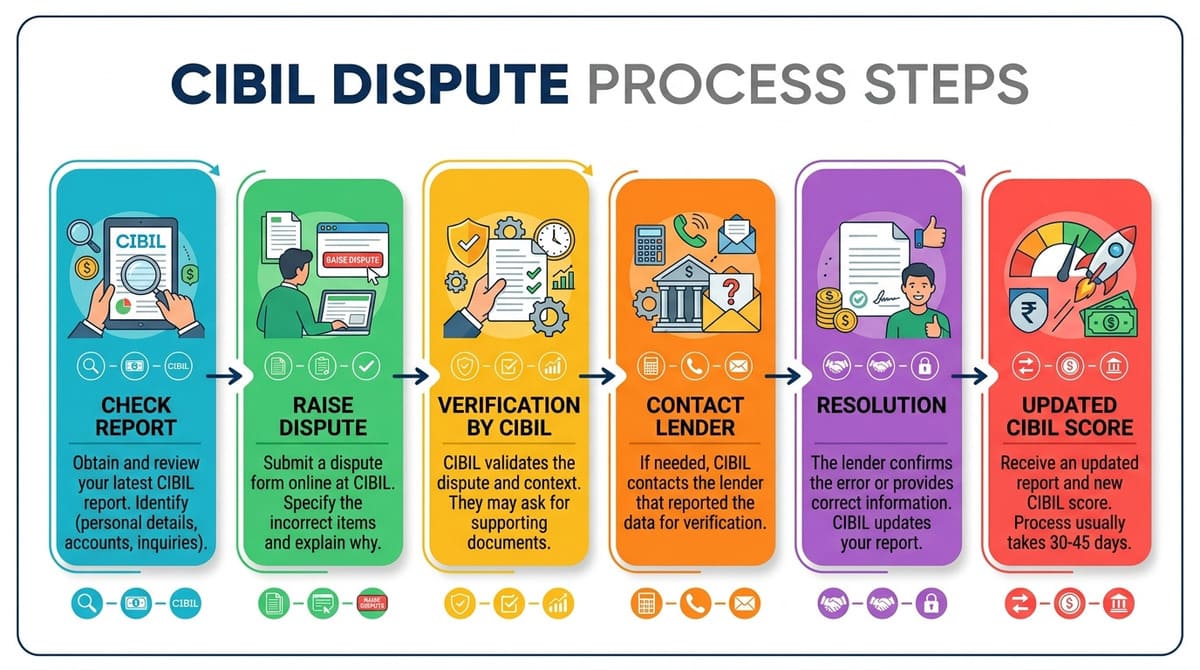
Step 1: Get your latest credit report. Download your official report directly from CIBIL’s website or through a bureau-authorized platform, rather than a third-party app that might show cached or outdated data.
Step 2: Identify the specific error. Go through the report line by line and compare it against your actual bank statements or closure documents. Note the exact account number and the exact discrepancy.
Step 3: Log in and access the dispute section. On CIBIL’s official portal, navigate to the dispute resolution section within your account.
Step 4: Select the incorrect entry and explain clearly. Choose the specific account or field that’s wrong, and write a clear, factual explanation. Attach supporting documents wherever possible — payment receipts, closure letters, or bank statements.
Step 5: Submit and track. Once submitted, CIBIL is required to coordinate with your lender to verify and correct the entry. Under the RBI-mandated timeline, this should be resolved within 30 calendar days. Keep the dispute reference number so you can follow up if needed.
11. How Delayed Updates Can Affect a New Loan Application
This is where reporting delays stop being a minor annoyance and start having real financial consequences.
Imagine you closed a personal loan two weeks ago and then applied for a car loan. The new lender pulls your CIBIL report — and it still shows your old personal loan as “active,” because your original lender hasn’t reported the closure yet. This inflates your apparent debt burden and can lead to a lower approved loan amount, a higher interest rate, or in some cases, outright rejection.
What you can do in this situation:
- Carry your loan closure letter or No Dues Certificate with you when applying for new credit soon after closing an account
- Proactively share your latest bank statement showing the account’s true status
- Politely request the new lender’s credit team to manually verify the closure with your previous lender, rather than relying solely on the automated CIBIL pull
Being prepared with documentation like this can often resolve the issue on the spot, without needing a formal dispute at all.
12. How to Track Your Score the Smart Way
Checking your CIBIL score is a good habit — but how you do it matters.
- Check once a month, not daily. Your score simply won’t move meaningfully on a day-to-day basis, and obsessive checking (even though it doesn’t hurt your score) tends to create unnecessary anxiety.
- Use one trusted, consistent source so you’re comparing like with like over time, rather than jumping between apps with different scoring snapshots.
- Read the full report, not just the number. The score is a summary; the report tells you why it is what it is.
- Track the trend line, not single data points. A score that’s steadily climbing over six months, even with small monthly bumps, is a far better sign than a single large jump.
13. Habits That Prevent Future Update Delays
Prevention really is easier than correction here. A few consistent habits go a long way:
- Pay EMIs a few days before the due date, not exactly on it — this creates a buffer against processing delays
- Avoid making payments on the very last day, especially near month-end when banking systems can be under heavier load
- Maintain sufficient balance in your account well before the auto-debit date to avoid bounced EMIs
- Keep a simple record (even a spreadsheet) of every payment date and amount
- Space out new credit applications rather than applying to multiple lenders at once
- Request written closure confirmation every time you close a loan or credit card
None of these guarantee instant updates — but together, they minimize the chances of genuine errors creeping into your report.
14. Common Myths About CIBIL Score Updates
Let’s clear up a few misconceptions that tend to cause unnecessary panic:
Myth: Paying one EMI will boost your score immediately. Reality: One payment is a single data point among many. It contributes positively, but the impact builds gradually with consistency, not overnight.
Myth: Checking your own score lowers it. Reality: Checking your own report is a “soft inquiry” and has no impact on your score whatsoever. Only “hard inquiries” — triggered when a lender checks your report during a loan or card application — can have a small, temporary effect.
Myth: Closing all your loans and cards will automatically increase your score. Reality: Closing accounts, especially your oldest ones, can sometimes reduce the average age of your credit history and lower your available credit, which may actually cause a temporary dip rather than an increase.
Myth: A settled loan is the same as a closed loan. Reality: As covered earlier, settlements are recorded distinctly and are viewed far more negatively by future lenders than a loan that was paid off in full.
15. Frequently Asked Questions
1. Why is my CIBIL score not updated after EMI payment?
Ans – Because lenders report data to CIBIL in monthly batches rather than in real time. Your payment is very likely recorded correctly at your bank; it just hasn’t been transmitted to CIBIL yet
2. How often should I check my CIBIL score?
Ans – Once a month is more than enough. Since updates typically arrive on a monthly cycle, checking more frequently rarely shows anything new.
3. Can I contact CIBIL directly if I have a problem?
Ans – Yes. You can raise a dispute directly through CIBIL’s official online dispute resolution portal, and they are required to coordinate with your lender on your behalf.
4. Does loan settlement affect how my score updates?
Ans – Yes, quite significantly. A settled loan is flagged differently from a fully closed one and tends to weigh on your score for a longer period.
5. Is my CIBIL score the same across all credit bureaus?
Ans – No. CIBIL, Experian, Equifax, and CRIF High Mark each use their own scoring models and may receive slightly different data timing from lenders, so small variations between bureaus are normal.
6. Why is my CIBIL score stuck at the exact same number for months?
Ans – This usually points to either no new credit activity being reported, or a pending update sitting in your lender’s next reporting cycle. It’s rarely a sign of a broken system.
7. Does prepaying a loan improve my score instantly?
Ans – No. Even a full prepayment has to pass through the same monthly reporting process before it’s reflected in your score.
8. Can a delayed update genuinely cause a loan rejection?
Ans – Yes, this can happen — for example, if a closed loan still shows as active on your report. Carrying proof of closure when applying for new credit soon after can help you avoid this.
9. What’s the fastest way to fix an obvious error on my report?
Ans – Raise a formal dispute with supporting documents through CIBIL’s official portal. Under RBI’s framework, this must be resolved within 30 days, or you become eligible for compensation.
10. Should I use a third-party app or CIBIL’s own website to check my score?
Ans – Either works for a general idea, but for anything official — like verifying details before a dispute — it’s best to pull your report directly from CIBIL’s website to avoid any caching or third-party lag.
16. Final Thoughts
If your CIBIL score isn’t updating the way you expected, take a breath — in the overwhelming majority of cases, this comes down to the normal monthly reporting rhythm between your lender and CIBIL, not a mistake on your part or theirs. Give it the standard 30–45 day window, keep your payment proofs handy, and recheck patiently.
If, after that reasonable window, you spot a genuine error — an incorrect overdue amount, a closed loan still marked active, or wrong personal details — you now know exactly how to raise a dispute and what timeline to expect, backed by RBI’s own compensation framework.
Building and protecting a strong CIBIL score isn’t about chasing instant results. It’s a slow, steady process built on consistent, on-time payments, sensible credit utilization, and periodic, careful review of your report. Stay consistent, stay patient, and the number will follow.
You may also find these guides useful:
- How to Improve CIBIL Score from 550 to 750: Step-by-Step Guide for Indians
- Does Checking CIBIL Score Reduce Credit Score? 5 Truths & Facts Explained
- Can I Get a Loan Without Income Proof? A Complete Guide for Indian Borrowers
External references for further reading:
- TransUnion CIBIL – Official Website
- CIBIL Compensation Framework for Delayed Updates
- Reserve Bank of India – Official Website
Disclaimer: This article is for educational purposes only and does not constitute financial advice. Credit score rules, reporting cycles, and dispute timelines may vary by lender and credit bureau, and are subject to change by regulatory authorities. Always verify current details on the official CIBIL and RBI websites before taking action.

Shilpesh Rathod is the founder of All Finance Knowledge. He holds a B.Com degree along with JAIIB and CAIIB banking certifications, and brings 19+ years of experience in the banking sector across savings, investments, and financial planning. Read more: https://allfinanceknowledge.com/about-us/
3 thoughts on “CIBIL Score Not Updated? Here’s Why (And Exactly How to Fix It in 2026)”