
Imagine you run a small tailoring shop. Business is decent, but most customers pay in cash and you have never filed an income tax return. Then your child’s school fees, a medical bill, or a machine repair lands on your desk and you need money within days. You walk into a bank, and the first thing the officer asks for is your salary slips or ITR.
If you have been in this situation, you are far from alone. India has crores of freelancers, small traders, gig workers, farmers, homemakers, students, and retirees who earn or manage money without a neat monthly payslip. The good news is that a loan without income proof in India is possible. The catch is that it works differently from a regular salaried loan, and the details matter.
In this guide you will learn:
- What lenders mean by “income proof” and why they ask for it
- The seven most realistic loan options without salary slips or ITR
- Which documents you can show instead
- Typical interest rates and charges, plus hidden costs to watch for
- How to spot fake loan apps and protect your data
- A step-by-step method to apply and improve your chances
Let’s start with the basics.
What Is Income Proof and Why Do Lenders Ask for It?
Income proof is any document that shows how much you earn and how regularly. A lender’s biggest worry is simple: will this person repay on time? Income documents help answer that question quickly.
The most common forms of income proof in India are:
- Salary slips for the last 3 to 6 months
- Bank statements showing regular salary credits
- Income Tax Returns (ITR) for the last 1 to 3 years
- Form 16 issued by an employer
- Profit and loss statements or business financials (for the self-employed)
When you cannot provide these, the lender has less information, so it either asks for something that reduces its risk (like gold or a fixed deposit) or charges a higher interest rate. That is the basic trade-off behind every loan without income proof.
Can You Really Get a Loan Without Income Proof in India?
Yes, but with realistic expectations. Loans without traditional income proof usually come with one or more of these conditions:
- Smaller loan amounts, because the lender cannot confirm a large repayment capacity
- Higher interest rates if the loan is unsecured
- Collateral or a guarantor, such as gold, an FD, property, or a co-applicant
- A good credit history, which proves you have repaid loans reliably before
Large public sector banks are generally strict about unsecured loans. Private banks, NBFCs (Non-Banking Financial Companies), and regulated digital lenders tend to be more flexible. They use alternative data such as bank transactions and credit scores. Secured loans, where you pledge an asset, are the easiest category.
Important: “No income proof” rarely means “no checks at all.” Lenders will still verify your identity, your bank account, and your credit behaviour. The checks are just different.
A Real-Life Example
Take Ramesh, a freelance video editor in Gujarat. His income swings between ₹15,000 and ₹60,000 a month, depending on projects, and clients pay by UPI or cash. He has no salary slips and has never filed an ITR. One night, his father needs an urgent procedure and the hospital asks for ₹50,000.
Ramesh does not apply for an unsecured personal loan, because he knows it would be rejected or expensive. Instead, he takes his family’s gold jewellery to a regulated lender, completes KYC with Aadhaar and PAN, gets the gold valued, and receives the money in his bank account the same day.
The lesson is that when your income documents are weak, your assets, your banking behaviour, and your credit score do the talking. Ramesh could also have borrowed against an FD or asked a family member to co-sign if he had needed more flexibility.
7 Types of Loans Available Without Income Proof
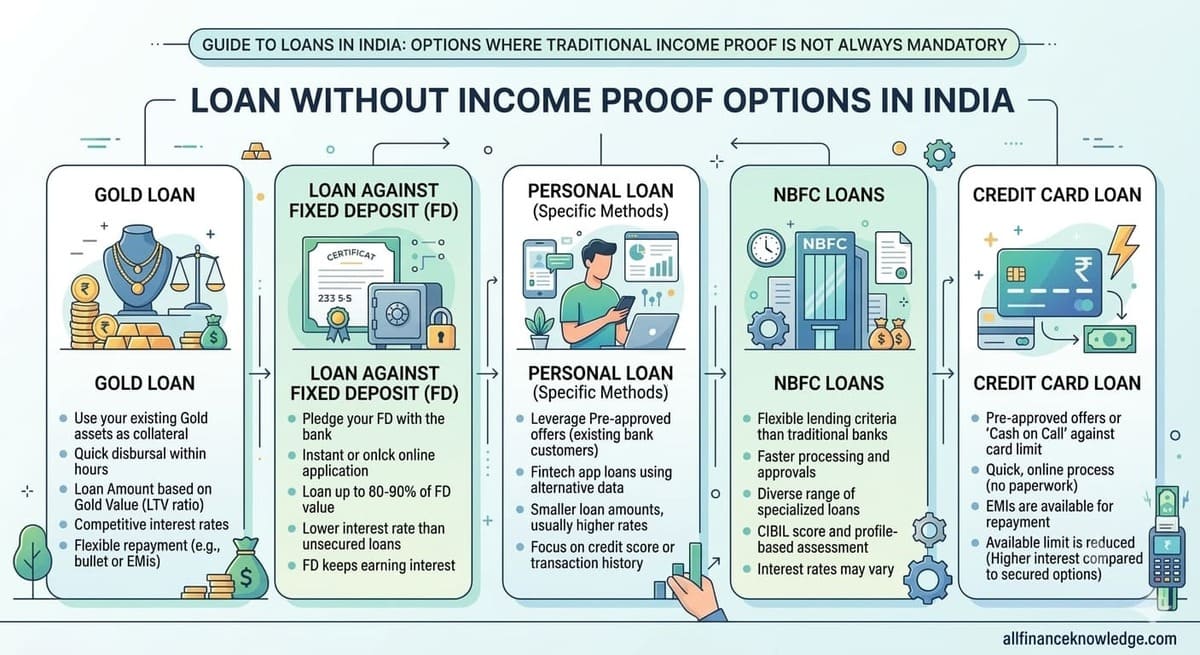
1. Gold Loan (The Easiest Option)
A gold loan is the most accessible loan without income proof in India. You pledge gold jewellery with a bank or NBFC, and the lender gives you a loan based on the gold’s value, not your salary.
Why it works: The loan is fully secured. If you do not repay, the lender can recover its money by auctioning the gold after due notice. That reduces risk, so income proof becomes largely irrelevant.
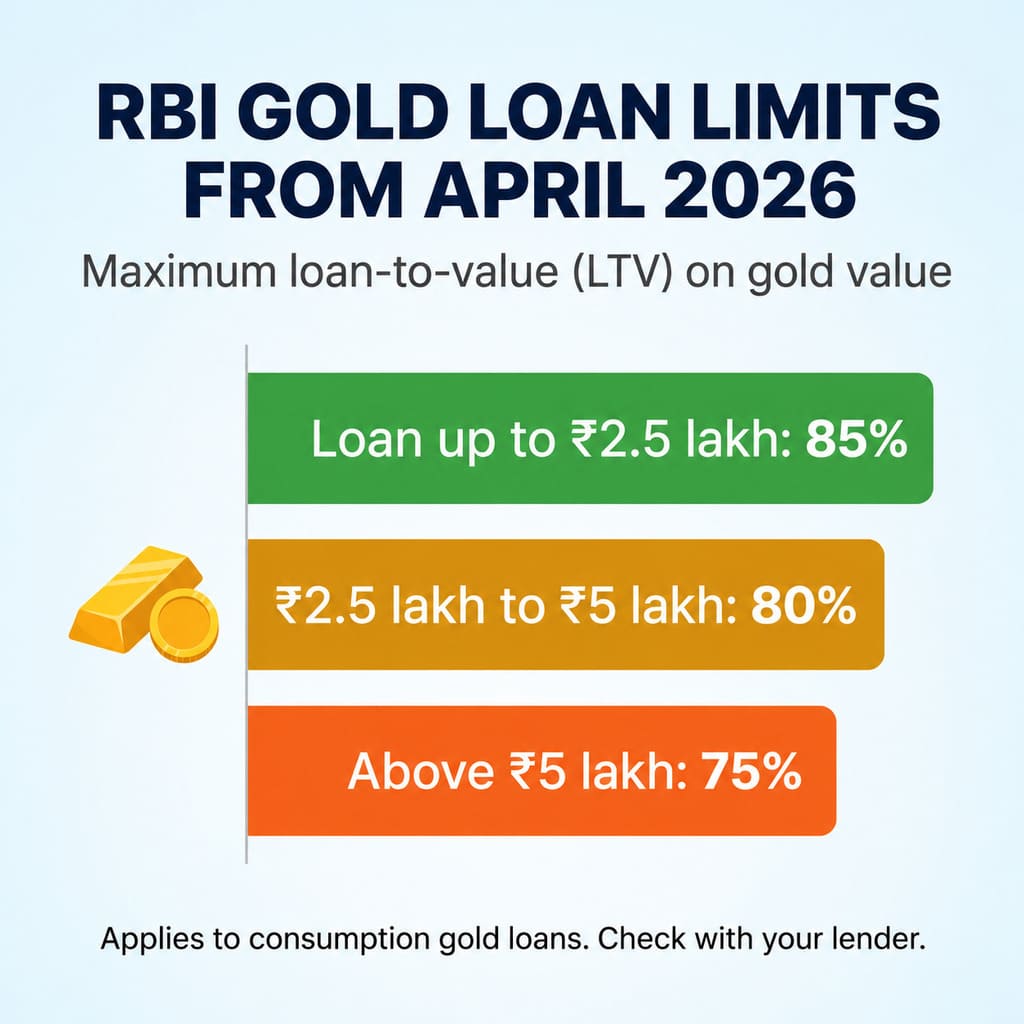
What changed in 2026: The RBI’s revised gold loan framework came into effect on April 1, 2026. It uses a tiered Loan-to-Value (LTV) structure for consumption loans. Loans up to ₹2.5 lakh can go up to 85% of the gold’s value, and loans above ₹5 lakh are capped at 75%. The middle band, ₹2.5 lakh to ₹5 lakh, is capped at 80%. In practical terms, smaller borrowers can now get a higher amount per gram than before, while very large loans face tighter limits. Lenders are also expected to return your gold within seven working days after you repay the loan.
Pros:
- Same-day disbursal in most cases
- Minimal paperwork, with no ITR or salary slips
- Interest rates are usually lower than unsecured personal loans
- Flexible repayment options such as monthly interest or bullet repayment
Cons:
- You risk losing your gold if you default
- Gold must be valued and stored safely, so choose a reputed lender
- Rates and fees differ widely between banks, NBFCs, and local financiers
Best for: Short-term emergencies and small business needs.
2. Loan Against Fixed Deposit (FD)
If you already hold an FD, you can borrow against it without showing income. Because the bank holds your deposit as security, approval is quick and the paperwork is minimal.
Key points:
- Banks typically lend up to 75% to 90% of the FD value
- The interest rate is usually 1% to 2% above your FD’s interest rate
- Your FD keeps earning interest while the loan is outstanding
- No impact on your credit score if you repay properly
This is often the cheapest way to borrow without income proof, since you are effectively paying only the small gap between the FD rate and the loan rate. It is a smart choice if you are a retiree or homemaker with savings parked in FDs.
3. Loan Against Property (LAP)
If you own a house, shop, or land, a Loan Against Property can unlock large funds, sometimes in lakhs or crores, with longer repayment tenures and lower rates than personal loans.
Lenders prefer income proof here too, but many are flexible with self-employed borrowers. They may assess your property value, rental income, or business cash flow using bank statements instead of ITRs.
Things to keep in mind:
- The property must have clear legal title and be mortgageable
- Processing time is longer because of valuation and legal checks
- Your property is at risk if you default, so borrow carefully
LAP suits big needs such as business expansion, a daughter’s wedding, or higher education abroad.
4. Loans Against Securities, Mutual Funds, or Insurance Policies
Many people overlook this option. If you hold mutual funds, shares, bonds, or an LIC policy with a surrender value, you may be able to borrow against them.
- Loan against mutual funds or shares: Lenders pledge your units or shares as collateral, and you continue to own them
- Loan against an insurance policy: Traditional policies like endowment plans may allow a loan of up to a certain percentage of surrender value
Since the collateral is financial and easy to value, income proof is rarely a hurdle.
5. Small Personal Loans from NBFCs and Digital Lenders
Many NBFCs and fintech platforms offer small unsecured personal loans, typically from ₹10,000 up to ₹2 lakh, using “alternative credit assessment.” Instead of salary slips, they study:
- Your credit score and credit history
- Bank statement patterns, including regular credits, UPI activity, and average balance
- Existing EMIs and your repayment behaviour
- Other verified digital data, shared with your consent
Typical requirements: Aadhaar, PAN, an active bank account, a mobile number linked to Aadhaar, and a decent credit score.
These loans are fast, but they are also the most expensive and the riskiest category because of fake apps (more on that below). Always verify the lender before applying.
6. Credit Card Loans and Pre-Approved Offers
If you already have a credit card with a good payment record, you may receive pre-approved personal loans or the option to convert big purchases into EMIs. These offers rely on your card usage and repayment history rather than income documents. Compare the interest rate carefully, since card-based loans can be pricey.
7. Government-Backed Schemes for Small Businesses
This is the most underrated route for freelancers, shopkeepers, and micro-entrepreneurs.
- PM Mudra Yojana (PMMY): Offers collateral-free business loans to small enterprises through banks, NBFCs, and microfinance institutions. The categories are Shishu (up to ₹50,000), Kishore (up to ₹5 lakh), and Tarun (up to ₹10 lakh), with a higher Tarun Plus tier introduced for larger needs. Official details are available on the MUDRA website.
- PM SVANidhi: A working capital scheme for street vendors. Details are on the PM SVANidhi portal.
- CGTMSE-backed loans: The credit guarantee scheme encourages banks to lend to small businesses without collateral.
Scheme limits and eligibility get revised from time to time, so confirm the current terms with your bank or the official portal before applying.
Documents You Can Use Instead of Income Proof
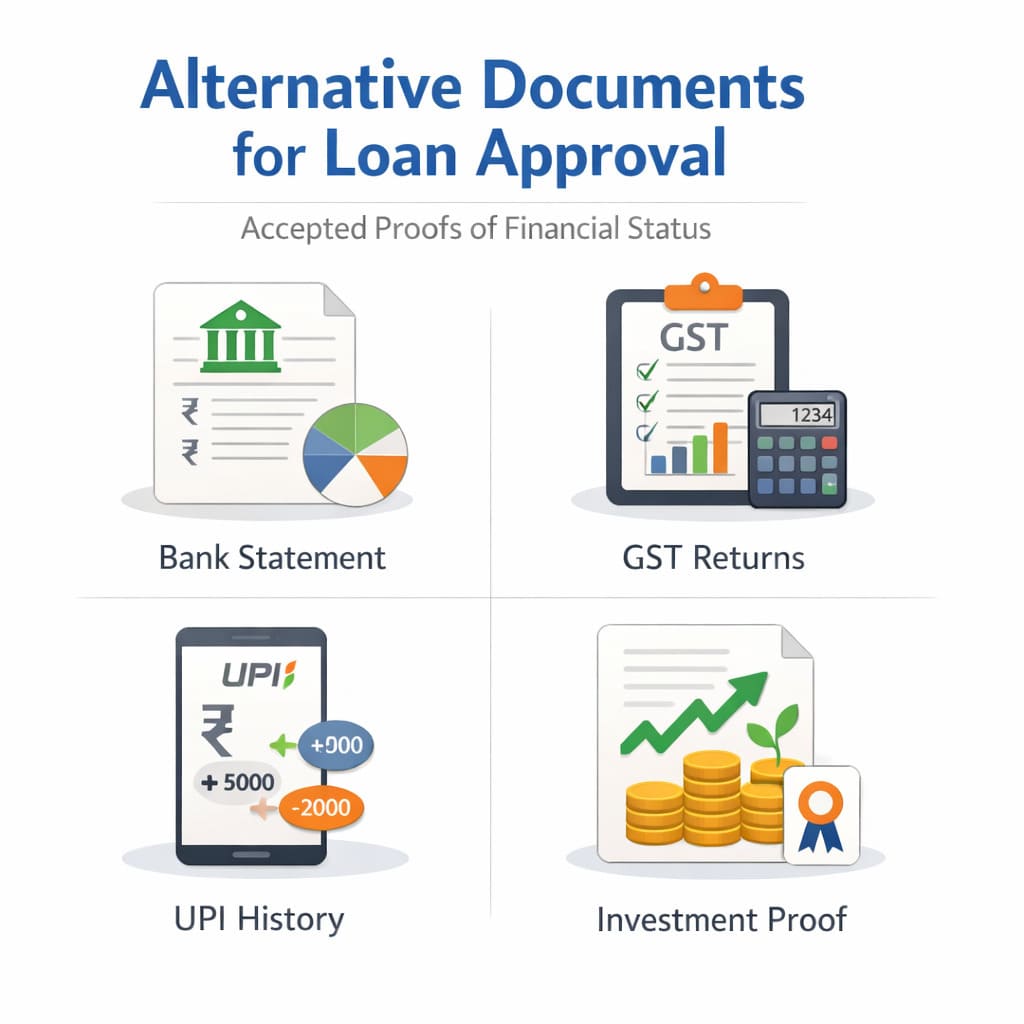
Even if you do not have salary slips or ITR, you can still build a strong application with alternative documents. The more of these you can show, the better.
| Alternative Document | What It Proves |
|---|---|
| Bank statements (last 6–12 months) | Regular inflows, average balance, spending habits |
| GST returns | Business turnover for traders and service providers |
| UPI transaction history | Consistent digital receipts, useful for small shops and freelancers |
| Rental agreement and rent receipts | Rental income |
| Fixed deposit receipts | Savings and security for a loan |
| Mutual fund or demat statements | Investments that can back a loan |
| Pension passbook or pension payment orders | Regular retirement income |
| Udyam Registration certificate | Proof of a registered micro, small, or medium enterprise |
| Utility bills, rent agreement, or property papers | Stable address and residence proof |
| Client invoices or contracts (freelancers) | Evidence of ongoing work |
A practical tip: If you earn mostly in cash, start depositing it into your bank account regularly. Even 3 to 6 months of consistent deposits create a paper trail that lenders can read. It also helps you later when you want to file an ITR and unlock cheaper loans.
Eligibility Criteria for Loans Without Income Proof
Eligibility varies by lender and loan type, but most will check the following:
- Age: Generally 21 to 60 years (some lenders go up to 65 or higher for secured loans)
- Citizenship: Indian resident
- KYC: Valid Aadhaar and PAN
- Mobile number: Active and linked to Aadhaar for OTP verification
- Bank account: An active account with some transaction history
- Credit score: A score of 750 or above is usually preferred and improves your odds significantly
- Existing debt: A manageable number of running loans and EMIs
Meeting these basics will not guarantee approval, but missing them can lead to quick rejection.
How Lenders Judge Your Repayment Ability Without Income Proof
When there is no payslip to read, lenders rely on a process called alternative credit assessment. Here is what they usually examine:
- Credit score and report: Your CIBIL score (and reports from Experian, Equifax, or CRIF High Mark) show whether you have repaid past loans and credit card dues on time.
- Bank statement analysis: Regular deposits, a healthy average balance, and few bounced cheques or failed payments all work in your favour.
- Existing obligations: If most of your monthly inflow is already going toward EMIs, a new loan looks risky.
- Collateral value: For secured loans, the asset’s value and quality matter more than your earnings.
- Digital footprint: Some fintech lenders use consented data, such as transaction patterns, to assess risk.
This is why two people with the same “no income proof” status can get very different offers. The one with a clean credit history and a regular banking trail wins.
Interest Rates and Charges: Know the Real Cost
Loans without income proof carry more risk for lenders, so they often cost more. Here is a general picture. Actual rates vary by lender, your profile, and market conditions, so always check the latest offers.
| Loan Type | Typical Interest Range* | Notes |
|---|---|---|
| Gold loan | Roughly 9% – 24% | Varies widely by lender and loan size |
| Loan against FD | FD rate + 1% to 2% | Among the cheapest options |
| Loan against property | Roughly 9% – 15% | Longer tenure, legal checks |
| NBFC/app-based personal loan | 12% – 36% | Highest cost, check the APR |
| Credit card loan/EMI | 12% – 30%+ | Depends on card issuer |
*Indicative ranges only, not a quote.
Charges to look for beyond the interest rate:
- Processing fee: Usually 1% to 5% of the loan amount, sometimes deducted upfront
- Late payment charges: Penalties for missed EMIs
- Foreclosure or prepayment charges: Fees for repaying early (not always charged)
- GST on fees: Added to processing and other charges
- Documentation or valuation fees: Common for gold loans and LAP
Always compare the APR (Annual Percentage Rate), not just the headline interest rate. The RBI’s digital lending framework requires lenders to give borrowers a Key Fact Statement (KFS) that clearly lays out the APR, fees, tenure, and repayment schedule before the loan is finalised. If a lender will not show you this in plain language, walk away.
How to Spot Fake Loan Apps and Protect Yourself
Anyone searching for “instant loan without documents” is a target for fraudsters, so this section deserves your full attention. Fake loan apps have trapped many borrowers with harassment, data theft, and outrageous charges.
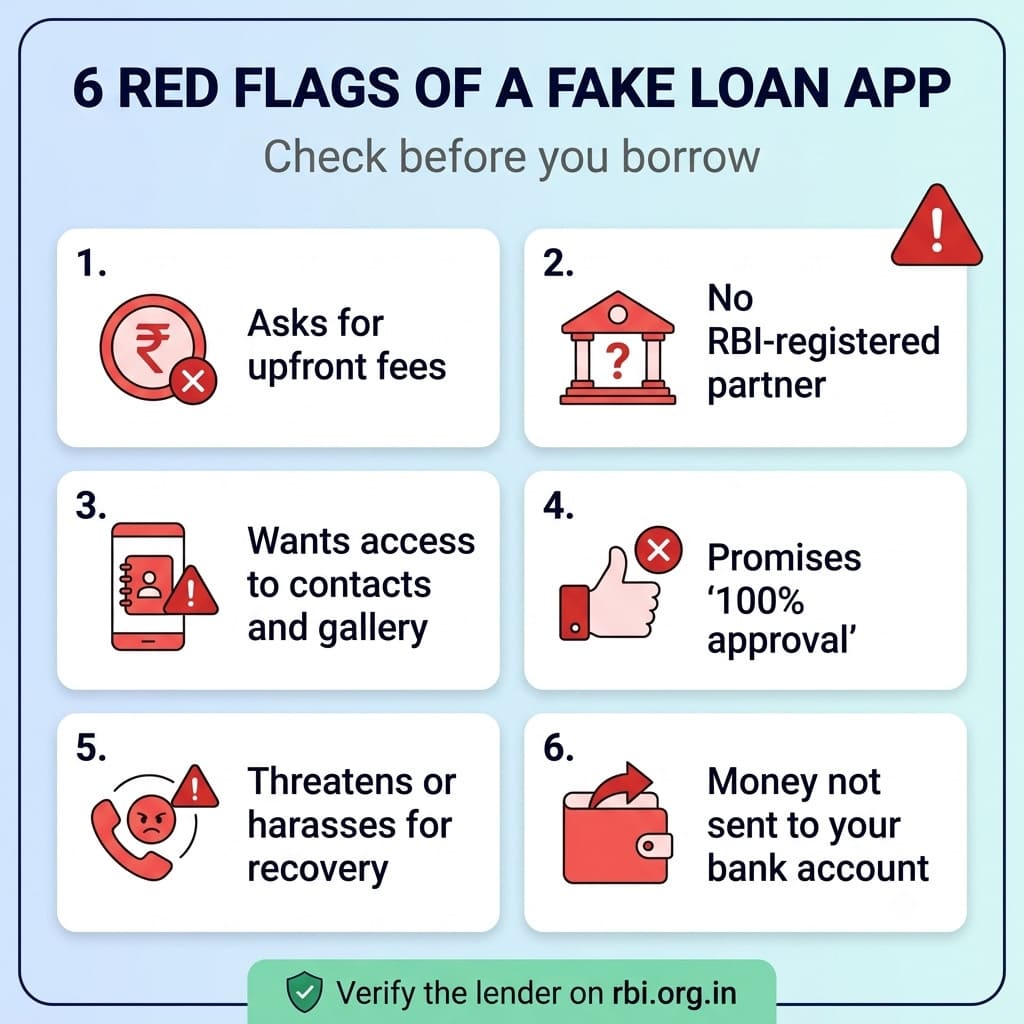
Red flags to watch for:
- Upfront fees: A genuine lender deducts fees from the loan or discloses them in the KFS. If someone asks for “insurance,” “registration,” or “processing” money before releasing your loan, it is a scam.
- No lender details: No registered company name, address, grievance officer, or an RBI-registered NBFC or bank partner
- Excessive permissions: Apps asking for access to your contacts, photos, gallery, or messages. Legitimate lenders do not need these.
- Guaranteed approval: “100% approval, no checks” is not how regulated lending works
- Pressure and threats: Abusive recovery calls, threats to message your contacts, or morphed photos are illegal
- Disbursal through third-party wallets: Under RBI rules, loan funds should go directly into the borrower’s bank account
How to verify a lender:
- Check whether the NBFC is on the RBI’s list at rbi.org.in.
- Check whether the app is listed in the RBI’s directory of digital lending apps. Under the Digital Lending Directions 2025, lending apps have to be reported to the RBI, which created an official directory of legitimate apps.
- Read the app’s reviews, but also look up the company independently.
- Confirm that the lending entity named in the agreement matches the one sending you money.
If you are cheated or harassed:
- Report financial cyber fraud on the national helpline 1930 or at cybercrime.gov.in
- Use the RBI’s complaint portal at cms.rbi.org.in for complaints against regulated entities
- Visit sachet.rbi.org.in to report unauthorised lending or deposit-taking activity
Step-by-Step: How to Apply for a Loan Without Income Proof
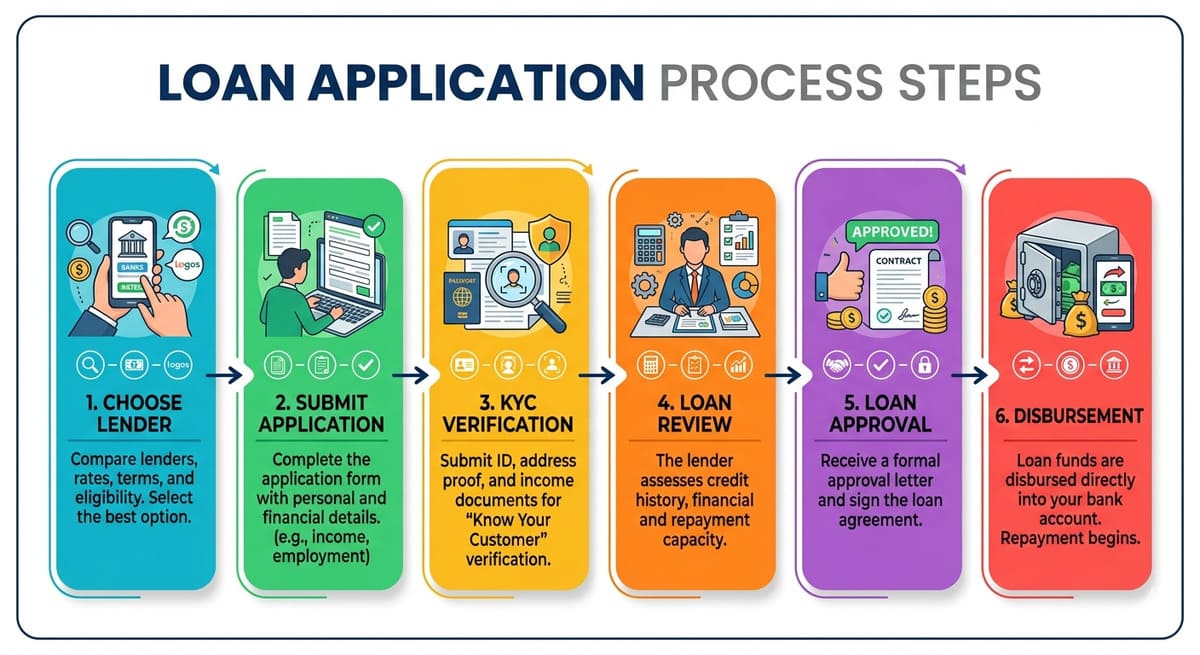
Step 1: Define your need and amount. Decide exactly how much you need and for how long. Borrowing more than necessary increases your interest burden.
Step 2: Check your credit score. You are entitled to a free full credit report once a year from each credit bureau. You can get one from CIBIL and the other bureaus. Fix errors, such as wrong dues or duplicate accounts, before you apply. Not sure how the score works? Read our CIBIL score explained guide first.
Step 3: Choose the right loan type. If you own gold or an FD, use that first. If you are a small business owner, check Mudra or other government schemes. Choose unsecured app loans last.
Step 4: Shortlist 2–3 regulated lenders. Compare the interest rate, processing fee, APR, prepayment terms, and customer reviews. Use a loan EMI calculator to see your monthly burden.
Step 5: Complete KYC. Submit your Aadhaar, PAN, and a recent photograph. Keep your Aadhaar-linked mobile handy for OTP verification.
Step 6: Submit alternative documents. Upload bank statements, GST returns, FD receipts, or other relevant papers from the table above.
Step 7: Read the loan agreement and KFS carefully. Check the interest rate, APR, tenure, EMI, penalties, and foreclosure rules. Digital loans also come with a cooling-off or look-up period during which you can exit by repaying the principal and proportionate interest, usually without a penalty.
Step 8: Receive the funds in your bank account. Confirm that the money arrives in your own account and that the amount matches what was promised.
Step 9: Set up auto-pay or reminders. A missed EMI hurts your credit score, which makes your next loan costlier.
When You Should Avoid Taking a Loan Without Income Proof
A loan is a tool, not a solution to every problem. Think twice if:
- You do not have a clear plan to repay, because irregular income can turn a small loan into a debt trap
- The interest rate or APR is very high compared with alternatives
- The expense is not an emergency, such as a vacation or a gadget upgrade
- You are already juggling multiple loans or credit card dues
- You are being pressured by an agent or app to borrow “right now”
A useful rule of thumb is that your total monthly EMIs should not eat up more than 30% to 40% of your average monthly inflows. Beyond that, even a small dip in earnings becomes a crisis.
Role of Your Credit Score in Getting a Loan Without Income Proof
When income documents are missing, your credit score becomes your résumé. A score of 750 or above generally signals reliable repayment behaviour and gives you:
- Higher chances of approval
- Lower interest rates
- Higher loan limits
- Faster processing
How to improve your credit score:
- Pay EMIs and credit card bills on or before the due date
- Keep credit card usage below 30% of your limit
- Avoid applying to many lenders at once, since each application can trigger a hard enquiry
- Maintain a healthy mix of credit over time, such as a credit card and a small loan
- Review your report for errors and dispute them promptly
If you are new to credit, consider a secured credit card against an FD. It is an easy way to build a score from zero. For more tips, read our guide on how to improve your CIBIL score.
Who Can Apply for Loans Without Income Proof?
Different groups face different situations. Here is how each can approach it.
- Freelancers and gig workers: Use bank statements showing client payments, invoices, and UPI history. Consider a gold loan or a small NBFC loan. Start filing ITR for better future options.
- Self-employed professionals and small traders: Use GST returns, Udyam registration, and business bank statements. Explore Mudra loans and LAP.
- Homemakers: You can borrow against your own gold, FDs, or insurance policies. Some lenders also accept a spouse as co-applicant.
- Students: Education loans may need a co-applicant or guarantor, usually a parent. Small personal loans are possible with a guarantor.
- Retired individuals: Pension statements, FDs, and property can all work as proof or collateral.
- Farmers and agricultural workers: Kisan Credit Card (KCC) and agri-gold loans are designed for people without salary records.
Risks of Taking a Loan Without Income Proof
Being aware of the downsides will help you make better decisions:
- Higher cost: Lenders price in the risk, so you may pay more than a salaried borrower would
- Shorter tenure: Unsecured small loans often need repayment within months, which means bigger EMIs
- Loss of collateral: Missed payments on a gold loan, FD loan, or LAP can lead to recovery action on your asset
- Credit score damage: Late payments and defaults stay on your report for years
- Scams and data misuse: Unregulated apps may misuse personal data or harass borrowers
- Debt cycle: Taking a new loan to repay an old one is a warning sign
Tips to Improve Your Chances of Approval
- Keep your bank account active. Route as much of your income as possible through it for at least 6 months.
- Maintain a healthy average balance. Frequent zero balances look risky.
- Offer collateral if you can. Gold, an FD, or a property instantly strengthens your case.
- Add a co-applicant or guarantor. A family member with a stable income can improve both approval odds and rates.
- Apply for a realistic amount. Smaller requests have a higher chance of success.
- Avoid multiple applications. Too many enquiries in a short time lower your score.
- Register your business. Even an Udyam Registration adds credibility for small business owners.
- Start filing ITR. Even a modest ITR opens doors to cheaper, larger loans in the future.
Alternatives to Borrowing
Before you take any loan, ask whether you can solve the problem differently:
- Borrow from family or friends, with a clear repayment plan so relationships stay healthy
- Use emergency savings or a recurring deposit that you can break at low cost
- Ask for a salary advance if you are employed
- Negotiate with creditors, since hospitals, schools, and landlords often allow instalments
- Cut non-essential spending temporarily to free up cash
- Sell unused assets, such as idle gold, a second vehicle, or electronics
- Join a regulated microfinance group or cooperative bank, which often serves borrowers without formal income records
Smart Borrowing Habits for Indian Borrowers
- Borrow only what you truly need
- Compare at least three offers, focusing on APR and total repayment, not just the EMI
- Never pay anyone to “approve” your loan
- Never share OTPs, UPI PINs, or passwords with anyone, including “loan agents”
- Keep copies of your loan agreement, KFS, and payment receipts
- Pay on time, every time, because your repayment record is the foundation of future credit
FAQs: Loan Without Income Proof
Q1. Can banks give loans without income proof?
Ans – Banks are cautious with unsecured loans, but they do offer secured options such as gold loans, loans against FDs, loans against securities, and loans against property. Government schemes like Mudra are also routed through banks.
Q2. Is Aadhaar enough to get a loan?
Ans – No. Aadhaar is used for KYC and identity verification, but lenders also require PAN and some proof of banking behaviour, collateral, or creditworthiness.
Q3. Are instant loan apps safe?
Ans – Only if the app is operated by or partnered with an RBI-regulated bank or NBFC, appears in the RBI’s directory of digital lending apps, shows the full terms in a Key Fact Statement, and pays money directly into your bank account. Avoid apps that demand access to your contacts and gallery.
Q4. What is the maximum loan amount without income proof?
Ans – It depends on the type. Unsecured loans usually range from ₹10,000 to ₹2 lakh. Secured loans can be far larger, since the limit depends on the value of your gold, FD, or property.
Q5. Can students get loans without income proof?
Ans – Yes, with a co-applicant or guarantor, usually a parent. Education loans consider the parent’s income, the course, and the institution.
Q6. Can I get a loan without income proof and low CIBIL score?
Ans – It is harder, but not impossible. Gold loans and loans against FDs depend mainly on collateral rather than your score. Expect higher rates, and work on rebuilding your credit over time. Our guide on improving your CIBIL score from 550 to 750 can help you get started.
Q7. Is PAN card mandatory for loan?
Ans – For most loans, yes. PAN is required for KYC and for tracking credit history. Some small gold loans may be available with other identity documents, but policies vary by lender.
Q8. Are digital loan apps legal in India?
Ans – Yes, if they operate through RBI-regulated banks or NBFCs and follow the RBI’s digital lending rules. Apps that are unregistered, hide terms, or use abusive recovery practices are illegal.
Q9. Does a gold loan affect my CIBIL score?
Ans – Gold loans from banks and NBFCs are generally reported to credit bureaus, so timely repayment can improve your score, while defaults can damage it.
Q10. How fast can I get a loan without income proof?
Ans – Gold loans and loans against FDs can be processed within hours. Small digital loans may be approved in minutes. LAP and government scheme loans take longer.
Final Verdict
A loan without income proof in India is realistic, but it works best when you borrow smartly. If you own gold or an FD, a secured loan is usually the cheapest and fastest route. If you run a small business, explore government-backed schemes before turning to expensive apps. If you must use an unsecured loan, stick to RBI-regulated lenders, read the Key Fact Statement, and borrow only what you can comfortably repay.
Most importantly, treat today’s loan as a stepping stone. Build a clean banking trail, maintain a strong credit score, and start documenting your income. A year from now, you will have the one thing that opens the cheapest loans: proof.
Disclaimer: This article is for general information only and is not financial advice. Interest rates, regulations, scheme limits, and eligibility criteria change from time to time and differ by lender. Please verify current terms with the lender or official sources such as the RBI before applying.

Shilpesh Rathod is the founder of All Finance Knowledge. He holds a B.Com degree along with JAIIB and CAIIB banking certifications, and brings 19+ years of experience in the banking sector across savings, investments, and financial planning. Read more: https://allfinanceknowledge.com/about-us/
2 thoughts on “Can You Get a Loan Without Income Proof in India? A Complete 2026 Guide”