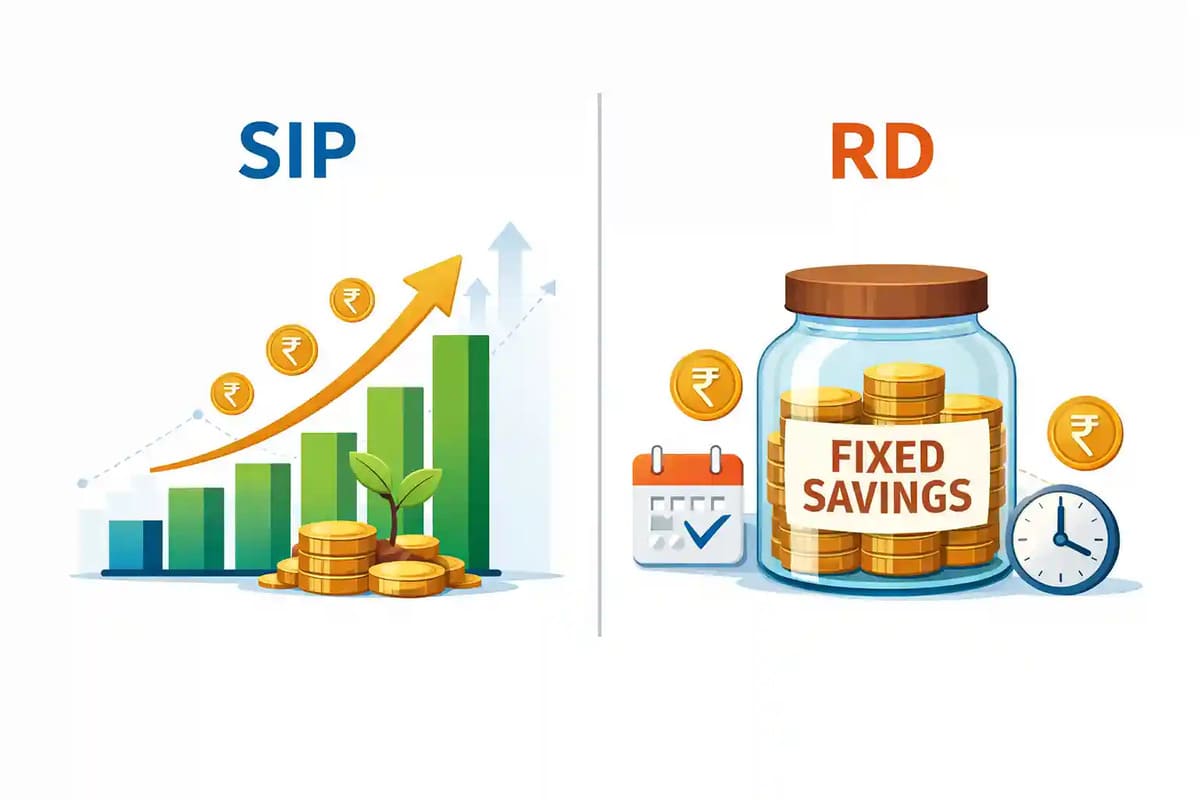
SIP vs RD: Which One Actually Builds Wealth in India?
A few years ago, one of my cousins asked me a question that I still think about: “I have ₹5,000 spare every month. Should I just put it in an RD like my father always did, or start an SIP like my colleagues keep talking about?”
It’s a fair question, and it’s one of the most important financial habits almost every salaried Indian eventually has to figure out. Both options ask you to do the same thing — set aside a fixed amount every month — but they take your money down completely different roads. One hands it to a bank that promises a fixed return. The other hands it to the stock market, which promises nothing but has historically delivered a lot more.
This guide walks through both options honestly — not as “SIP good, RD bad” propaganda, but as a real comparison with numbers, risk, taxation, and a bit of common sense about who each one actually suits.
What is an SIP?
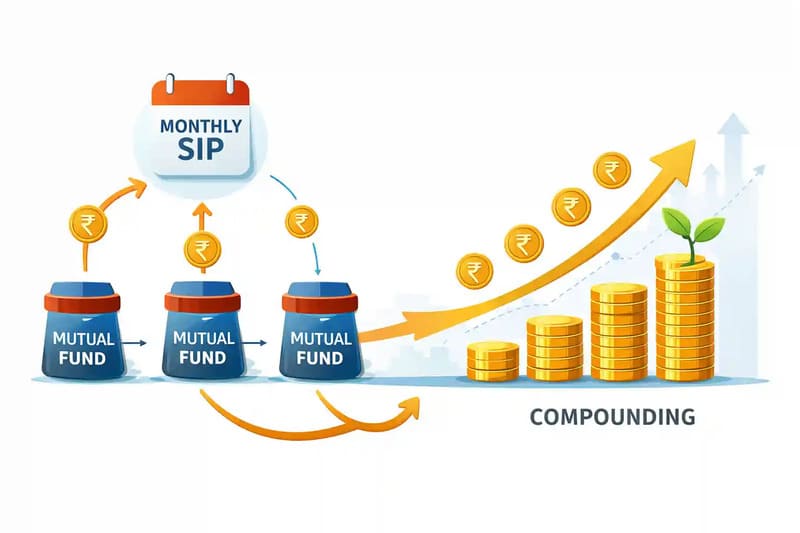
A Systematic Investment Plan, or SIP, isn’t a product by itself — it’s just a way of buying into a mutual fund, regulated under AMFI guidelines. Instead of writing one large cheque, you commit to investing a fixed sum every month, and that money goes into units of whichever mutual fund scheme you’ve chosen — equity, debt, or a mix of both.
The appeal isn’t complicated. Most people don’t have a spare lakh sitting around to invest in one go, and even if they did, timing the market with a lump sum is genuinely hard — even for professionals. An SIP sidesteps that problem entirely. You invest the same amount on the same date every month, regardless of whether the market went up 3% or fell 4% the week before.
What makes SIPs work in practice:
- You can start with as little as ₹500 a month — there’s no real barrier to entry
- Your money can go into equity funds, debt funds, or hybrid funds depending on your risk appetite
- Returns move with the market, so there’s no fixed promise — but historically, well-chosen equity funds have delivered strong long-term growth
- It builds a habit. Once the auto-debit is set up, investing stops being a decision you make every month and just becomes something that happens
- You benefit from both compounding and something called rupee cost averaging (more on that shortly)
Here’s a simple way to picture it: if you set up an SIP of ₹5,000 a month in an equity fund, that money buys fund units every month — sometimes at a high price, sometimes at a low one. Over 10-15 years, the ups and downs tend to average out, and the underlying growth of the businesses you’re invested in does the heavy lifting.
What is a Recurring Deposit (RD)?
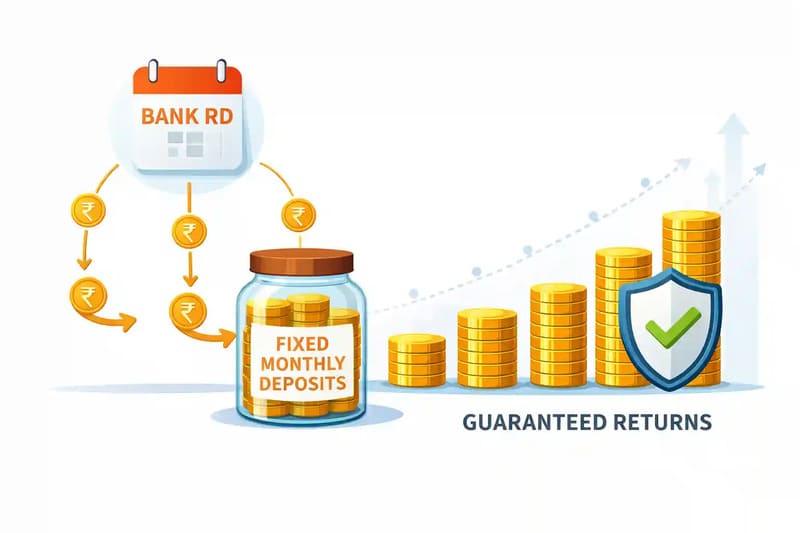
A Recurring Deposit is the older, more familiar cousin — the one your parents probably used. It’s offered by banks and post offices, and the mechanics are dead simple: you deposit a fixed amount every month for a fixed tenure, and the bank pays you a pre-agreed rate of interest on it.
There’s no ambiguity with an RD. You know on day one exactly what you’ll get on the last day. That certainty is the entire selling point.
What makes RDs work in practice:
- Fixed monthly contribution, no surprises
- Interest rate is locked in when you open the account, even if rates in the broader market change later
- Tenures range from as short as 6 months to as long as 10 years
- Capital is effectively risk-free — banks are covered under deposit insurance up to ₹5 lakh per depositor per bank
- Ideal if you genuinely cannot stomach seeing your investment value dip, even temporarily
As of mid-2026, most large banks are offering RD rates somewhere between 6% and 7.3% depending on tenure, and the Post Office recurring deposit scheme has been holding steady around 6.7% for regular citizens, with slightly better rates for senior citizens. These numbers move a little every quarter as the RBI adjusts policy, so it’s worth checking your bank’s current rate sheet before opening one — but the range gives you a realistic ballpark.
If you put away ₹5,000 a month into an RD for 5 years at roughly 6.5%, you’d know almost to the rupee what you’re getting at maturity, with zero exposure to market swings.
SIP vs RD: Quick Comparison Table
| Feature | SIP | RD |
| Underlying asset | Mutual fund units (market-linked) | Bank/post office deposit (fixed income) |
| Risk level | Moderate to high, depending on fund type | Very low, near risk-free |
| Typical long-term return | 10–14% annually (equity funds, not guaranteed) | 6–7.3% annually (fixed, guaranteed) |
| Inflation protection | Generally yes, over 10+ years | Weak — often barely keeps pace |
| Best suited for | Long-term wealth creation | Short-term safety and predictability |
| Tax treatment | LTCG on equity funds taxed at 12.5% above ₹1.25 lakh/year; ELSS gets 80C benefit | Interest is fully taxable at your income slab rate |
| Flexibility | Can pause, increase, decrease, or stop anytime | Locked structure; premature withdrawal usually attracts a penalty |
| Minimum investment | As low as ₹500/month | As low as ₹100/month |
How the Numbers Actually Play Out (₹5,000/month, 15 Years)
Comparison tables are useful, but nothing makes the difference land like actual rupee figures. So let’s run the same ₹5,000-a-month commitment through both instruments over a 15-year stretch.
The assumptions:
- Monthly investment: ₹5,000
- Time horizon: 15 years
- SIP: assumed average annual return of 12% (a reasonable long-term historical figure for diversified equity funds — not guaranteed, and returns will genuinely bounce around year to year)
- RD: assumed interest rate of 6.5% (roughly the current market average, compounded quarterly)
Total amount you actually put in either way: ₹9,00,000 (₹5,000 × 12 × 15)
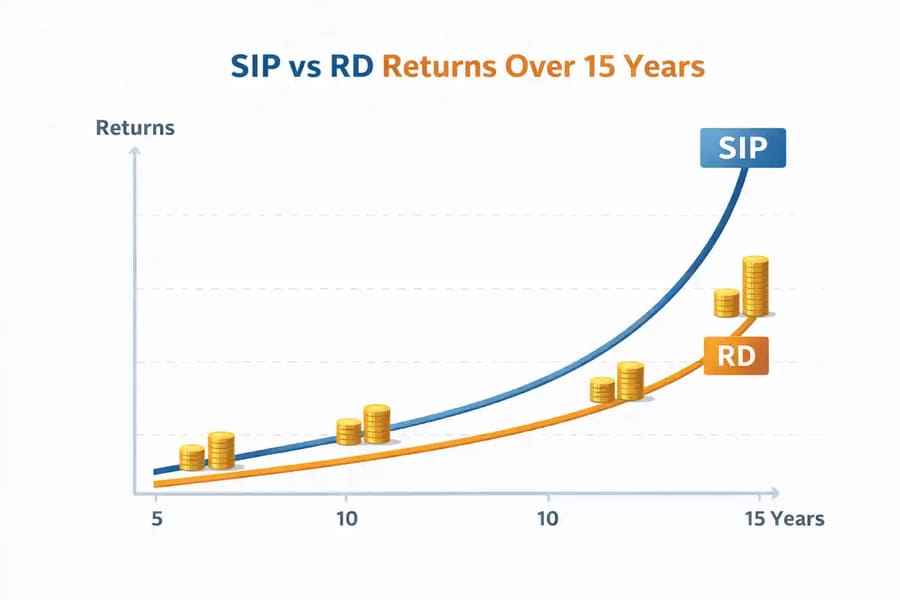
Where the SIP lands: Somewhere in the ₹25–30 lakh range at maturity, depending on how the market actually performed during those 15 years.
Where the RD lands: Roughly ₹13–14 lakh at maturity — a fixed, near-certain number.
That’s a gap of over ₹12 lakh on the exact same monthly commitment. It’s not because SIPs are magic — it’s because equity, over long stretches, has historically grown faster than the interest banks are willing (or able) to pay on deposits. The catch, and it’s a real one, is that the SIP number isn’t guaranteed. In a bad 15-year window, it could land lower. In a strong one, it could land considerably higher. The RD number, on the other hand, barely moves regardless of what happens in the world.
Why SIPs Tend to Win Over the Long Run
Compounding does more work the longer you leave it alone
Every rupee your SIP earns has the chance to earn its own return the following year, and that snowballs. In the early years, the effect is barely noticeable — you might look at your SIP after 3 years and feel like it’s grown slower than an RD would have. That’s normal. Compounding is famously unimpressive in year 3 and startling in year 15. The mistake most people make is judging an SIP’s performance too early and bailing out before compounding has had a chance to do anything meaningful.
Your money grows with the economy, not against a fixed number
An RD pays you whatever rate the bank quoted on day one, and that number is disconnected from how the country’s businesses are actually doing. An equity SIP, by contrast, owns a small slice of real companies — and as those companies grow revenue, expand, and become more profitable, the value of your holding tends to rise with them. Over a business cycle, this connection to real economic growth is what gives equity its long-term edge over a fixed-rate product.
Rupee cost averaging quietly works in your favour
Because you’re investing the same ₹5,000 every month regardless of the market’s mood, you automatically buy more fund units when prices are down and fewer when prices are up. You never have to guess whether “now” is a good time to invest — the discipline of a fixed monthly SIP does that guessing for you, and over time it tends to smooth out your average purchase cost.
Risk: What You’re Really Signing Up For
SIP risk, honestly stated
Let’s not sugarcoat it — SIPs can and do show negative returns in the short term. If you check your SIP’s value six months after starting it during a market downturn, you might see less than you put in. That’s real, and it happens to everyone who invests in equity, not just unlucky beginners.
What history does show, though, is that the longer the holding period, the smaller the chance of ending up in the red. Over rolling 10-15 year periods, diversified equity funds in India have rarely delivered negative returns — though “rarely” isn’t the same as “never,” and past performance is genuinely not a promise of future results.
RD risk, honestly stated
There’s almost none, in the conventional sense. Your principal is safe, your interest rate is locked, and short of the bank itself collapsing (which is why deposit insurance limits matter), you’re not going to lose money. The real risk with an RD is quieter and less obvious — it’s the risk of your money technically “growing” while actually losing purchasing power. More on that next.
Inflation — The Silent Deal-Breaker
This is the part most people skip past, and it’s arguably the most important section in this entire article — because saving alone isn’t the same as growing wealth.
Say inflation is running at roughly 6% a year, and your RD is paying you 6.5%. On paper, you’re earning a positive return. In reality, your real return — what your money can actually buy after accounting for rising prices — is close to zero. You’ve saved diligently for years and, in terms of actual purchasing power, barely moved forward.
This is exactly why RDs are described as “safe” rather than “wealth-building.” They protect your principal from market losses, but they don’t reliably protect your money’s value from inflation. Equity-oriented SIPs, over long periods, have historically outpaced inflation by a meaningful margin — which is the difference between preserving money and actually growing it in real terms.
Taxation: SIP vs RD
Tax rules matter more than people give them credit for, because a great pre-tax return can turn mediocre once the tax department takes its share.
SIP taxation:
- Gains from equity mutual funds are treated as capital gains, not regular income
- Long-term capital gains (units held over 1 year) are taxed at 12.5% on gains above ₹1.25 lakh in a financial year, per current income tax rules
- ELSS (Equity Linked Savings Scheme) funds go a step further — they qualify for a deduction of up to ₹1.5 lakh under Section 80C, on top of everything else
RD taxation:
- Every rupee of interest you earn is fully taxable, added to your total income, and taxed at your income slab rate — 20% or 30% if you’re in a higher bracket
- Banks deduct TDS if your interest crosses ₹40,000 in a year (₹50,000 for senior citizens)
- There’s no special exemption or lower rate for RD interest, the way there is for long-term equity gains
For most salaried investors in the 20-30% tax bracket, this alone tilts the scale further toward SIPs for long-term money — you’re not just earning more, you’re keeping more of what you earn.
A Real-World Example: The 30-Year-Old Earning ₹40,000
Let’s make this concrete with a person rather than a spreadsheet.
Meet a 30-year-old software tester earning ₹40,000 a month in Pune. After rent, groceries, and the usual monthly leaks, she has ₹5,000 she can commit without stress. She’s weighing the same choice as everyone else — RD or SIP.
If she chooses RD:
By the time she’s 45, she’ll have a guaranteed corpus of roughly ₹13-14 lakh, assuming rates stay similar to today’s. It’s safe, it’s predictable, and she’ll sleep fine.
If she chooses SIP:
In an index fund or diversified equity fund, that same ₹5,000 could realistically grow to ₹25-30 lakh over the same 15 years — nearly double, though with real ups and downs along the way, including at least a couple of years where the value on her app screen dips and makes her nervous.
For a goal that’s 15-20 years away — retirement, a child’s education, a house down payment — the SIP route has historically done far more of the heavy lifting. For a goal that’s 2-3 years away, where she can’t afford a bad market year right before she needs the money, RD (or something similarly safe) makes a lot more sense. The right answer genuinely depends on the timeline, not on which product sounds more exciting.
Who Should Pick SIP?
SIPs tend to suit:
- Young professionals with 10+ years before they’ll actually need the money
- Anyone building toward retirement, a child’s future education, or long-term wealth rather than a near-term expense
- People who can tolerate seeing their portfolio dip temporarily without panicking and exiting
- Investors who’d rather grow their money faster than protect every last rupee at all costs
Who Should Pick RD?
RDs tend to suit:
- Conservative investors who genuinely lose sleep over market volatility — and that’s a legitimate reason, not a weakness
- Short-term goals, typically under 3 years, where you can’t afford a downturn right before you need the cash
- Emergency fund building, where certainty matters more than growth
- Senior citizens looking to keep a portion of savings completely safe, even if it’s not their entire portfolio
Can You Do Both? (Yes — Here’s How)
This isn’t really an either/or decision, and treating it that way is probably the biggest misconception people carry into this topic. Most experienced investors run both, just for different jobs.
A workable split looks something like this: keep 3-6 months of expenses in something safe and liquid — an RD or a similar instrument — as your emergency cushion. Then direct everything else meant for long-term goals into SIPs. The RD protects you from short-term shocks (a job loss, a medical bill, an unexpected repair), while the SIP quietly compounds in the background for the goals that are still 10-15 years out.
Think of it less as “SIP vs RD” and more as “SIP for growth, RD for the ground floor.” One gives you a safety net; the other gives you a reason to actually get ahead.
Mistakes People Make With Both
A few patterns show up again and again, and they’re worth naming plainly:
- Choosing RD purely out of fear, without actually calculating what that fear is costing you in lost long-term growth
- Expecting SIP returns in 2 years — equity needs time, and judging it on a short window is like judging a marathon runner at the 500-metre mark
- Stopping an SIP the moment the market falls — this is usually the worst possible moment to stop, since it’s precisely when your money is buying units cheap
- Ignoring inflation entirely when comparing “safe” returns against “risky” ones
- Investing without a defined goal or timeline, which makes it impossible to know whether SIP or RD (or both) is even the right tool for the job
Final Verdict: SIP vs RD — Which Is Better in the Long Term?
If the goal is genuine long-term wealth creation — ten years or more, inflation-beating growth, and you can handle short-term ups and downs without losing sleep — SIP is the stronger long-term tool, and the numbers in this article back that up fairly clearly.
If the goal is safety, certainty, or a short timeline where you can’t risk a bad market year, RD remains a perfectly sound choice — it’s just not designed to build wealth the way SIP is.
The honest answer for most people isn’t “pick one.” It’s “use RD for what’s near and certain, and use SIP for what’s far and worth growing.”
If you’re still figuring out how to fit either of these into a monthly budget, it might help to first work out where your money is actually going — our guide on planning a monthly budget on a ₹30,000 salary is a good place to start before you commit to either.
Frequently Asked Questions
Q1. Is SIP better than RD for long-term investment?
ANS – For horizons of 10 years or more, yes, generally — SIPs in equity mutual funds have historically delivered higher returns thanks to compounding and market growth, though this isn’t guaranteed the way RD returns are.
Q2. Can SIP give negative returns?
ANS – Yes, especially over short periods. A market downturn can leave your SIP value below what you’ve invested. Over longer horizons (10-15 years), the odds of a negative outcome have historically been much lower, but it’s not impossible.
Q3. Is RD safer than SIP?
ANS – Yes, unambiguously. RD returns are fixed and guaranteed by the bank, with your principal protected. SIP returns depend entirely on market performance.
Q4. Can I stop my SIP anytime?
ANS – Yes. SIPs are flexible — you can pause, reduce, increase, or stop them whenever you like, without the kind of penalty an RD typically charges for early closure.
Q5. What’s the minimum amount needed to start an SIP or RD?
ANS – SIPs can usually be started with as little as ₹500 a month, and RDs with as little as ₹100 a month, though this varies slightly by fund house or bank.
Final Thoughts
Neither SIP nor RD is the “correct” answer on its own — they’re built for different jobs, and the smartest investors usually end up using both at different points in their financial life. What actually separates people who build wealth from people who don’t isn’t which product they picked. It’s whether they started early, stayed consistent when the market got uncomfortable, and kept their eyes on the long game instead of reacting to every monthly statement.
Start early. Stay consistent. Think in decades, not months.
Disclaimer: This article is for educational purposes only and does not constitute financial or investment advice. Interest rates, fund performance, and tax rules mentioned here are indicative and subject to change — please verify current figures with your bank or fund house, and consult a qualified financial advisor before making investment decisions.
.About the Author: Shilpesh Rathod is the founder of All Finance Knowledge. He holds a B.Com degree along with JAIIB and CAIIB banking certifications, and brings 19+ years of experience in the banking sector across savings, investments, and financial planning.

Shilpesh Rathod is the founder of All Finance Knowledge. He holds a B.Com degree along with JAIIB and CAIIB banking certifications, and brings 19+ years of experience in the banking sector across savings, investments, and financial planning. Read more: https://allfinanceknowledge.com/about-us/
8 thoughts on “SIP vs RD: Which One Actually Builds Wealth in India? (2026 Guide)”