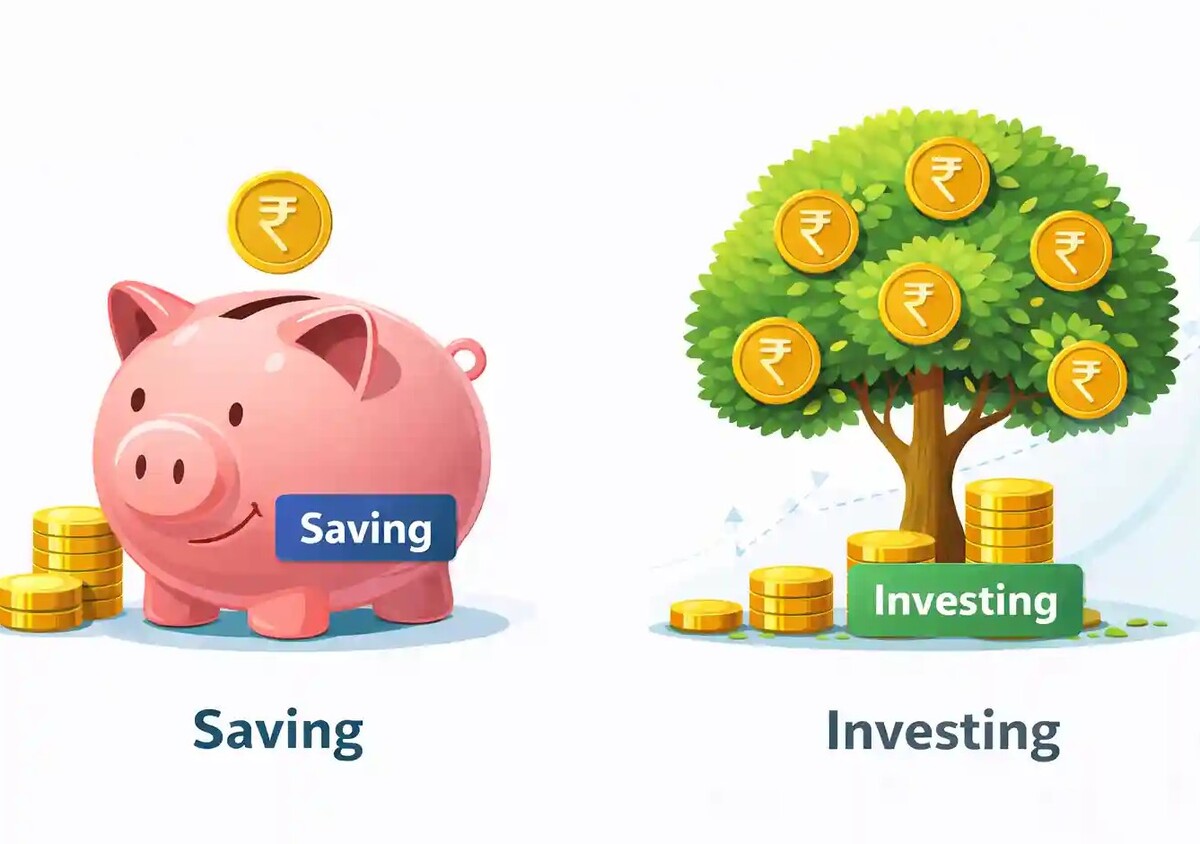
“Saving vs Investing” is one of the most important financial concepts every beginner must understand.
From childhood, we are taught to save money for future needs. While saving is a good habit and provides financial safety, saving alone is no longer enough in today’s economy.
With rising inflation and increasing living costs, money kept in savings accounts or fixed deposits may not grow enough to meet future goals. In fact, if you only save and do not invest, your money may lose real value over time.
In this article, you will learn:
- What saving and investing mean
- Key differences between saving and investing
- Why saving alone is not enough
- How inflation affects your money
- How beginners can start investing safely
- The right balance between saving and investing
What Is Saving Money?
Saving means setting aside a portion of your income and keeping it in safe and easily accessible places.
Common saving options include:
- Savings accounts
- Fixed deposits (FDs)
- Recurring deposits (RDs)
- Cash reserves
Benefits of Saving
Saving plays a very important role in financial planning:
✔ Helps handle emergencies
✔ Prevents unnecessary borrowing
✔ Provides financial security
✔ Supports short-term goals
For example, having savings can help you manage unexpected expenses like medical emergencies, repairs, or job loss.
However, saving has one major limitation:
👉 It does not significantly grow your money.
Why Saving Alone Is Not Enough
Saving is important—but depending only on saving can limit your financial growth.
Let’s understand why.
1️⃣ Impact of Inflation
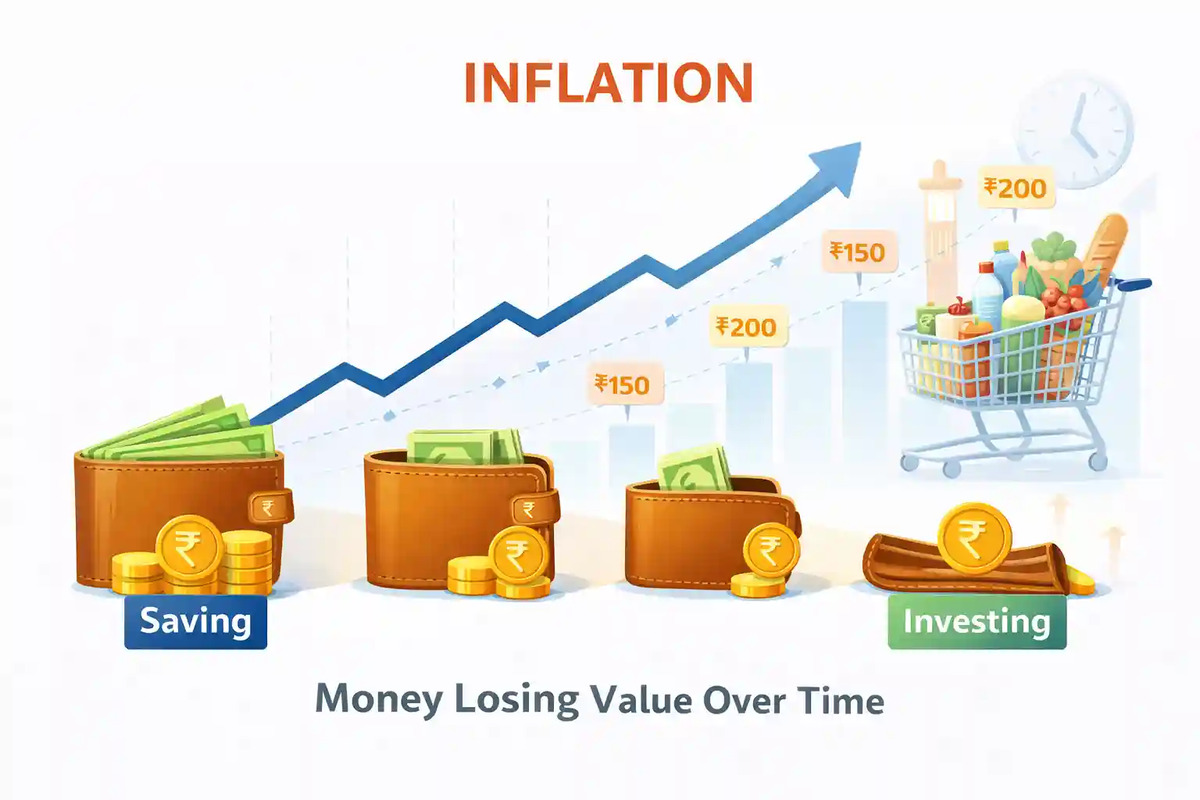
Inflation is the increase in prices over time, which reduces the purchasing power of money.
Example:
- Savings interest: 3%
- Inflation: 6%
If you save ₹1,00,000:
- After 1 year → ₹1,03,000
- But real value decreases due to higher prices
👉 This means your money is losing value in real terms.
2️⃣ Low Returns
Savings accounts, FDs, and RDs offer low interest rates, usually between 3%–7%.
These returns are often lower than inflation, which means your money is not growing effectively.
3️⃣ Missed Compounding Opportunity
Compounding is one of the most powerful tools for wealth creation.
When you only save:
- You earn simple or fixed interest
- Your money does not grow exponentially
When you invest:
- Returns generate additional returns
- Wealth grows faster over time
4️⃣ Delayed Financial Goals
Without investing, it becomes difficult to achieve major goals like:
- Buying a house
- Retirement planning
- Children’s education
Saving alone may not be enough to meet these goals within a reasonable time.
5️⃣ False Sense of Security
Having money in your bank account feels safe, but:
👉 Its real value keeps decreasing due to inflation
This creates a false sense of financial security.
What Is Investing and How It Works
Investing means putting your money into financial assets with the goal of growing it over time.
Common investment options include:
- Mutual funds
- SIP (Systematic Investment Plan)
- Stocks
- Bonds
- Real estate
How Investing Works
When you invest:
- Your money is used to generate returns
- Returns are reinvested
- Over time, compounding increases your wealth
Benefits of Investing
✔ Higher return potential
✔ Beats inflation
✔ Builds long-term wealth
✔ Helps achieve financial goals
Saving vs Investing: Key Differences
| Factor | Saving | Investing |
|---|---|---|
| Risk | Very low | Moderate to high |
| Returns | Low | Higher (long-term) |
| Inflation Protection | Poor | Better |
| Purpose | Safety | Wealth creation |
| Time Horizon | Short-term | Long-term |
The above key differences of saving vs investing are explained based on different factors
Why Investing Is Necessary Today
Modern financial needs are increasing:
- Education costs are rising
- Healthcare expenses are high
- Retirement periods are longer
Saving alone cannot handle these challenges.
👉 Investing helps you:
✔ Build wealth
✔ Stay financially independent
✔ Beat inflation
✔ Achieve long-term goals
Real-Life Example: Saving vs Investing
Let’s compare two individuals:
Person A (Saver)
- Saves ₹5,000 per month in RD
- Earns fixed returns
- Limited wealth growth
Person B (Investor)
- Invests ₹5,000 per month through SIP
- Benefits from compounding
- Builds larger corpus over time
👉 After 15–20 years:
- Person A struggles to beat inflation
- Person B builds significant wealth
Real-Life Example: Saving vs Investing
Let’s compare two individuals:
Person A (Saver)
- Saves ₹5,000 per month in RD
- Earns fixed returns
- Limited wealth growth
Person B (Investor)
- Invests ₹5,000 per month through SIP
- Benefits from compounding
- Builds larger corpus over time
👉 After 15–20 years:
Person B builds significant wealth
Person A struggles to beat inflation
Can Beginners Invest Safely?
Yes, beginners can invest safely by starting with simple and low-risk options.
Beginner-Friendly Investment Options
- SIP in index funds
- Large-cap mutual funds
- Hybrid funds
These options are easier to understand and less risky compared to direct stock investing.
In India, mutual funds are regulated by the Securities and Exchange Board of India, ensuring transparency and investor protection.
How to Balance Saving and Investing
The goal is not “saving vs investing” but:
👉 Saving + Investing together
Ideal Strategy
- Build an emergency fund (3–6 months expenses)
- Save for short-term needs
- Invest for long-term goals
- Use SIP for disciplined investing
When Should You Save vs When Should You Invest?
Understanding when to save and when to invest is the key to building a strong financial foundation. Both are important, but they serve different purposes.
When Should You Focus on Saving?
Saving is essential when your priority is safety and liquidity. You should focus more on saving in the following situations:
- When you are building an emergency fund (3–6 months of expenses)
- When you have short-term goals (less than 2–3 years), such as travel, gadgets, or small purchases
- During job uncertainty or unstable income
- When you need quick access to money without risk
In these cases, saving protects you from financial stress and helps you avoid unnecessary debt.
When Should You Focus on Investing?
Investing becomes important when your goal is long-term growth and wealth creation. You should focus on investing when:
- You have already built an emergency fund
- Your goals are long-term (5+ years), such as retirement, buying a house, or children’s education
- You want to beat inflation and grow your money
- You are ready to take calculated and moderate risk
Investing allows your money to grow through compounding, which is not possible with traditional saving methods.
The Smart Approach: Balance Both
The best strategy is not choosing one over the other—but using both wisely.
A simple rule you can follow:
👉 Save for safety
👉 Invest for growth
For example, you can:
- Save a portion of your income for emergencies
- Invest the remaining amount through SIP or other options
This balanced approach ensures that you are financially secure in the short term and financially strong in the long term.
💡 Key takeaway: Saving protects your money, but investing multiplies it. To achieve financial success, you need both working together.
Common Myths About Investing
Many beginners avoid investing due to myths:
❌ Investing is too risky
❌ You need a lot of money
❌ The stock market is gambling
Reality:
✔ Long-term investing reduces risk
✔ You can start with small amounts
✔ Disciplined investing builds wealth
Mistakes to Avoid
Avoid these common mistakes:
❌ Only saving without investing
❌ Starting investment without an emergency fund
❌ Expecting quick returns
❌ Stopping investment during market fall
Simple Plan for Beginners
If you are just starting:
- Track your income and expenses
- Save 20–30% of your income
- Build an emergency fund
- Start SIP with a small amount
- Increase investment gradually
Final Thoughts: Saving vs Investing
Saving and investing are both important—but they serve different purposes.
- Saving gives you security
- Investing gives you growth
In today’s economy, saving alone is not enough to build wealth.
👉 The smartest approach is:
✔ Save for safety
✔ Invest for growthIf you want financial stability and long-term success, learning to invest is no longer optional—it is essential.
Frequently Asked Questions (FAQs)
Q1-Why is saving money not enough today?
Ans-Saving alone cannot beat inflation, which reduces the value of money over time.
Q2. What is the main difference between saving and investing?
Ans-Saving protects money, while investing helps grow money over the long term.
Q3. Is investing risky for beginners?
Ans-Basic investing, like SIPs in mutual funds, is relatively safe for long-term goals.
Q4. How much should I save before investing?
Ans: You should save at least 3–6 months of expenses as an emergency fund before investing.
Q5. Can I save and invest at the same time?
Ans-Yes, a balanced approach of saving for safety and investing for growth is ideal.
Disclaimer: This article is for educational purposes only and does not constitute financial advice. Please consult a qualified financial advisor before making any investment decisions.
4 thoughts on “Saving vs Investing: Why Saving Money Alone Is Not Enough Today”