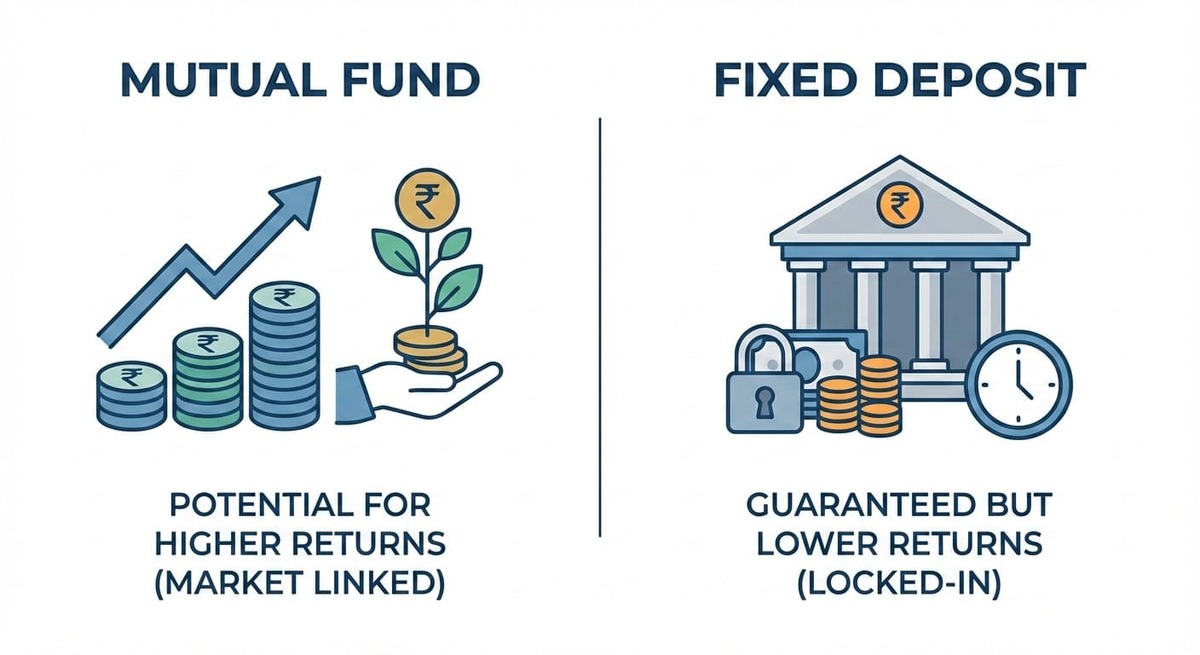
Investing is one of the most important financial decisions you make, especially when you are just starting your financial journey. For beginners in India, the most common confusion is choosing between Mutual Funds and Fixed Deposits (FDs). Both options are popular, trusted, and widely used. But they serve different purposes. In this article, we will explain Mutual Fund vs FD in simple language, compare them on key factors, and help beginners decide which option suits them best.
Choosing the wrong investment option can cost you lakhs in lost returns over time.
What Is a Fixed Deposit (FD)?
A Fixed Deposit is a traditional investment option offered by banks and NBFCs where you deposit a lump sum for a fixed period at a predetermined interest rate.
Key Features of FD:
- Fixed and guaranteed returns
- Low risk
- Tenure ranges from 7 days to 10 years
- Interest rate usually between 5%–7.5%
FDs are ideal for people who want safety and stability.
What Is a Mutual Fund?
A Mutual Fund pools money from many investors and invests it in assets like stocks, bonds, or a mix of both. It is managed by professional fund managers.
Key Features of Mutual Funds:
- Returns depend on market performance
- Higher return potential than FD
- Suitable for long-term goals
- Can start with SIP as low as ₹500
Mutual funds are ideal for wealth creation.
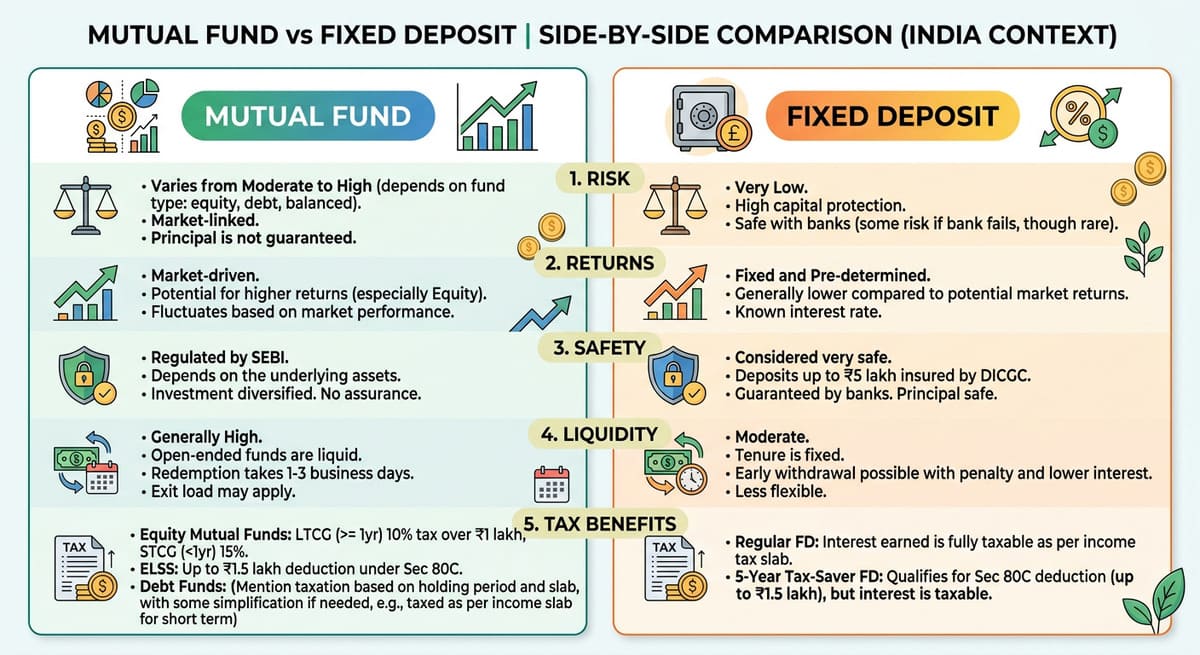
Mutual Fund vs FD: Detailed Comparison
| Factor | Fixed Deposit | Mutual Fund |
|---|---|---|
| Risk | Very Low | Low to High (depends on type) |
| Returns | 5%–7.5% | 8%–14% (long term average) |
| Safety | Very High | Market-linked |
| Inflation Protection | Poor | Better |
| Liquidity | Medium | High (open-ended funds) |
| Tax Efficiency | Low | Better (ELSS, LTCG) |
| Beginner Friendly | Yes | Yes (with SIP) |
“Mutual funds and fixed deposits differ in risk, returns, and flexibility.”
🔹 Mutual Fund vs FD: Real-Life Example
Let’s understand the difference with a simple example.
Scenario:
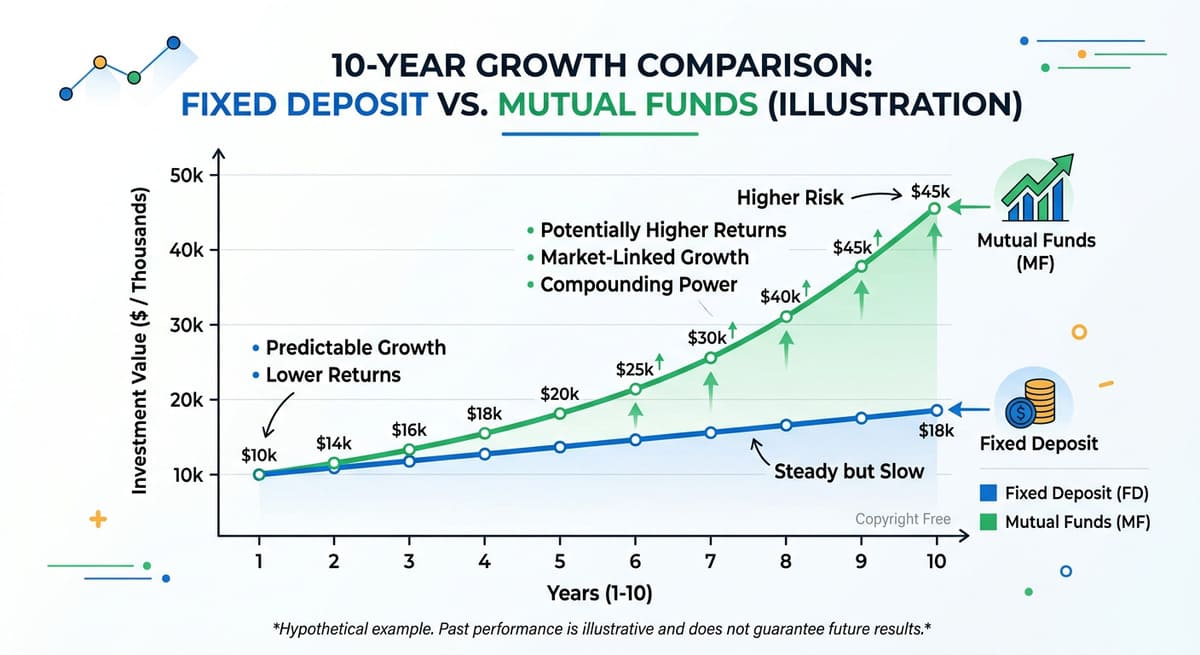
Ravi invests ₹1,00,000 in a Fixed Deposit at 6.5% for 10 years.
At the same time, Suresh invests ₹1,00,000 in a mutual fund with an average return of 12%.
After 10 Years:
- Ravi (FD) → लगभग ₹1.87 lakh
- Suresh (Mutual Fund) → लगभग ₹3.10 lakh
📌 Even though both invested the same amount, the difference comes from compounding and higher returns.
👉 This clearly shows why mutual funds are better for long-term wealth creation.
🔹 Types of Mutual Funds for Beginners
Many beginners think mutual funds are risky—but choosing the right type reduces risk significantly.
1. Equity Mutual Funds
- Invest in stocks
- Higher returns (long term)
- Suitable for 5+ years
2. Debt Mutual Funds
- Invest in bonds
- Lower risk than equity
- Suitable for short to medium term
3. Hybrid Funds
- Mix of equity + debt
- Balanced risk and return
4. Index Funds (Best for Beginners)
- Track Nifty/Sensex
- Low cost
- Stable performance
📌 Beginners should start with index or large-cap funds via SIP.
🔹 Advantages of Fixed Deposits
Even though mutual funds are popular, FDs still have strong benefits.
✔ Capital Safety
Your money is safe (especially in reputed banks)
✔ Guaranteed Returns
You know exactly how much you will earn
✔ No Market Stress
No ups and downs like the stock market
✔ Simple to Understand
Perfect for beginners or senior citizens
🔹 Advantages of Mutual Funds
Mutual funds are powerful for long-term investors.
✔ Higher Return Potential
Beats FD returns over time
✔ Inflation Protection
Helps your money grow in real terms
✔ Professional Management
Experts manage your investments
✔ Flexibility
Start small, invest regularly, withdraw anytime
🔹 Disadvantages You Should Know
❌ Fixed Deposit Disadvantages
- Returns may not beat inflation
- Fully taxable interest
- Limited growth
❌ Mutual Fund Disadvantages
- Market risk involved
- Returns are not guaranteed
- Requires patience and discipline
📌 Understanding both sides helps you make better decisions.
🔹 Inflation: The Hidden Factor
Many beginners ignore inflation.
Example:
- FD return = 6%
- Inflation = 6%
👉 Real return = 0%
📌 Your money is not actually growing.
Mutual funds, on the other hand, can generate real positive returns over time.
🔹 When Should You Choose FD?
FD is better when:
- You need money in the short term (1–3 years)
- You cannot take any risk
- You want guaranteed returns
- You are building an emergency fund
🔹 When Should You Choose Mutual Funds?
Mutual funds are better when:
- Your goal is 5+ years away
- You want wealth creation
- You can handle small market fluctuations
- You want to beat inflation
🔹 Common Beginner Mistakes
Avoid these mistakes:
❌ Investing everything in FD
→ Leads to low growth
❌ Avoiding mutual funds due to fear
→ Missing long-term wealth
❌ Expecting quick returns from mutual funds
→ Leads to disappointment
❌ Stopping SIP during market fall
→ Breaks compounding
📌 Smart investors stay consistent.
🔹 Step-by-Step Guide for Beginners
If you are confused, follow this simple plan:
Step 1:
Keep 3–6 months expenses in FD or savings account
Step 2:
Start SIP in mutual fund (₹500–₹2000/month)
Step 3:
Increase investment as income grows
Step 4:
Stay invested for long term (10–20 years)
Returns: Mutual Fund vs FD
FD Returns:
FD returns are predictable but often fail to beat inflation. This means your money may lose purchasing power over time.
Mutual Fund Returns:
Over long periods, mutual funds (especially equity funds) have historically delivered higher returns, helping investors beat inflation.
👉 For long-term goals like retirement or children’s education, mutual funds perform better.
“Mutual funds have higher growth potential compared to fixed deposits.”
Risk: Which Is Safer for Beginners?
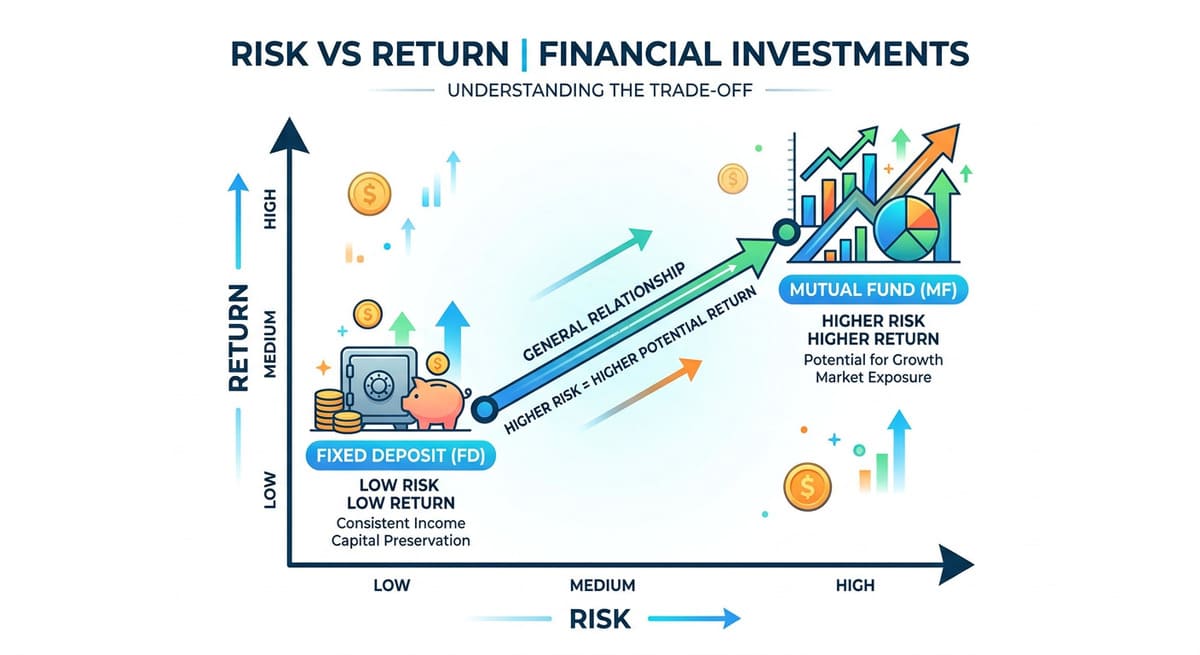
- FD: Almost zero risk (bank-backed)
- Mutual Fund: Risk varies by type
Beginner-Friendly Mutual Funds:
- Index Funds
- Large-cap Funds
- Balanced Funds
These options are relatively stable and suitable for beginners.
“Higher returns usually come with higher risk in investments.”
Taxation: Mutual Fund vs FD
FD Taxation:
- Interest is fully taxable
- Added to your income slab
- No tax benefit (except 5-year tax-saving FD)
Mutual Fund Taxation:
- Equity mutual funds: Tax-efficient
- Long-term capital gains taxed at 10% above ₹1 lakh
- ELSS offers Section 80C tax benefit
Time Horizon: Short Term vs Long Term
- Short-term (1–3 years): FD is better
- Long-term (5+ years): Mutual fund is better
Beginners should match investment choice with goals.
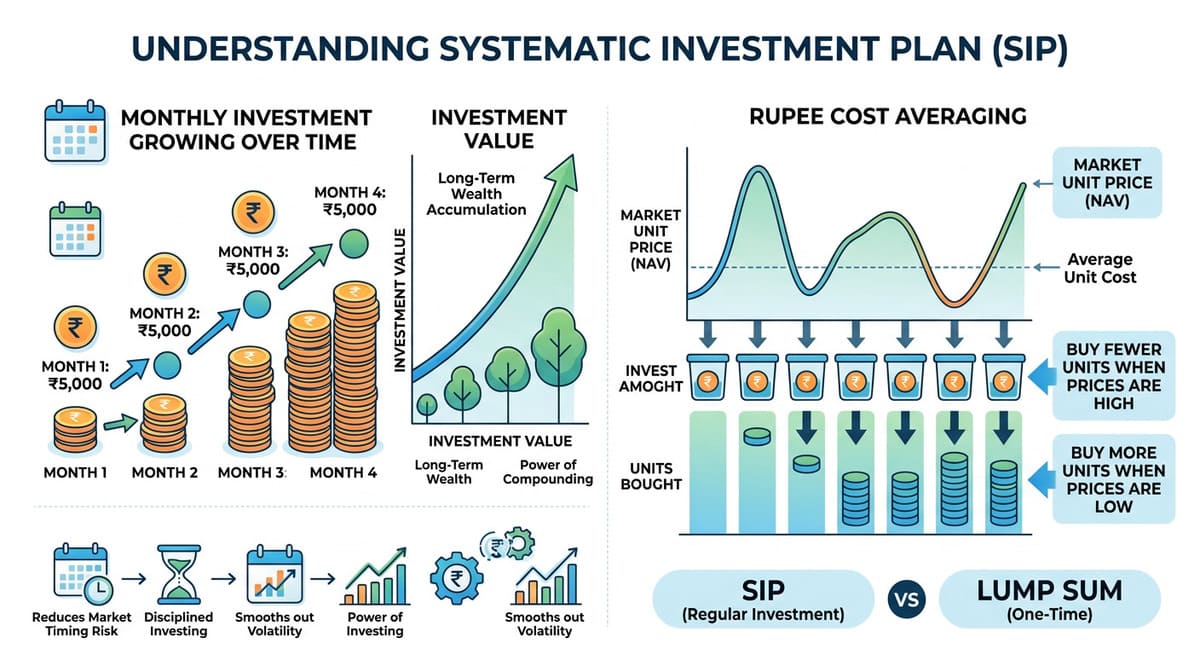
SIP vs Lump Sum FD
A Systematic Investment Plan (SIP) allows beginners to invest small amounts regularly.
Benefits of SIP:
- Disciplined investing
- Rupee cost averaging
- No need to time the market
This makes mutual funds less risky for beginners.
“SIP helps beginners invest regularly and reduce market timing risk.”
Which Is Better for Beginners?
Choose FD if:
✔ You want guaranteed returns
✔ You need money in the short term
✔ You are very risk-averse
Choose Mutual Fund if:
✔ You want higher returns
✔ You have long-term goals
✔ You want to beat inflation
👉 Best strategy: Use FD for safety and Mutual Fund for growth.
Smart Beginner Strategy (Recommended)
- Emergency fund → FD or savings account
- Long-term wealth → Mutual fund SIP
- Tax saving → ELSS mutual fund
This balanced approach reduces risk and increases returns.
Frequently Asked Questions ( Mutual Fund Vs FD)
Q1. Is mutual fund safe for beginners?
Yes, especially index funds and large-cap funds when invested long term.
Q2. Which gives better returns, FD or mutual fund?
Mutual funds generally give higher returns over the long term.
Q3. Can beginners invest in mutual funds monthly?
Yes, through SIP starting from as low as ₹500
Q4. Is FD better than mutual fund?
FD is safer, but mutual funds are better for wealth creation.
Q5. Should beginners invest in both?
Yes, combining both provides safety and growth
Q6. Can I lose money in mutual funds?
Yes, in the short term, but long-term risk is lower.
Q7. Is FD 100% safe in India?
Mostly safe, but insured up to ₹5 lakh per bank.
Q8. Which is better for monthly income?
FD is better for stable income, mutual funds for growth.
🔹 Mutual Fund vs FD: Final Verdict
There is no “one best option” — it depends on your goal.
- FD = Safety + Stability
- Mutual Fund = Growth + Wealth Creation
👉 The smartest strategy is to use both wisely.
Disclaimer- This article is for educational purposes only and does not constitute financial advice. Investment decisions should be made based on individual goals and risk tolerance.
1 thought on “Mutual Fund vs FD: Which Is Better for Beginners?”