
Most people start investing in one of two ways. Either a friend whispers a “hot tip” and they buy a stock they barely understand, or they open a demat account, stare at hundreds of options, and never buy anything. Both lead to the same place: no plan, no confidence, and results that depend on luck.
A stock market portfolio solves this. It turns scattered investing decisions into one organised plan that matches your goals, your timeline, and your comfort with risk.
This guide explains what a portfolio is, why it matters, and how to build one from scratch, even if you have never bought a share. You will get worked examples, sample allocations, a stock-selection checklist, tax basics, and the mistakes that hurt most beginners. If you are completely new to money management, start with our beginner’s guide on what is personal finance, then come back here.
Quick Takeaways
- A portfolio is a mix of investments (stocks, mutual funds, ETFs, bonds, gold) chosen to work together, not just a pile of stocks.
- Your asset allocation, meaning how you split money across asset types, matters as much as which stocks you pick.
- Diversification reduces risk but does not remove it. No portfolio is risk-free.
- Regular investing through SIPs and a review once or twice a year beats constant tinkering.
- Start with your goals and emergency fund first. Pick investments second.
What Is a Stock Market Portfolio?
A stock market portfolio is the full collection of investments you hold to reach your financial goals. It can include:
- Individual stocks: ownership shares in listed companies.
- Mutual funds: pooled money managed by professionals across many stocks or bonds.
- Index funds and ETFs: low-cost funds that track a market index like the Nifty 50 or Sensex.
- Bonds and debt funds: lending instruments that usually provide steadier, lower returns.
- Gold and other assets: often added to balance equity risk.
Think of a portfolio like a cricket team. A team of eleven batsmen would struggle, and so would eleven bowlers. A good team has openers, middle-order players, all-rounders, bowlers, and a wicketkeeper, each playing a role. A good portfolio works the same way: some investments aim for growth, some for stability, and some for protection when markets fall.

The idea behind it is simple. When one investment struggles, another may hold steady or rise, so your overall journey is smoother than putting everything into a single stock.
Why Is a Stock Market Portfolio Important?
It Manages Risk Intelligently
Markets are unpredictable. Even excellent companies can fall sharply because of a bad quarter, a regulatory change, a global event, or plain sentiment. If your savings sit in one or two stocks, a single bad event can damage your wealth badly.
Spreading money across sectors, company sizes, and asset types means one failure cannot sink the whole plan. The goal is not to avoid every loss, which is impossible, but to make sure no single loss is catastrophic.
It Can Make Returns More Stable
Different investments react differently to the same news. When interest rates rise, banks may benefit while real estate and housing finance companies feel pressure. When the stock market is nervous, gold and high-quality bonds often hold up better. A mix of these makes your overall returns less jumpy than any single holding.
It Connects Money to Real-Life Goals
Money invested without a purpose tends to be sold at the wrong time. A portfolio ties each investment to a goal: a home down payment in five years, a child’s education in twelve, retirement in twenty-five. Each goal has its own timeline and risk level, which tells you how much to put into equity and how much into safer options.
It Keeps Emotions in Check
Fear and greed are the biggest enemies of investors. When the market crashes, people panic and sell at lows. When it soars, they chase stocks at peaks. A written plan with a clear allocation gives you something to follow when emotions run high. Instead of asking “should I sell everything?”, you ask “does this still fit my plan?”
It Makes Compounding Work for You
Compounding means your returns start earning returns of their own. It works best when you stay invested for long periods without interruption. A portfolio you can stick with through ups and downs is what lets compounding do its job.
The Building Blocks: Asset Classes Explained
Before choosing specific investments, understand the main categories you can choose from.
Equity (stocks and equity funds). Equity offers the highest long-term growth potential but also the largest short-term swings. It suits money you will not need for at least five to seven years.
Debt (bonds, debt mutual funds, fixed deposits, PPF). Debt investments aim for stability and regular income. Returns are usually lower than equity over long periods, but the ride is smoother. They suit shorter goals and the conservative part of any portfolio.
Gold. Many investors keep a small slice in gold, through gold ETFs, sovereign gold products, or similar options, because it often behaves differently from stocks during uncertain times. It is a diversifier, not a growth engine.
Cash and liquid funds. This is your emergency fund and short-term needs. Money you may need within a year or two should not sit in the stock market. If you have not built an emergency fund yet, do that first, before investing in equity.
Real estate and REITs (optional). Some investors add real estate exposure through REITs. This is an advanced step, not necessary for beginners.
Your asset allocation is the percentage split across these categories. Research on portfolio behaviour has repeatedly pointed to allocation as a major driver of how a portfolio behaves over time, which is why serious investors decide it before picking individual stocks.
Types of Stock Market Portfolios
Different investors need different portfolios. Here are the three common styles.
| Portfolio type | Typical focus | Risk level | Suits |
|---|---|---|---|
| Conservative | Large-cap stocks, bonds, debt funds, some gold | Low | Retirees, near-term goals, risk-averse investors |
| Balanced (moderate) | Mix of equity and debt in roughly similar proportions | Medium | Investors with 5–10+ year horizons |
| Aggressive | Heavy in equity, including mid-cap and small-cap | High | Younger investors with long horizons and stable income |
Conservative Portfolio
The priority here is protecting capital and earning steady returns. It leans on large, established companies, bonds, and debt funds. Growth is slower, but sleep is better. Someone retiring in a few years, or saving for a goal two or three years away, would naturally lean this way.
Balanced Portfolio
A balanced portfolio blends growth and stability. When equity markets rise, the equity portion grows. When they fall, the debt portion cushions the damage. This is the sweet spot for many working professionals who want growth without sleepless nights.
Aggressive Portfolio
An aggressive portfolio puts most money into equity, often including mid-cap and small-cap stocks that can grow fast but fall hard. Someone in their twenties or thirties with a stable job and a 20-year horizon can afford to ride out the swings. Even so, aggressive does not mean reckless. Diversification still applies.
How to Build a Stock Market Portfolio: Step by Step
Step 1: Set Clear Financial Goals
Start by writing down what you are investing for and when you will need the money. Be specific:
- Short-term (0–3 years): a vacation, a vehicle, wedding expenses.
- Medium-term (3–7 years): a house down payment, higher education.
- Long-term (7+ years): retirement, children’s future, financial independence.
Each goal gets a target amount, a deadline, and its own risk level. Money for a goal two years away should not go into small-cap stocks, however attractive they look today.
Remember that saving alone is not enough to grow your wealth today, which is why every goal needs an investing plan. To see how your time horizon changes the strategy, read long-term vs short-term investing.
Step 2: Cover the Basics First
Many beginners skip this step and regret it. Before investing in equity, make sure you have:
- An emergency fund covering three to six months of expenses in a savings account or liquid fund.
- Adequate health and term life insurance, so a medical emergency does not force you to sell investments at a loss.
- No high-interest debt. Paying off a credit card charging 36% or more is a guaranteed “return” no stock can reliably match.
Step 3: Understand Your Risk Tolerance and Risk Capacity
These are two different things.
- Risk capacity is how much risk you can afford, based on income stability, age, dependants, and time horizon.
- Risk tolerance is how much risk you can emotionally handle. If a 20% fall in your portfolio would make you sell everything, then your tolerance is lower than you think.
Ask yourself honestly: if my ₹5 lakh investment became ₹3.5 lakh in six months, would I stay calm, add more, or panic? Your honest answer should guide your equity percentage. A portfolio you can stick with beats a theoretically perfect one that you abandon during the first crash.
Step 4: Decide Your Asset Allocation
This is the most important decision. A simple starting point is the old rule of thumb: subtract your age from 100 (or 110) to estimate your equity percentage, then put the rest in debt and gold. A 30-year-old would hold roughly 70–80% in equity under this rule.
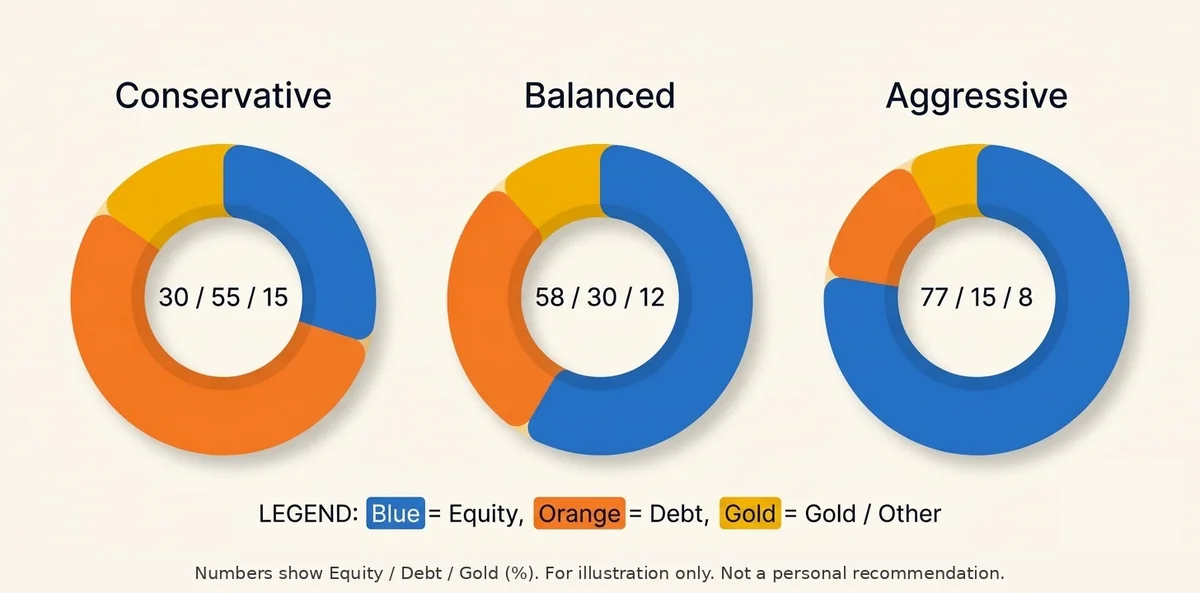
This is only a starting point, not a law. Adjust for your goals, income stability, and comfort. Here are some illustrative examples:
| Profile | Equity | Debt | Gold / Other |
|---|---|---|---|
| Conservative (near retirement) | 25–35% | 50–60% | 10–15% |
| Balanced (mid-career, 10+ yr goals) | 50–65% | 25–35% | 5–10% |
| Aggressive (young, long horizon) | 70–85% | 10–20% | 5–10% |
This table is for illustration only and is not a personal recommendation.
Step 5: Choose How You Will Invest
You have several routes, and you can combine them.
Index funds and ETFs. These track a market index automatically, such as the Nifty 50. They are low-cost, diversified in one purchase, and require no stock-picking skill. For most beginners, this is the best foundation. Not sure whether to pick an index fund or a large-cap fund? Our comparison of index fund vs large cap fund explains which is safer for long-term investors.
Actively managed mutual funds. A fund manager picks the stocks. Some beat the index over time, but many do not after fees, so compare costs and long-term track records carefully. If you are new to this option, our guide on what a mutual fund is and how it works explains the basics. For a starting shortlist, see the best low-risk mutual funds for beginners in India.
Direct stocks. Buying individual companies gives you control and potentially higher returns, but it demands research and discipline. A sensible approach is to keep direct stocks as a smaller “satellite” portion (say 10–30%) around a solid “core” of index or diversified funds.
Bonds, debt funds, and PPF. These form the stability layer. Choose according to your tax bracket and time horizon. If you are unsure whether to choose funds or fixed deposits, see our comparison of mutual fund vs FD.
To buy stocks and ETFs directly you will need a trading and demat account. You can verify intermediaries on the SEBI website.
Step 6: Diversify Properly
Diversification means more than owning many stocks. Real diversification spreads across:
- Asset classes: equity, debt, gold.
- Sectors: banking, IT, FMCG, pharma, energy, auto, and so on.
- Company size: large-cap (stable giants), mid-cap (growing companies), small-cap (high risk, high potential).
- Investment style: growth, value, dividend-focused.
- Geography (optional): some investors add international exposure through funds.
Beware of false diversification. Owning ten stocks that are all banks is not diversified. Owning five mutual funds that hold nearly the same top 20 stocks is not either. Check overlaps before adding another fund.
There is also an opposite problem, over-diversification. Holding 60 stocks or 15 mutual funds makes the portfolio hard to track and dilutes the effect of your best ideas. For most individuals, 15–25 well-chosen stocks (if buying directly), or 3–6 funds, is plenty.
Step 7: Select Quality Investments
If you pick individual stocks, avoid decisions based on rumours, social media tips, or fear of missing out. Use a repeatable checklist (see the next section).
Step 8: Invest Regularly Through SIPs
A Systematic Investment Plan (SIP) invests a fixed amount at regular intervals, usually monthly. It removes the pressure of timing the market and builds discipline. When prices are high you buy fewer units, and when prices are low you buy more, which averages your purchase cost over time. Our guide on how SIP investing builds long-term wealth covers this in detail. If you are comparing a SIP with a recurring deposit, read SIP vs RD.
Step 9: Review and Rebalance
Markets drift your allocation away from the plan over time. Review once or twice a year and rebalance if needed. More on this below.
How to Select Quality Stocks: A Practical Checklist
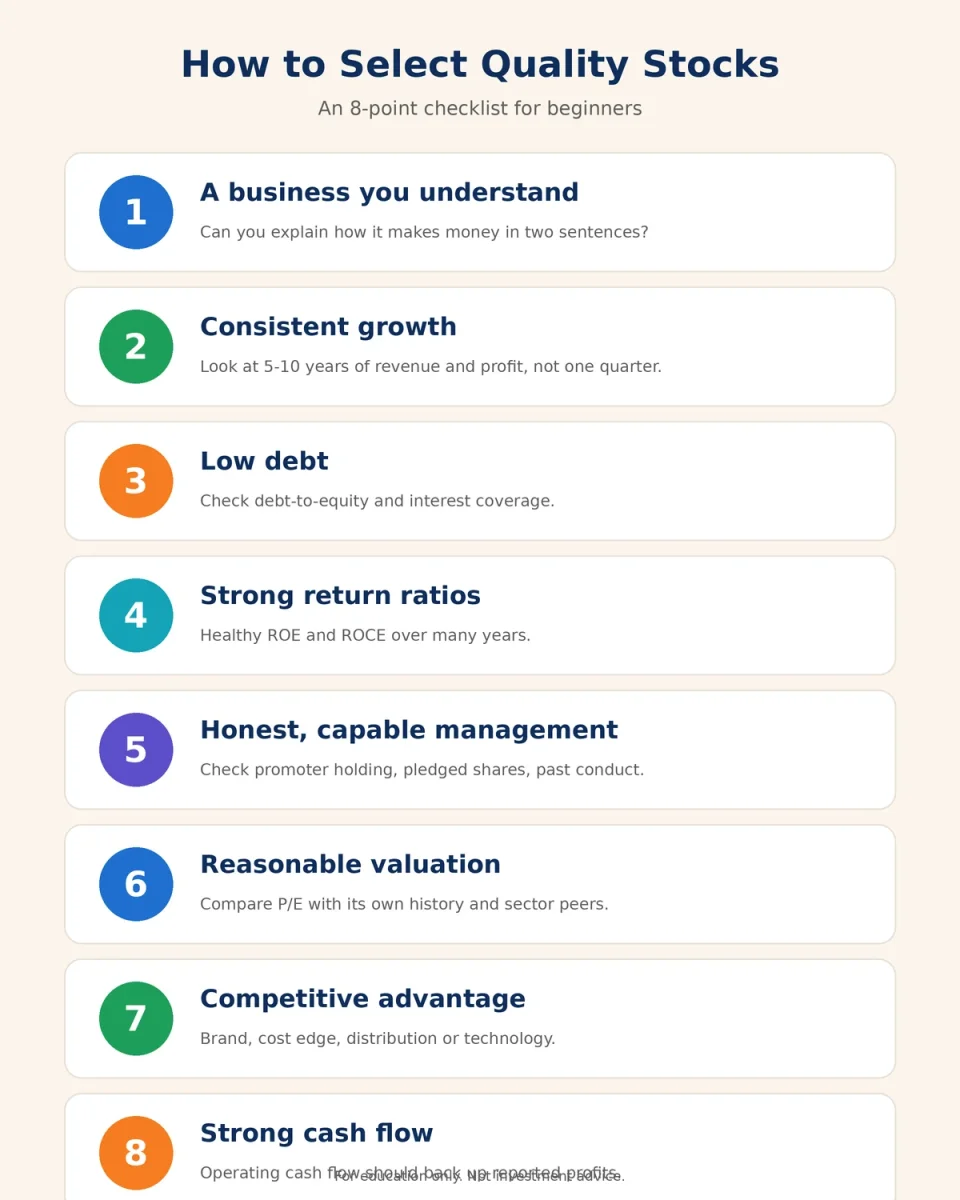
You do not need a finance degree to screen stocks sensibly. Here are the factors experienced investors commonly check.
1. A business you understand. If you cannot explain in two sentences how the company makes money, think twice. Understanding the business protects you from nasty surprises.
2. Consistent revenue and profit growth. Look at 5–10 years of numbers, not just one good quarter. Steady growth suggests a durable business.
3. Low debt. Companies with heavy borrowing can struggle when interest rates rise or business slows. Check the debt-to-equity ratio and interest coverage. Banks and financial companies are the exception, since they work differently.
4. Strong return ratios. Return on equity (ROE) and return on capital employed (ROCE) show how efficiently management uses money. Consistently healthy figures over many years are a good sign.
5. Honest, capable management. Look at promoter holding, any history of pledged shares, related-party dealings, and how management has treated minority shareholders in the past.
6. Reasonable valuation. Even a great company can be a poor investment if you overpay. Compare the price-to-earnings (P/E) ratio with the company’s own history and with its sector peers.
7. Competitive advantage. Does the company have a brand, cost advantage, distribution network, or technology that rivals struggle to copy?
8. Cash flow. Profits on paper are not the same as cash in the bank. Check that operating cash flow backs up reported profits.
Free tools such as Screener.in and company filings on the NSE and BSE websites give you the numbers. For deeper learning, Zerodha’s free Varsity course is an excellent resource.
A Worked Example: The Power of Regular Investing
Numbers make the benefit of long-term investing clearer. Suppose you invest ₹10,000 per month through a SIP, and your investments earn an assumed average of 12% per year (this is purely illustrative, as actual returns vary and are never guaranteed).
| Duration | Total amount invested | Approximate value at 12% |
|---|---|---|
| 10 years | ₹12 lakh | ₹23 lakh |
| 20 years | ₹24 lakh | ₹1 crore (about ₹99–100 lakh) |
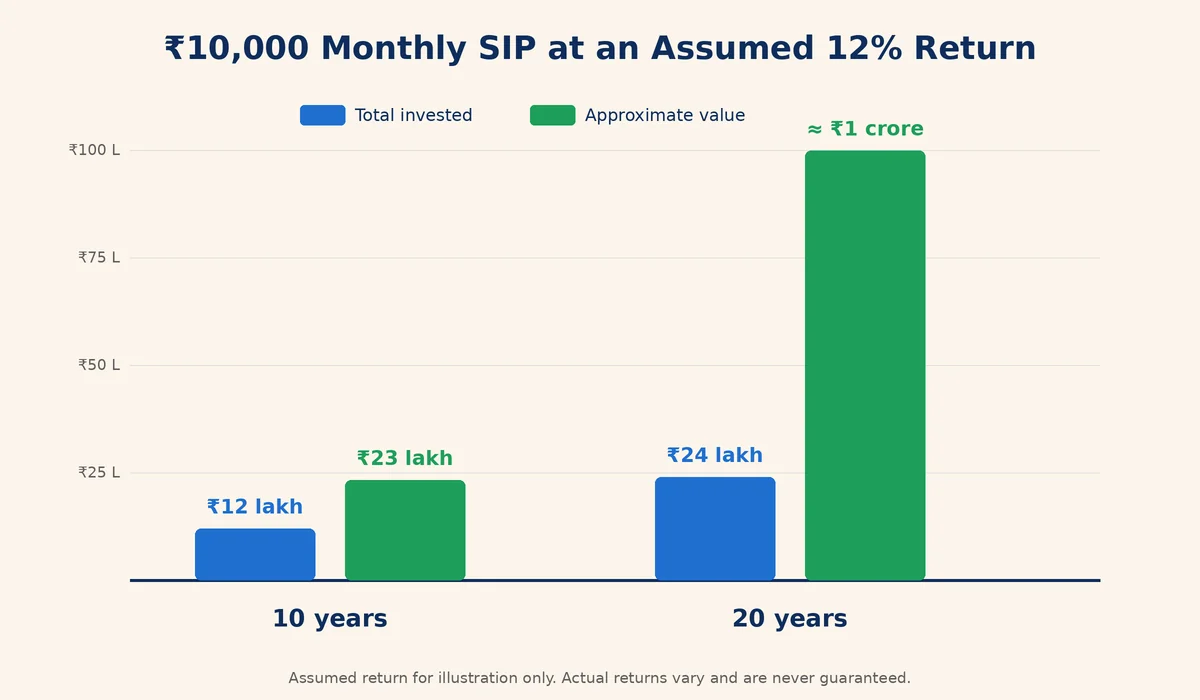
Notice what happens. In the second decade, your wealth grows by far more than in the first, even though you invested the same monthly amount. That is compounding at work, and it is why starting early matters so much. Waiting ten years to begin does not cost you ten years of savings. It costs you the most powerful years of growth. You can see more real examples in our post on how compounding works.
Real markets are bumpy, though. Returns will not arrive as a smooth 12% each year. There may be years of 25% gains and years of 15% losses. The investor who keeps investing through both is the one who benefits.
Sample Portfolio Structures (For Learning Purposes)
Here are three simple illustrations of how a portfolio might be organised. These are examples to help you think, not recommendations.
Example A: The Simple Beginner Portfolio
- 60% broad market index fund (Nifty 50 or similar)
- 15% flexi-cap or diversified equity fund
- 20% debt fund or PPF
- 5% gold ETF
This takes four holdings, minimal research, and a small monthly SIP.
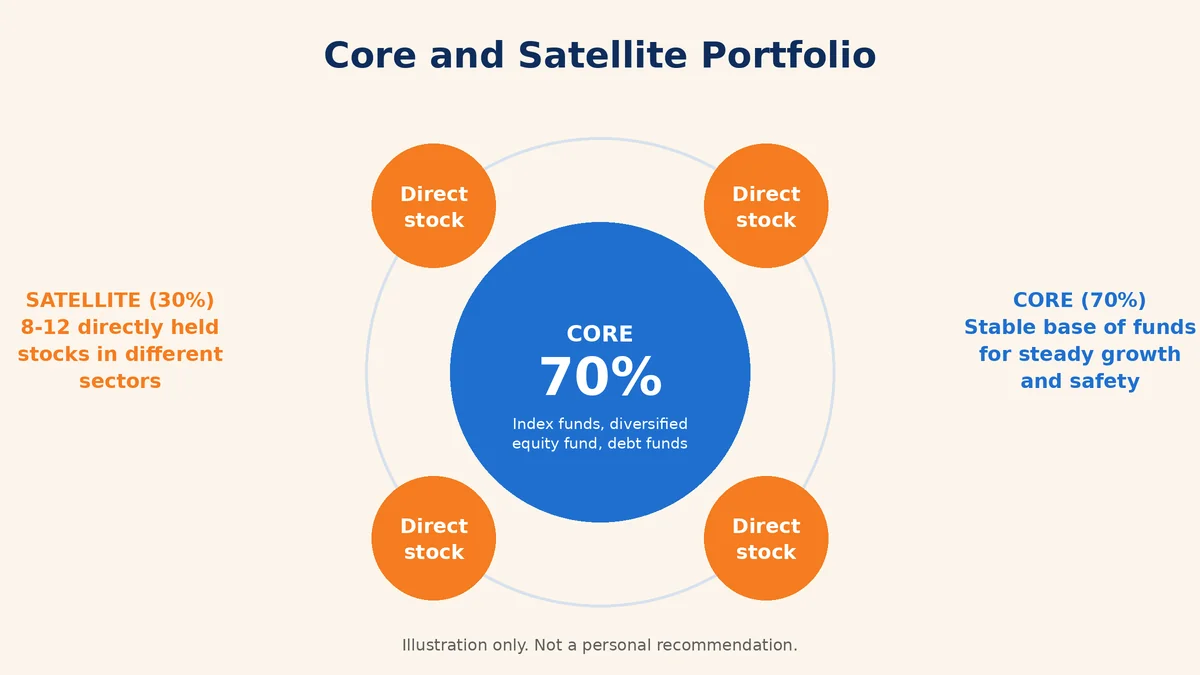
Example B: Core and Satellite Portfolio
- Core (70%): index funds, a diversified equity fund, and debt funds
- Satellite (30%): 8–12 directly held stocks across different sectors
This suits investors who enjoy researching companies but want a safety net.
Example C: Conservative Income-Focused Portfolio
- 30% large-cap equity or index funds
- 55% debt funds, bonds, or fixed income
- 10% gold
- 5% liquid fund
This suits people close to retirement or with near-term goals.
Rebalancing: Keeping Your Portfolio on Track
Suppose you start with a 60% equity and 40% debt portfolio. After a strong market year, equity may grow to 72% of your portfolio. You are now taking more risk than you planned, simply because the stock market rose.
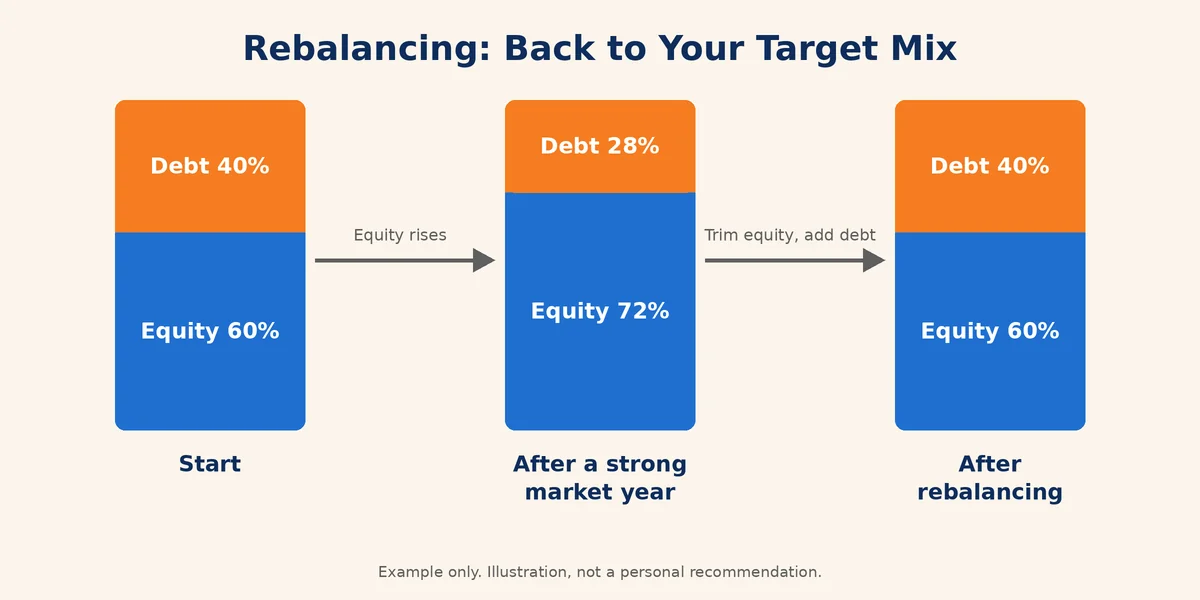
Rebalancing means bringing the portfolio back to its target. There are two common approaches:
- Calendar-based: review once or twice a year, on a fixed date such as your birthday or the start of the financial year.
- Threshold-based: rebalance whenever an asset class drifts by a set margin (say 5 percentage points) from its target.
You can rebalance by selling some of the overweight asset and buying the underweight one. Alternatively, you can direct new SIP money into the lagging category, which avoids selling and any tax on it.
Rebalancing feels uncomfortable, because it forces you to trim what has been winning and add to what has been lagging. That discipline is exactly what keeps risk under control.
Review also means checking whether your goals have changed (a new baby, a job change, a medical expense). If your life changes, your portfolio should too.
Taxes on Stock Market Investments: The Basics
Taxes affect your real returns, so know the basics. The following reflects rules for resident individuals in India at the time of writing, and these change from time to time, so always verify on incometax.gov.in or with a tax professional.
- Short-term capital gains (STCG) apply when you sell listed equity shares or equity mutual funds within 12 months of buying them.
- Long-term capital gains (LTCG) apply when you sell after holding for more than 12 months, and gains above an annual exemption limit are taxed at a lower rate than short-term gains.
- Dividends are added to your income and taxed at your slab rate.
- Debt fund taxation has changed in recent years, so check the current treatment before investing.
To see how recent changes affect your overall tax, read our post on new income tax rules after Budget 2025. The key takeaway: holding good investments for the long term is usually kinder to your tax bill and your returns than frequent trading.
Common Mistakes to Avoid
Most portfolio damage comes from behaviour, not from bad luck. Here are the mistakes that appear again and again.
1. Investing without a plan. Buying whatever is trending leaves you with a random collection of stocks, not a portfolio.
2. Chasing tips and rumours. If a stranger on social media or a messaging group is sure a stock will double, ask what they gain from telling you. Unsolicited tips are a classic route to losses and scams. The SEBI investor website, investor.sebi.gov.in, has guidance on spotting fraud.
3. Over-trading. Frequent buying and selling racks up brokerage, taxes, and mistakes. Most successful long-term investors trade far less than beginners expect.
4. Putting everything in one stock or sector. Concentration can create fortunes, but it can also destroy them. Beginners should avoid the gamble.
5. Panic selling. Market corrections of 10–20% happen regularly, and larger crashes occur from time to time. Selling in a panic locks in losses and often means missing the recovery. Decide in advance what you will do when markets fall.
6. Ignoring costs. A fund charging 1% more per year than a comparable one may not sound like much, but over 20 years it can eat a large chunk of your final wealth. Always compare expense ratios.
7. Using money you may need soon. Equity is for money you will not touch for years. Never invest your emergency fund or next year’s school fees in stocks.
8. Borrowing to invest. Leverage magnifies both gains and losses. Beginners should avoid it entirely.
9. Checking your portfolio daily. Constant monitoring tempts you into unnecessary action. Quarterly or half-yearly reviews are plenty for a long-term investor.
10. Never learning. Markets evolve. Keep reading, keep asking questions, and learn from your own mistakes.
The Psychology of Investing
You can have the perfect portfolio on paper and still lose money if your behaviour works against you. A few mental traps to watch:
- Herd mentality: buying because everyone else is buying.
- Loss aversion: feeling losses far more strongly than equal gains, which makes people hold losers too long and sell winners too early.
- Recency bias: assuming whatever happened recently will continue forever.
- Overconfidence: mistaking a lucky streak for skill.
Practical protections include writing down your investment plan, automating SIPs so you do not have to make a decision each month, and setting rules in advance, such as “I will not sell any long-term holding during a market fall unless my original reason for buying has changed.”
Stock Market Portfolio for Beginners: A Simple Starting Plan
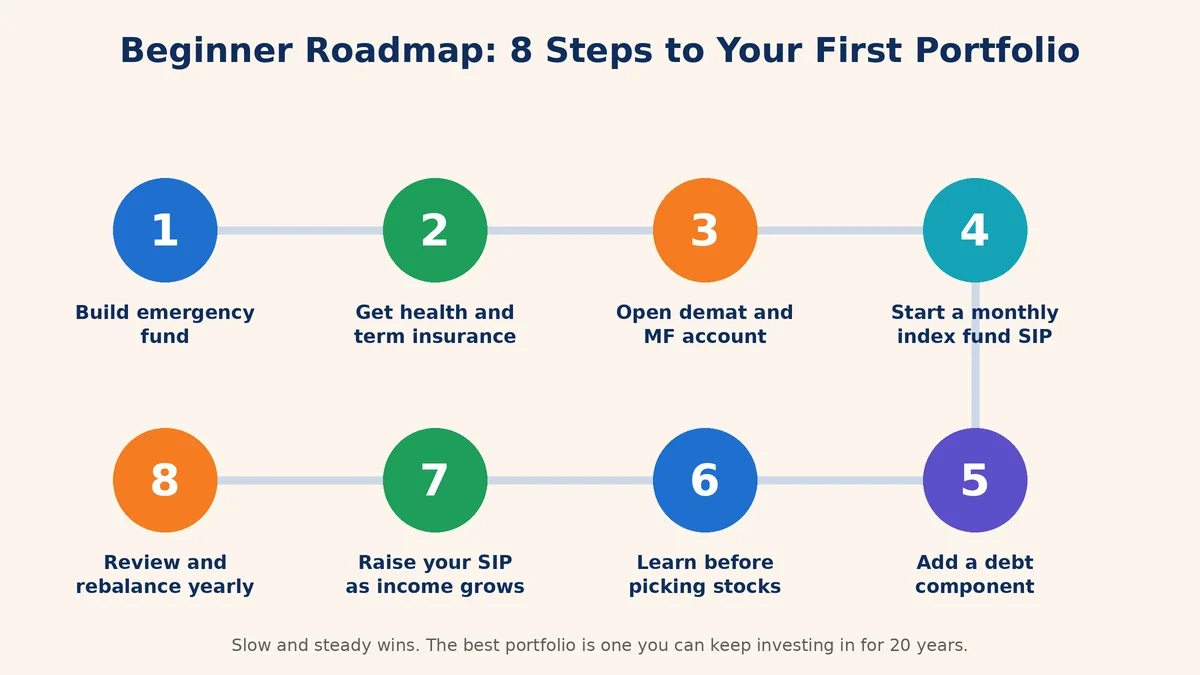
If all of this still feels like a lot, here is a calm, simple path.
- Build your emergency fund (three to six months of expenses).
- Get basic insurance (health and term life, if you have dependants).
- Open a demat account and a mutual fund account with a SEBI-registered platform.
- Start a monthly SIP in a low-cost index fund. Even ₹1,000–₹5,000 a month is a legitimate start. Not sure how much you can spare? The 50-30-20 rule is a simple way to split your income, and our example of how to plan a monthly budget on a ₹30,000 salary shows it in practice.
- Add a debt component (PPF, debt fund, or similar) in line with your target allocation.
- Learn before you pick stocks. Study a few companies on paper for several months before putting real money in.
- Increase your SIP whenever your income rises, even by a small amount.
- Review once or twice a year, rebalance if needed, and otherwise leave it alone.
The best portfolio is not the cleverest one. It is the one you can keep investing in for 20 years.
Final Thoughts
Building a strong stock market portfolio is not about predicting the market, finding the next multibagger, or being smarter than everyone else. It is about a handful of unglamorous habits: setting clear goals, spreading your money sensibly, investing regularly, keeping costs and taxes in check, and staying calm when markets are not.
No portfolio can guarantee profit, and anyone who promises otherwise should make you cautious. What a well-built portfolio can do is improve your odds, protect you from your own worst impulses, and give compounding the time it needs.
So start where you are, with the amount you have. Write down your goals, choose a simple allocation, begin your first SIP, and let time do its work.
Related Reading
- What Is a Mutual Fund? How It Works for Beginners
- How SIP Investing Can Help You Build Long-Term Wealth
- Index Fund vs Large Cap Fund: Which Is Safer for Long-Term Investors?
- How Compounding Works (With Real Examples)
Disclaimer: This article is for educationFrequently Asked Questions (FAQs)al and informational purposes only and does not constitute financial, investment, tax, or legal advice. Investments in securities markets are subject to market risks, and past performance does not guarantee future results. Examples and allocations shown are illustrative. Please read all scheme-related documents carefully and consult a SEBI-registered investment adviser or qualified financial professional before making investment decisions.
Frequently Asked Questions (FAQs)
Q. What is a stock market portfolio?
Ans : A stock market portfolio is the complete collection of investments you hold, such as stocks, mutual funds, ETFs, bonds, and gold, organised to achieve your financial goals while managing risk.
Q. How can beginners build a stock market portfolio?
Ans : Begin with an emergency fund and basic insurance. Then start a monthly SIP in a diversified, low-cost index fund, add some debt exposure based on your risk comfort, and learn gradually before buying individual stocks.
Q. How much money do I need to start?
Ans : You can start with a very small amount. Many mutual fund SIPs begin at ₹500 or ₹1,000 per month. The habit of investing regularly matters more than the starting amount.
Q. Why is diversification important?
Ans : Diversification spreads your money across different sectors, company sizes, and asset classes, so one poor performer does not damage your entire portfolio. It reduces risk but does not remove it.
Q. How many stocks should a portfolio have?
Ans : There is no magic number. Many investors who buy stocks directly hold roughly 15 to 25 across different sectors. Fewer than about 10 can be too concentrated, and more than 30 or 40 becomes difficult to follow.
Q. How often should I review my portfolio?
Ans : Reviewing once or twice a year is usually enough for long-term investors. Rebalance if your allocation has drifted noticeably from your targets or your goals have changed.
Q. Is investing in mutual funds better than direct stocks?
Ans : Neither is universally better. Mutual funds and index funds offer instant diversification and professional management, which suits beginners. Direct stocks offer more control and potentially higher returns, but require time, research, and discipline. Many investors combine both.
Q. Is a stock market portfolio good for long-term wealth creation?
Ans : Historically, diversified equity investments have been among the better long-term wealth builders, but returns are never guaranteed and short-term losses are normal. Success depends on staying invested, investing regularly, and keeping costs low.
Q. What is the difference between SIP and lump sum investing?
Ans : A SIP invests a fixed amount at regular intervals, which spreads your purchase prices over time and builds discipline. A lump sum invests everything at once. SIPs suit people investing from monthly income, while lump sums depend more on market timing.
Q. Can I lose all my money in the stock market?
Ans : You can lose money, especially if you hold a few risky stocks, trade excessively, or use borrowed money. A diversified, long-term portfolio makes a total loss very unlikely, but temporary declines of 20–40% have happened in past market crashes, so only invest money you can leave untouched for years.

Shilpesh Rathod is the founder of All Finance Knowledge. He holds a B.Com degree along with JAIIB and CAIIB banking certifications, and brings 19+ years of experience in the banking sector across savings, investments, and financial planning. Read more: https://allfinanceknowledge.com/about-us/
2 thoughts on “Stock Market Portfolio: How to Build One Step by Step”