
Introduction
Many people believe that investing is complicated, risky, or only meant for wealthy individuals. Because of this fear, beginners often keep their money only in savings accounts or fixed deposits. While saving is important, investing wisely helps your money grow over time and beat inflation.Mutual funds are an important part of personal finance basics for anyone who wants to build long-term wealth.
One of the easiest and most popular investment options for beginners is a mutual fund which allow you to invest in the market without tracking share prices daily or having deep financial knowledge.
If you are new to investing and want a simple, structured, and regulated way to grow your money, this beginner’s guide will help you understand what a mutual fund is, how it works, its types, benefits, risks, and how to start step by step.
This article is written in easy language and is suitable for first-time investors.
What Is a Mutual Fund?
It is an investment vehicle where money from many investors is collected and invested in different financial instruments, such as:
- Shares (stocks)
- Bonds
- Government securities
- Money market instruments
Instead of investing individually, investors pool their money together. This pooled money is managed by a professional fund manager, whose job is to invest it according to the fund’s objective.
Each investor owns a small portion of the fund based on the amount invested.
Simple Example
Let’s understand this with a simple example:
- 100 people invest ₹1,000 each
- Total money collected = ₹1,00,000
This money is invested across multiple companies or assets.
If the investments perform well, investors earn returns.
If the market falls, the value may decrease.
Profits or losses are shared among investors based on how much they invested.
How Does a Mutual Fund Work?
It works in a regulated manner.
Step-by-Step Process
- Investors invest money in a mutual fund
- The money is pooled together
- A professional fund manager invests it in assets
- The investments generate returns or losses
- Investors receive gains or losses proportionately
Each investor is allotted units of the mutual fund.
What Is NAV (Net Asset Value)?
NAV (Net Asset Value) is the price of one unit of a mutual fund.
- NAV increases when fund investments perform well
- NAV decreases when the market value falls
Example:
- You invest ₹10,000 at NAV ₹10
- You receive 1,000 units
If NAV later becomes ₹15:
- Investment value = ₹15,000
NAV is calculated daily after market hours.
Types of Mutual Funds for Beginners
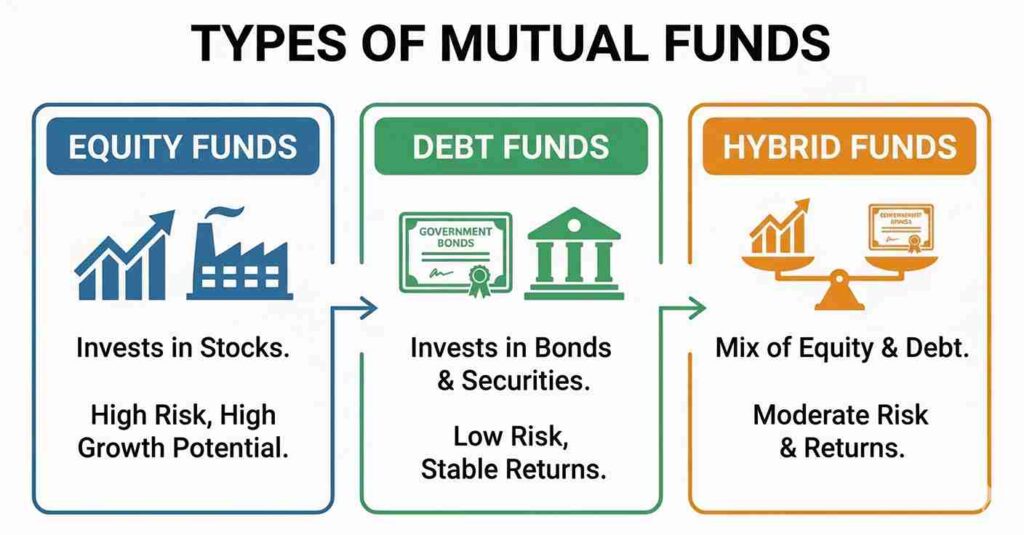
1. Equity Mutual Funds
- Invest mainly in company shares
- Higher return potential
- Higher market risk
- Suitable for long-term goals (5+ years)
Best for: Long-term wealth creation
2. Debt Funds
- Invest in bonds and fixed-income securities
- Lower risk compared to equity
- More stable returns
Best for: Conservative investors and short-term goals
3. Hybrid Funds
- Mix of equity and debt
- Balanced risk and return
- Suitable for beginners
Best for: Moderate risk investors
4. Index Funds
- Track market indices like Nifty 50 or Sensex
- Low cost and transparent
- Passive investment strategy
Best for: Beginners and long-term investors
5. Liquid and Money Market Funds
- Very low risk
- Short-term investment
- Easy withdrawal
Best for: Parking surplus funds temporarily
What Is SIP in Mutual Funds?
SIP (Systematic Investment Plan) allows you to invest a fixed amount at regular intervals (monthly or quarterly).
Benefits of SIP:
- Start with as low as ₹500
- No need to time the market
- Encourages disciplined investing
- Helps benefit from long-term compounding
Example:
Investing ₹2,000 per month through SIP for 20 years can potentially build a sizable corpus, depending on market performance.
Beginners who want to invest regularly often use SIP strategies to build wealth over time. You can learn more in our guide on How SIP Investing Can Help You Build Long-Term Wealth.

Why Mutual Funds Are Good for Beginners
1. Professional Management
Your investments are handled by experienced fund managers.
2. Diversification
Money is spread across different assets, reducing risk.
3. Low Entry Barrier
You don’t need a large amount to start investing.
4. Transparency
Fund performance, holdings, and expenses are publicly available.
5. Liquidity
Most mutual funds allow easy redemption.
How to Start Investing in Mutual Funds (Step-by-Step)
Step 1: Define Your Goal
- Short-term or long-term?
- Wealth creation or savings?
Step 2: Choose the Right Fund
Beginners may consider index funds or hybrid funds.
Step 3: Complete KYC
You will need:
- PAN card
- Aadhaar
- Bank account details
Step 4: Start SIP or Lump Sum
SIP is generally recommended for beginners.
Step 5: Review Periodically
Check performance once or twice a year, not daily.
Risk Involved in Mutual Fund
Even though mutual funds are beginner-friendly, they also carry certain risks:
• Market Risk – Prices may fall when markets decline
• Interest Rate Risk – Debt funds may be affected by rate changes
• Fund Manager Risk – Performance depends on fund strategy
• Liquidity Risk – Some funds may have exit restrictions
Common Mutual Fund Myths
Mutual funds are risky
✅ Risk depends on fund type and duration
❌ Only experts can invest
✅ Anyone can invest easily
❌ Need a lot of money
✅ Start with ₹500 SIP
Mutual Funds vs Fixed Deposits
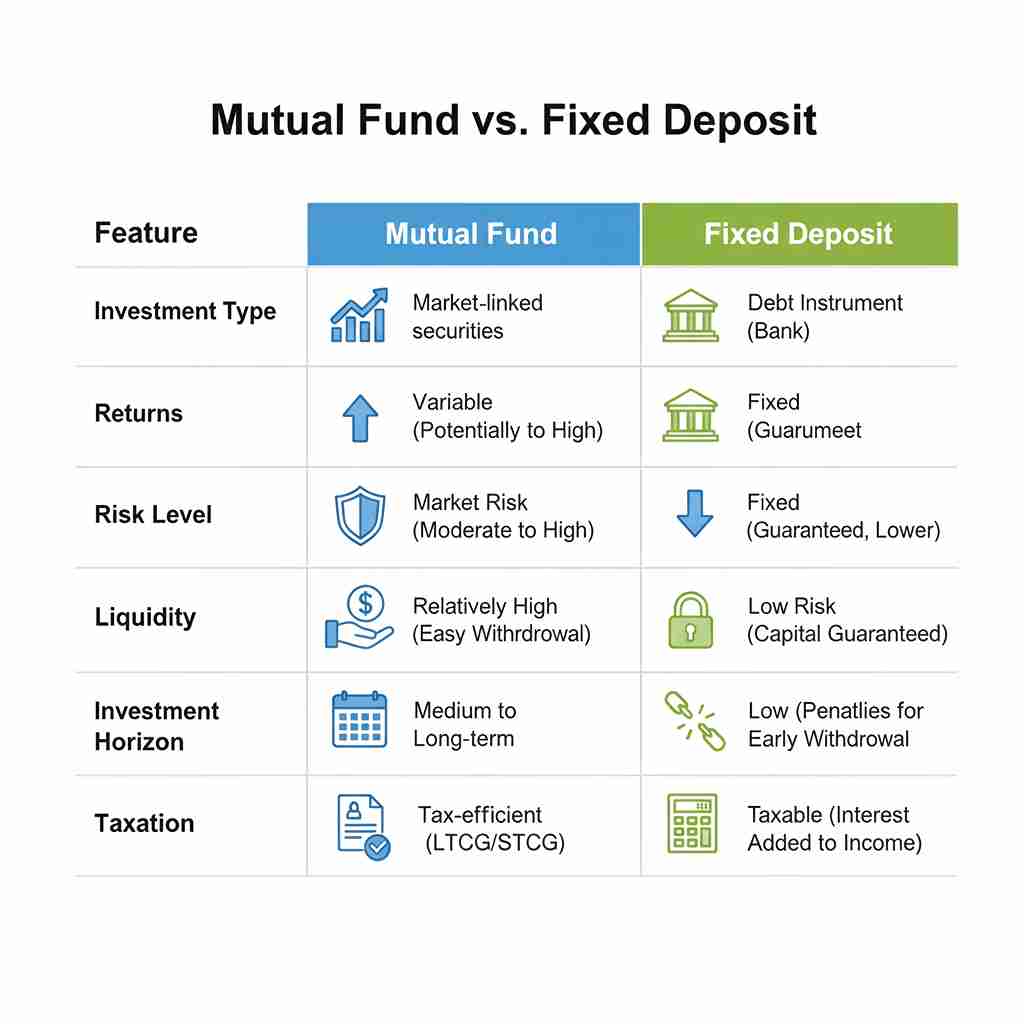
| Feature | Mutual Fund | Fixed Deposit |
|---|---|---|
| Returns | Market-linked | Fixed |
| Risk | Medium | Low |
| Inflation Protection | Yes | No |
| Liquidity | High | Medium |
Who Regulates Mutual Funds in India?
Mutual funds in India are regulated by the Securities and Exchange Board of India (SEBI).
SEBI ensures that:
- Mutual funds follow strict rules
- Investor interests are protected
- Fund disclosures remain transparent
Because of this regulatory framework, mutual funds are considered one of the most structured investment options for retail investors in India.
Conclusion
Mutual funds are a practical and beginner-friendly way to start investing. With features like professional management, diversification, and SIP flexibility, they make long-term investing simple and accessible.
If you start early, stay invested, and choose funds wisely, mutual funds can help you work toward your financial goals in a disciplined manner.
Disclaimer
This article is for educational purposes only and does not constitute financial or investment advice. Please consult a qualified financial advisor before making investment decisions.
Frequently Asked Questions (FAQs)
🔹 FAQ 1: What is a mutual fund in simple words?
A mutual fund is an investment where money from many investors is pooled together and invested in stocks, bonds, or other assets by professional fund managers.
🔹 FAQ 2: How does a mutual fund work?
When you invest in it, your money is combined with other investors’ money. A fund manager invests this pooled money in different assets to generate returns over time.
🔹 FAQ 3: Is mutual fund good for beginners?
Yes, they are suitable for beginners because they offer diversification, professional management, and the option to start with small amounts through SIP.
🔹 FAQ 4: What is SIP in mutual funds?
SIP (Systematic Investment Plan) allows you to invest a fixed amount regularly (monthly or quarterly) in a mutual fund, making investing disciplined and affordable.
🔹 FAQ 5: How much money is needed to start investing in mutual funds?
You can start investing in it as little as ₹500 per month through SIP, depending on the fund.
🔹 FAQ 6: Are mutual funds safe?
Mutual funds are regulated by SEBI, but they are subject to market risks. Choosing funds based on your risk profile and long-term goals helps reduce risk.
🔹 FAQ 7: What are the main types of mutual funds?
Common types include equity funds, debt funds, hybrid funds, index funds, and ELSS (tax-saving fuds).
🔹 FAQ 8: Can I lose money in mutual funds?
Yes, returns depend on market performance. However, long-term investing and diversification can help manage market fluctuations.
🔹 FAQ 9: How long should I stay invested in a mutual fund?
For equity funds, a minimum investment period of 5 years or more is recommended for better returns.
🔹 FAQ 10: Is mutual fund better than fixed deposit?
Mutual funds usually offer higher returns than fixed deposits in the long term, but they carry higher risk compared to FDs.
10 thoughts on “What Is a Mutual Fund? How It Works for Beginners”