December 26, 2025
By Shilpesh Rathod
Investing is not only about how much money you invest—it is also about how long you stay invested. The time period for which you invest your money plays a major role in determining your potential returns, risk level, and financial outcomes.
Many beginners often ask an important question:
Should I invest for the long term or the short term?
Both approaches have their advantages and risks. Choosing the right strategy depends on your financial goals, risk tolerance, and time horizon.
In this article, we explain long-term vs short-term investing in simple language. You will learn the key differences between these two strategies, their benefits, risks, and how beginners in India can decide which approach suits their financial goals.
⚠️ This article is for educational purposes only and does not provide financial or investment advice.
What Is Investing?
Investing means putting your money into financial assets with the aim of growing your wealth over time. Instead of keeping money idle in a savings account, investing allows your money to generate returns through interest, dividends, or capital appreciation.
For beginners, investing may feel complicated, but understanding basic concepts can make the process much easier.
Some common investment options include:
- Stocks (shares of companies)
- Mutual funds
- Fixed deposits
- Bonds
- Exchange-Traded Funds (ETFs)
Each investment option has a different level of risk, return, and time horizon.
The way you invest largely depends on how long you plan to keep your money invested, which brings us to the concept of investment time horizon.
If you are new to investing, you may first want to understand the basics of money management in this guide on What Is Personal Finance? A Beginner’s Guide.
Understanding Investment Time Horizon
An investment time horizon refers to the length of time you plan to keep your money invested before you need it.
For example:
- If you are saving for retirement 25 years later, you have a long-term horizon.
- If you want money for a vacation next year, that is a short-term horizon.
Your investment horizon helps determine:
- The level of risk you can take
- The type of investment options suitable for you
- The expected returns
Generally speaking:
- Long-term investing focuses on growth and wealth creation.
- Short-term investing focuses on liquidity and capital safety.
Understanding your time horizon is one of the most important steps in successful financial planning.
What Is Long-Term Investing?
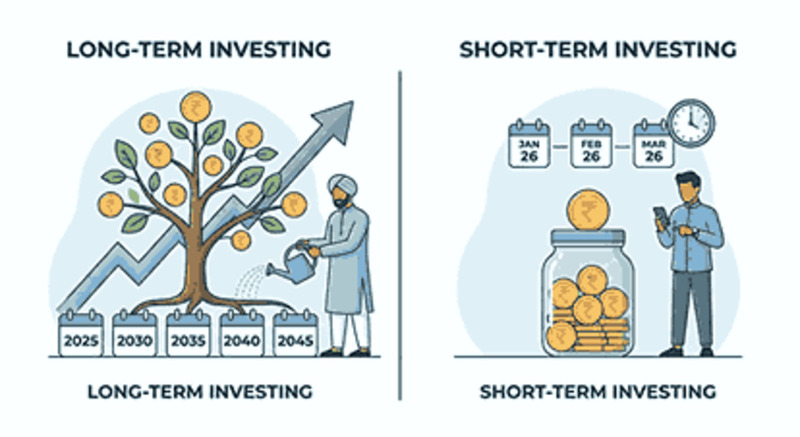
Long-term investing refers to investing money for a long duration, typically five years or more. The goal is to benefit from compounding and long-term market growth.
Investors who follow this strategy usually stay invested through market ups and downs instead of reacting to short-term fluctuations.
Long-term investing is commonly used for major financial goals that are many years away.
Many long-term investors use Systematic investment strategeis as SIP investing to build wealth gradually.
Investors should always understand financial products carefully. Educational resources from the Securities and Exchange Board of India can help beginners learn about investing safely.
Common Examples of Long-Term Goals
Some financial goals that require long-term investing include:
- Retirement planning
- Children’s higher education
- Building long-term wealth
- Buying a house in the future
- Financial independence
Since these goals require significant money, investors often rely on investments that have higher growth potential over long periods.
Popular Long-Term Investment Options
Some commonly used long-term investment instruments include:
- Equity mutual funds
- Index funds
- Stocks held for many years
- Public Provident Fund (PPF)
- National Pension System (NPS)
- Retirement-oriented investment plans
These investments may experience short-term volatility but can potentially generate higher returns over longer periods.
Benefits of Long-Term Investing
1. Power of Compounding
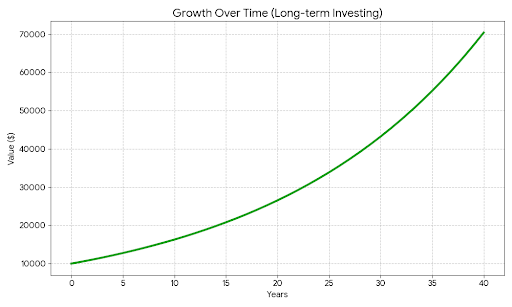
Compounding is one of the biggest advantages of long-term investing. It allows your earnings to generate additional earnings over time.
For example:
If you invest ₹10,000 annually with a return of 12%, the value of your investment can grow significantly over 15–20 years due to compounding.
The concept of compounding is powerful for long-term wealth creation. You can learn more in our detailed guide on How Compounding Works (With Real Examples).
The longer you stay invested, the stronger the compounding effect becomes.
The concept of compounding is powerful for long-term wealth creation. You can learn more in our detailed guide on How Compounding Works (With Real Examples).
2. Reduced Impact of Market Volatility
Financial markets often fluctuate in the short term. Prices may rise or fall due to economic events, political factors, or global news.
However, over long periods, markets have historically shown overall growth trends.
Long-term investing allows investors to ignore short-term market noise and focus on long-term growth.
3. Less Stressful Beginners
Short-term trading requires constant monitoring of markets. Long-term investing, on the other hand, is relatively simpler.
Investors can:
- Invest regularly
- Review their portfolio periodically
- Avoid daily market tracking
This makes long-term investing less stressful and more suitable for beginners.
4. Potential for Higher Returns
Equity-based investments have historically generated higher long-term returns compared to many short-term instruments.
Although returns are never guaranteed, long-term investors often benefit from:
- Economic growth
- Corporate profits
- Market expansion
Risks of Long-Term Investing
Despite its benefits, long-term investing also carries certain risks.
Some potential risks include:
- Market downturns affecting portfolio value
- Economic changes impacting returns
- Choosing poor investment options
- Lack of diversification
However, these risks can often be managed through proper asset allocation and regular portfolio review.
What Is Short-Term Investing?
Short-term investing involves investing money for a short duration, usually less than one to three years.
The main focus of short-term investing is capital safety and liquidity, rather than high growth.
Investors who need money soon often prefer short-term investment options that provide stable and predictable returns.
Common Short-Term Financial Needs
Short-term investments are typically used for goals such as:
- Emergency expenses
- Travel or vacation planning
- Buying a vehicle or gadget
- Saving for a short-term purchase
- Temporary parking of surplus funds
Since the investment period is short, investors usually prefer low-risk instruments.
Popular Short-Term Investment Options
Some widely used short-term investment options include:
- Short-term fixed deposits
- Recurring deposits
- Liquid mutual funds
- Treasury bills
- Savings accounts
- Money market instruments
These investments prioritize capital protection and liquidity over high returns.

Benefits of Short-Term Investing
Short-term investing also offers several advantages depending on financial goals.
1. High Liquidity
Short-term investments allow investors to access their money quickly when needed.
This is particularly useful for emergencies or near-term expenses.
2. Lower Risk
Short-term investments usually involve lower risk compared to equity investments.
Many of these instruments focus on capital preservation rather than aggressive growth.
3. Suitable for Immediate Goals
Short-term investing is ideal when investors have specific financial needs within a few years.
It helps ensure that money is available when required.
Risks of Short-Term Investing
Although short-term investing is relatively safer, it also has some limitations.
Some key drawbacks include:
- Lower return potential
- Returns may not beat inflation
- Limited wealth creation opportunities
- Need for frequent reinvestment decisions
Because of these reasons, short-term investments alone may not be sufficient for long-term financial goals
Long-Term vs Short-Term Investing: Key Differences
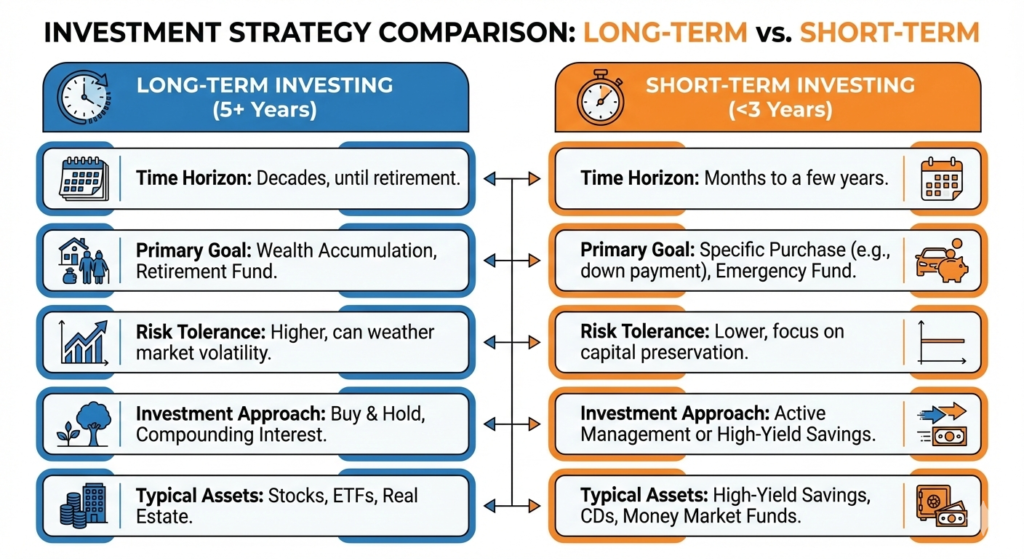
The main differences between long-term and short-term investing are summarized below.
| Feature | Long-Term Investing | Short-Term Investing |
|---|---|---|
| Time period | 5+ years | Up to 1–3 years |
| Risk level | Moderate to high | Low |
| Return potential | Higher (not guaranteed) | Lower |
| Market volatility | Can be tolerated | Should be avoided |
| Goal type | Wealth creation | Capital protection |
Understanding these differences helps investors choose the right strategy based on their financial needs.
Which Is Better: Long-Term or Short-Term Investing?
There is no universal answer to this question.
The right investment strategy depends on several factors:
- Your financial goals
- Investment time horizon
- Risk tolerance
- Income stability
- Existing savings
In reality, many financially disciplined individuals combine both strategies.
For example:
- Short-term investments for emergency funds and near-term expenses
- Long-term investments for retirement and wealth creation
This balanced approach helps investors manage risk while preparing for future financial goals.
Importance of Financial Discipline
Regardless of whether you choose long-term or short-term investing, financial discipline is essential.
Successful investors typically follow these principles:
- Invest regularly
- Avoid emotional investment decisions
- Diversify investments
- Review financial goals periodically
- Keep learning about personal finance
Consistent discipline over time plays a major role in achieving financial success.
Frequently Asked Questions (FAQs)
Q-1 Is long-term investing suitable for beginners?
Ans- Yes, long-term investing is often suitable for beginners because it requires less frequent trading and allows time for investments to grow through compounding.
Q-2 Can I do both long-term and short-term investing?
Ans- Yes, many investors combine both strategies to meet different financial goals. Short-term investments help manage liquidity needs while long-term investments focus on wealth creation.
Q-3 Is short-term investing completely safe?
Ans-Short-term investments generally involve lower risk, but no investment is completely risk-free. Investors should always evaluate potential risks before investing.
Q-4 How long is considered long-term investing?
Ans-Typically, investments held for five years or more are considered long-term investments.
Final Thoughts
Understanding the difference between long-term vs short-term investing is essential for building a smart financial strategy.
Short-term investments help manage immediate financial needs and provide liquidity, while long-term investments focus on wealth creation and financial stability.
By clearly identifying your goals, maintaining financial discipline, and choosing appropriate investment options, you can build a balanced investment strategy that supports both present and future financial needs.
Understanding the difference between saving and investing is also important. Read our guide on Saving vs Investing: Why Saving Money Alone Is Not Enough Today.
Disclaimer – This article is for educational and informational purposes only. It does not constitute financial, tax, or investment advice.
Readers should consult a qualified financial advisor before making any investment decisions.
About the Author
Shilpesh Rathod writes about personal finance, investing basics, and money management for beginners in India. His goal is to simplify financial concepts and help readers make informed decisions.
4 thoughts on “Long-Term vs Short-Term Investing: Key Differences Explained”