Buying a home is probably the biggest financial decision most of us will ever make — and the interest rate on your home loan quietly decides whether that decision feels like a smart move or a 20-year burden. If you’re exploring a home loan with HDFC Bank (one of India’s largest and most trusted housing finance lenders), this guide breaks down everything you need to know in plain, simple language: current interest rates, how they’re calculated, what affects your personal rate, how to bring it down, and how to avoid the small mistakes that cost borrowers lakhs of rupees over the life of a loan.
No jargon overload, no sales pitch — just a clear, practical walkthrough written the way a knowledgeable friend would explain it to you over coffee.
Quick Summary: HDFC Home Loan Interest Rates at a Glance
| Loan Type | Interest Rate Range (p.a.)* | Tenure |
|---|---|---|
| Salaried – Adjustable Rate Home Loan | 7.90% – 8.70% | Up to 30 years |
| Self-Employed – Adjustable Rate Home Loan | 8.00% – 9.10% | Up to 30 years |
| TruFixed Home Loan (fixed for initial years) | 8.50% – 9.50% | Up to 30 years |
| Home Loan Balance Transfer | 7.90% onwards | Up to 30 years |
| Home Renovation / Extension Loan | 8.10% onwards | Up to 15 years |
| Top-Up Loan | 8.50% onwards | As per residual tenure |
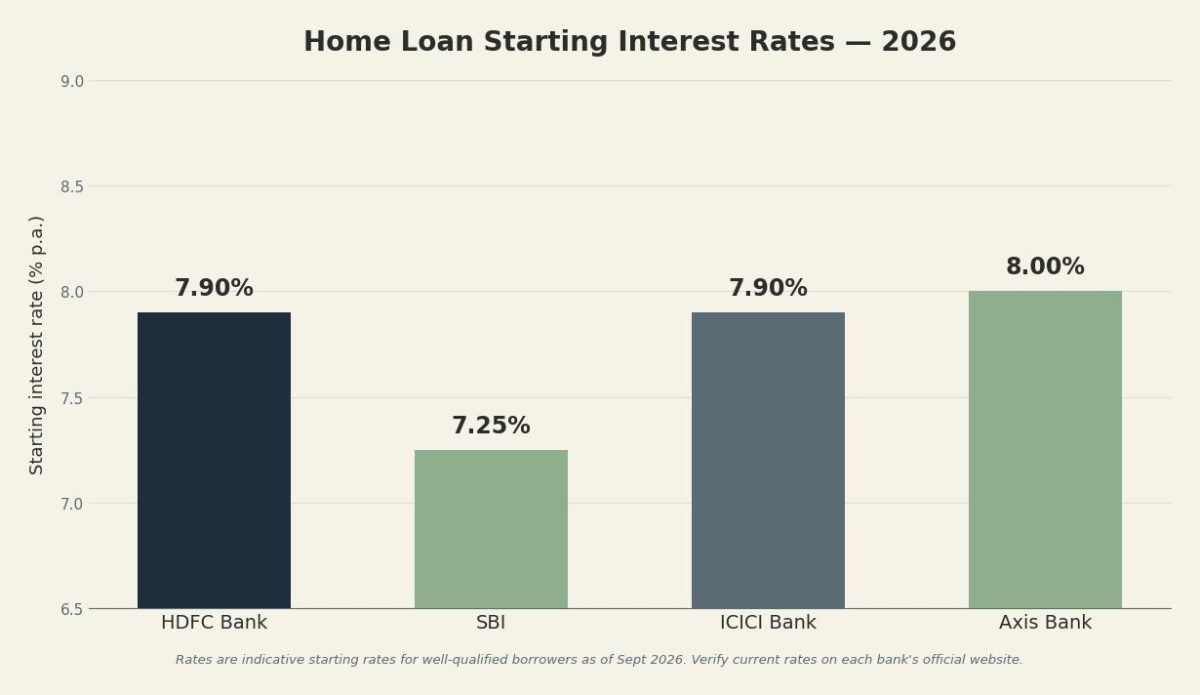
*Rates are indicative, subject to change, and depend on your credit score, income, loan amount, employment type, and the bank’s periodic revisions. Always verify the current card rate on HDFC Bank’s official website before applying.
How HDFC Home Loan Interest Rates Work
Unlike a fixed grocery bill, your home loan interest rate isn’t a single number that applies to everyone. HDFC Bank — like most Indian lenders — prices home loans on a risk-based model. That means two people borrowing the exact same amount for the exact same property could end up with noticeably different interest rates, purely because of differences in their credit profile.
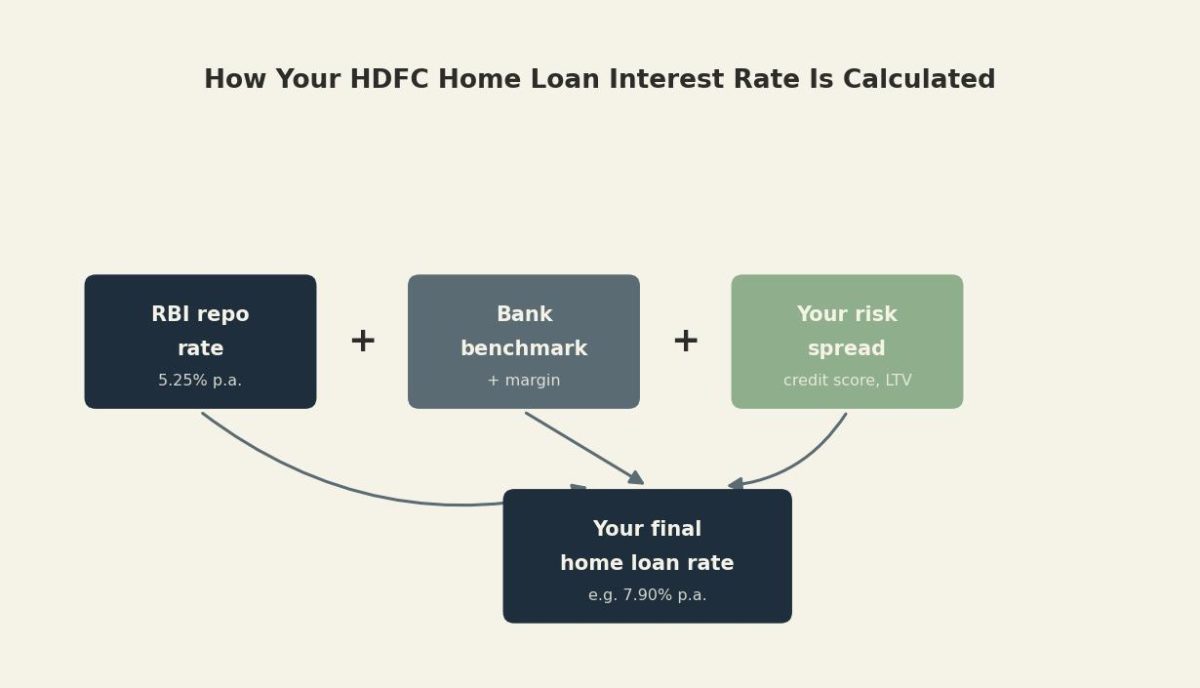
Here’s the structure you need to understand:
1. The Benchmark Rate
HDFC Bank’s home loan rates are linked to an internal benchmark — historically the Retail Prime Lending Rate (RPLR), and for newer floating-rate loans, rates are also influenced by the RBI’s repo rate movements. As of September 2026, the RBI’s policy repo rate stands at 5.25%, having been cut gradually through late 2025 as inflation eased. When the RBI changes the repo rate, banks eventually pass on some (not always all) of that change to borrowers, especially those on repo-linked or floating-rate loans.
2. The Spread (Your Personal Risk Premium)
On top of the benchmark, the bank adds a “spread” — an extra percentage based on your individual risk profile. This is where your credit score, income stability, loan-to-value ratio, and employment type come in. A borrower with a credit score above 750, stable income, and a smaller loan-to-value ratio typically gets the lowest end of the spread. Someone with a thin credit file or higher perceived risk lands on the higher end.
3. Fixed vs Floating vs Hybrid (TruFixed)
HDFC offers three broad structures:
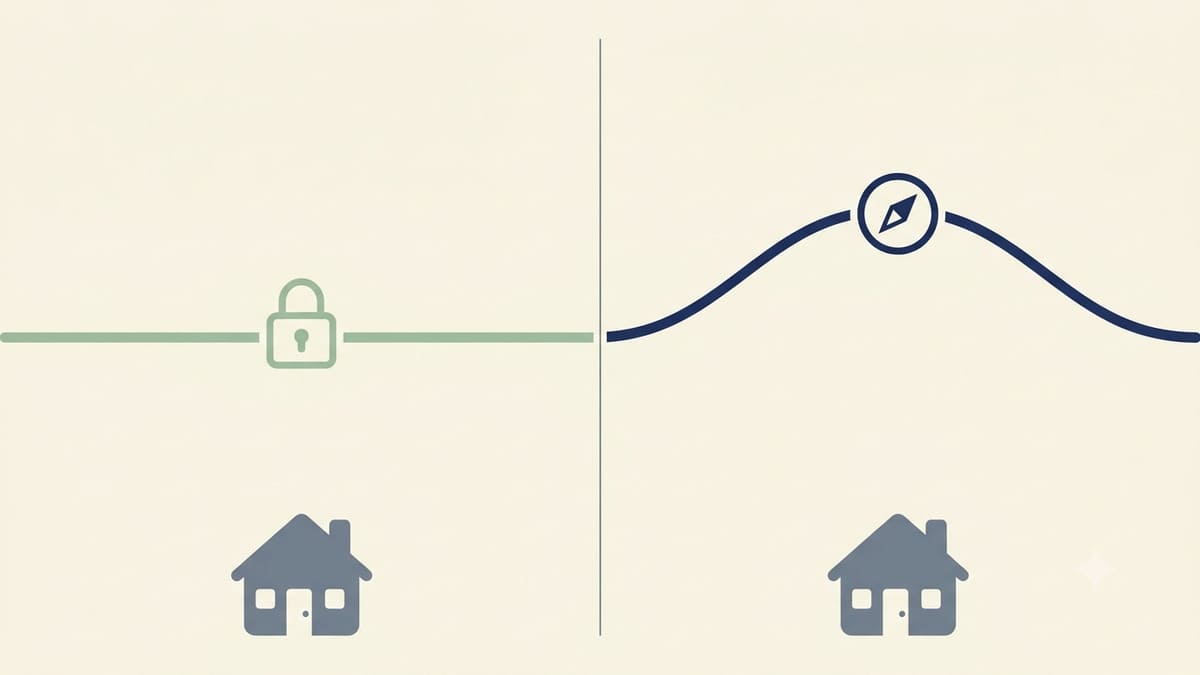
- Adjustable Rate Home Loan (ARHL) / Floating Rate: Your interest rate moves with the market benchmark. It can go up or down during your tenure. Most borrowers in India choose this because it’s usually cheaper over the long run and floating rates come with no prepayment penalty.
- TruFixed Loan: The rate stays fixed for an initial period (commonly the first two years), after which it automatically converts to a floating rate. This gives you short-term predictability if you expect rates to rise soon.
- Fixed Rate (full tenure): Rare in the housing loan space now and usually priced noticeably higher, since the bank is taking on the interest-rate risk instead of you.
Why Your Interest Rate Might Differ From Your Neighbour’s
It’s common to see two friends who bought similar flats end up with different EMIs. Here’s what typically explains the gap:
Credit score (CIBIL score): This single number carries enormous weight. A score of 750+ generally unlocks the best available rates. Anything below 650 usually means a higher spread — or in some cases, rejection. If you haven’t checked your score in a while, it’s worth doing before you start loan shopping — you can pull your report directly from CIBIL’s official website.
Loan-to-Value (LTV) ratio: The lower the percentage of the property value you’re borrowing, the safer you look to the lender. Someone making a 30% down payment (70% LTV) will often get a slightly better rate than someone borrowing 90% of the property value.
Income type and stability: Salaried employees at reputed companies, especially in government or listed private-sector jobs, are generally seen as lower risk than self-employed applicants with fluctuating income, simply because income proof is easier to verify.
Loan amount: Very large loan amounts (super-prime borrowers) sometimes get preferential pricing, while small-ticket loans in certain segments may carry a slightly different spread.
Existing relationship with the bank: If you already have a salary account, fixed deposits, or another loan with HDFC Bank, you may be eligible for relationship-based rate concessions — always worth asking your relationship manager directly.
Property location and type: Loans for ready-to-move-in flats in well-documented, RERA-registered projects are usually processed faster and sometimes priced more competitively than loans for under-construction or non-approved projects.
HDFC Home Loan Eligibility Criteria
Before you fall in love with a particular flat or plot, it’s worth checking whether you’d actually qualify for the loan amount you need. HDFC Bank’s eligibility assessment generally looks at the following broad parameters:
| Criteria | Salaried Applicants | Self-Employed Applicants |
|---|---|---|
| Age | 21 to 65 years (at loan maturity) | 21 to 70 years (at loan maturity) |
| Minimum income | Varies by city; typically ₹15,000–₹25,000/month | Business/professional income proof for the last 2–3 years |
| Work experience | Minimum 1–2 years in current job (varies) | Minimum 3 years in the same business/profession |
| Credit score | 750+ ideal for best rates | 750+ ideal for best rates |
| Loan-to-Value (LTV) | Up to 75–90% depending on loan amount | Up to 75–90% depending on loan amount |
| Maximum tenure | Up to 30 years | Up to 30 years |
These figures are indicative ranges seen across the industry and HDFC’s typical policy — actual eligibility depends on your specific profile, the city you’re buying in, and internal underwriting norms that can change over time. It’s always best to run your numbers through the official eligibility calculator or speak with a loan officer directly.
A useful rule of thumb: most lenders, including HDFC, try to keep your total EMI obligations (including any existing loans) within roughly 40–50% of your monthly take-home income. If you’re already paying EMIs on a car loan or personal loan, factor that in before estimating how much home loan you can comfortably service.
Types of HDFC Home Loan Products
HDFC Bank doesn’t offer a single, one-size-fits-all home loan — there’s a product for almost every stage of the homeownership journey:
- Home Loan: The standard product for purchasing a new or resale residential property.
- Home Loan Balance Transfer: Designed for existing borrowers with another lender who want to move their outstanding loan to HDFC, usually to access a lower rate or better service.
- Plot + Construction Loan: For buyers who purchase a plot of land and then build a house on it, disbursed in stages as construction progresses.
- Home Renovation Loan: For repairs, remodeling, or upgrading an existing home, typically with a shorter tenure than a standard home loan.
- Home Extension Loan: For adding a floor or extra rooms to your existing property.
- Top-Up Loan: An additional loan on top of your existing home loan, usable for almost any personal or financial need, offered to borrowers with a clean repayment track record.
- NRI Home Loan: A tailored product for Non-Resident Indians looking to buy property in India, with slightly different documentation requirements around power of attorney and repayment sources.
Each of these products can carry a slightly different interest rate band, since the risk profile of, say, a plot-and-construction loan differs from a straightforward resale purchase. Always ask specifically about the rate applicable to the exact product you need.
Understanding Home Loan Balance Transfer: Is It Worth It?
If you took your home loan a few years ago — especially during a period of higher interest rates — it’s worth periodically checking whether a balance transfer makes financial sense. Here’s how to think about it:
When a balance transfer usually makes sense:
- The rate difference between your current lender and the new offer is 0.4%–0.5% or more.
- You have a long remaining tenure (transfers save more money when there are many years of interest left to pay).
- Your credit score has improved significantly since you first took the loan, qualifying you for a meaningfully better rate.
When it might not be worth it:
- Your remaining tenure is short (say, under 5 years), in which case the processing fees and paperwork may outweigh the interest savings.
- The new lender’s processing fee, legal charges, and other switch-related costs eat up most of the potential savings.
A simple way to decide: calculate your total interest savings over the remaining tenure at the new rate, then subtract all transfer-related costs. If what’s left is a meaningful amount — and not just a few thousand rupees — the switch is usually worth pursuing.
Home Loan Protection: Should You Buy Insurance?
Lenders, including HDFC, often offer (and sometimes bundle) a home loan protection insurance plan alongside the loan. This is worth understanding clearly:
- What it covers: In the event of the borrower’s death or, in some plans, critical illness or disability, the outstanding loan amount is settled by the insurer, protecting your family from being burdened with the remaining EMIs.
- Is it mandatory? No — home loan insurance is optional in India, and you are not legally required to buy it from the same bank that’s financing your loan. You’re free to compare standalone term insurance plans, which are sometimes more cost-effective for the same coverage.
- What to check before buying: the premium payment structure (single premium vs. regular), whether the cover reduces as your loan balance reduces, and whether it’s bundled into your loan amount (which means you’d be paying interest on your insurance premium too).
It’s a genuinely useful safety net for a family relying on a single income, but it’s worth comparing a few options rather than accepting the first bundled offer without checking the market.
HDFC Home Loan EMI: How to Estimate Your Monthly Outgo
Before you commit, it helps to understand roughly what your EMI (Equated Monthly Installment) will look like. The formula lenders use is:
EMI = [P × R × (1+R)^N] / [(1+R)^N – 1]
Where P is the principal loan amount, R is the monthly interest rate (annual rate ÷ 12 ÷ 100), and N is the number of monthly installments.
You don’t need to calculate this by hand — use our free Home Loan EMI Calculator to get an instant estimate by simply entering the loan amount, tenure, and rate. As a rough reference point, at an 8.5% floating rate over 20 years, the EMI works out to approximately ₹867 per lakh borrowed. So on a ₹50 lakh loan, you’re looking at an EMI in the region of ₹43,000, though your actual figure will vary based on your final sanctioned rate.
A tip that saves real money: Even a 0.25% difference in your interest rate can change your total interest outgo by lakhs of rupees over a 20-year tenure. It genuinely pays to negotiate, compare, and shop around before signing.
Fixed vs Floating: Which Should You Choose in 2026?
This is one of the most common questions borrowers ask, and there’s no universal right answer — it depends on your risk appetite and the interest rate cycle.
Choose floating if:
- You want the flexibility to prepay without penalty (floating-rate home loans in India carry no foreclosure charges for individual borrowers, as per RBI guidelines).
- You believe rates are more likely to fall or stay stable over your loan tenure — which aligns with the current environment, where the RBI has been on a rate-cutting path through 2025–26.
- You want to benefit automatically if the RBI cuts rates further.
Choose TruFixed (hybrid) if:
- You want certainty in your EMI for the first couple of years, perhaps because you’re early in your career or managing other large expenses.
- You’re worried about a possible rate hike in the near term and want to lock in today’s pricing for a defined period.
Most financial planners recommend floating rates for long-tenure home loans (15–30 years) simply because interest rate cycles move up and down repeatedly over such a long period, and floating loans let you ride those cycles — plus refinance or prepay freely if a better deal comes along.
Step-by-Step: How to Apply for an HDFC Home Loan

- Check your eligibility and credit score first. This saves you from a hard credit inquiry that could ding your score if you’re clearly not going to qualify.
- Gather your documents — identity proof, address proof, income proof (salary slips/ITR), bank statements, and property documents.
- Use the online eligibility calculator on HDFC’s website or app to get an estimate of your loan amount and rate.
- Submit your application online or at a branch, along with the required documents.
- Property and legal verification — HDFC’s team verifies the property title, approvals, and valuation.
- Sanction letter — once approved, you receive a sanction letter mentioning your approved loan amount, tenure, and interest rate.
- Loan agreement and disbursal — after signing the agreement, funds are disbursed, either in full or in tranches for under-construction properties.
Documents Typically Required
- PAN card and Aadhaar card (KYC)
- Passport-size photographs
- Latest salary slips (for salaried applicants) or ITR and business proof (for self-employed applicants)
- Bank statements for the last 6 months
- Property documents (sale agreement, title deed, approved building plan, RERA registration where applicable)
- Processing fee cheque/online payment
Requirements can vary slightly based on your employment category and the property type, so it’s best to get a checklist directly from your HDFC relationship manager.
Fees and Charges You Shouldn’t Overlook
The advertised interest rate isn’t the only cost of a home loan. Before signing, ask specifically about:
- Processing fee: Usually a percentage of the loan amount, subject to a minimum/maximum cap.
- Legal and technical valuation charges
- Stamp duty on the loan agreement (MODT), which varies by state
- Conversion/switch fee, if you want to move from a fixed to a floating rate later, or vice versa
- Prepayment/foreclosure charges — floating-rate loans for individuals generally have none, but fixed-rate loans may carry charges
Reading the full fee schedule (not just the headline interest rate) will give you a much more accurate picture of your total borrowing cost.
7 Practical Ways to Get a Lower HDFC Home Loan Interest Rate
- Improve your credit score before applying. Pay off existing dues, avoid multiple loan inquiries in a short span, and keep your credit utilization low for a few months before applying. (See our detailed guide to improving your CIBIL score for a step-by-step plan.)
- Increase your down payment. A lower loan-to-value ratio often translates into a better rate and lower overall risk for the lender.
- Choose a shorter tenure if you can afford the EMI. Shorter tenures sometimes come with marginally better pricing and dramatically reduce your total interest paid.
- Add a co-applicant with strong income. A working spouse or family member as a co-applicant can improve your combined eligibility and sometimes your rate.
- Leverage an existing relationship with HDFC Bank. Salary account holders or existing customers sometimes get preferential pricing — always ask.
- Negotiate, especially with a strong profile. Loan pricing has room for negotiation, particularly for borrowers with excellent credit history and stable, high income.
- Consider a balance transfer later. If your credit profile improves after a couple of years, transferring your loan to a lower rate (with HDFC or another lender) can meaningfully cut your interest cost — just weigh the transfer costs against the savings first.
HDFC vs Other Major Lenders: A Quick Perspective
As of 2026, home loan interest rates across major Indian banks broadly start in a similar band — public sector banks like SBI often advertise slightly lower starting rates (around 7.25%–8.70%), while large private banks including HDFC Bank, ICICI Bank, and Axis Bank price competitively in a similar range depending on borrower profile. The lowest advertised “starting from” rate is rarely what every borrower gets — your final rate depends entirely on your individual credit profile, so it’s worth getting a few in-principle quotes before deciding. If you’d like a side-by-side breakdown, check out comparison of SBI vs HDFC home loan interest rates.
Rather than chasing the lowest headline number alone, compare the effective cost: interest rate + processing fees + any hidden charges + flexibility to prepay, since a slightly higher rate with zero prepayment penalty can sometimes work out cheaper for a disciplined borrower who plans to prepay aggressively.
Tax Benefits on Your HDFC Home Loan
One thing that often gets overlooked in the rate-shopping process is the tax advantage home loans carry under the Indian Income Tax Act:
- Section 24(b): Deduction of up to ₹2 lakh per year on the interest paid, for a self-occupied property.
- Section 80C: Deduction of up to ₹1.5 lakh per year on the principal repaid (within the overall 80C limit, which also covers PPF, ELSS, and other instruments).
- Section 80EEA (where applicable): Additional deduction for first-time home buyers on affordable housing loans, subject to conditions.
These benefits effectively reduce your real cost of borrowing, so it’s worth factoring them into your comparison rather than looking only at the headline interest rate. For a deeper breakdown with examples, read abount home loan tax benefits under Section 24 and 80C. Since tax rules change from year to year, it’s a good idea to confirm the latest applicable limits with a qualified chartered accountant or the official Income Tax Department website before filing.
Common Mistakes Borrowers Make
- Focusing only on the interest rate and ignoring processing fees, insurance bundling, and prepayment terms.
- Not checking their credit score before applying, leading to a lower-than-expected offer or rejection.
- Choosing the maximum tenure just to reduce EMI, without realizing how much extra interest that adds up to over the years.
- Not reading the fine print on fixed-to-floating conversion clauses, especially with TruFixed products.
- Skipping a comparison across lenders and going with the first offer received.
A little diligence upfront — comparing two or three lenders, checking your credit report, and reading the sanction letter carefully — can save you a significant amount of money over a 15–20 year loan.
Frequently Asked Questions (FAQs)
Q1. What is the current HDFC home loan interest rate?
Ans– As of September 2026, HDFC Bank’s home loan interest rates start from around 7.90% p.a. for well-qualified salaried borrowers, going up depending on credit profile, loan amount, and employment category. Always check the official HDFC Bank home loan interest rates page for the exact current card rate, since rates are revised periodically.
Q2. Is HDFC home loan interest rate fixed or floating?
Ans– HDFC offers both. Most borrowers opt for the Adjustable Rate Home Loan (floating), while the TruFixed option keeps your rate fixed for an initial period before converting to floating.
Q3. How is my HDFC home loan interest rate decided?
Ans – It’s based on the bank’s benchmark rate plus a spread determined by your credit score, income profile, loan-to-value ratio, employment type, and the property being financed.
Q4. Can I reduce my existing HDFC home loan interest rate?
Ans – Yes. You can use HDFC’s rate conversion facility (for a nominal fee) to switch to the bank’s latest rate, or consider a balance transfer to another lender if you find significantly better terms elsewhere.
Q5. Is there a prepayment penalty on HDFC home loans?
Ans – For individual borrowers on floating-rate home loans, there is generally no prepayment or foreclosure penalty, in line with RBI guidelines. Fixed-rate loans may carry charges — confirm this in your loan agreement.
Q6. What credit score do I need for the best HDFC home loan rate?
Ans – Generally, a CIBIL score of 750 or above puts you in the best pricing bracket. Scores below that may still qualify but typically at a higher spread.
Q7. Does HDFC offer home loans to self-employed individuals?
Ans – Yes, HDFC Bank offers home loans to self-employed professionals and business owners, though documentation requirements (like ITRs and business proof) and pricing may differ slightly from salaried applicants.
Q8. Is HDFC home loan good for first-time buyers?
Ans- Yes, due to competitive interest rates, long tenure, and flexible repayment options, HDFC is suitable for first-time home buyers.
Final Thoughts
Home loan interest rates will always fluctuate with the broader economy, but the factors within your control — your credit score, your down payment, your choice of tenure, and how carefully you compare lenders — matter just as much as the headline rate a bank advertises. Before signing anything, get a written sanction letter, read the fee schedule line by line, and don’t hesitate to negotiate or shop around. A well-informed borrower with a strong credit profile is almost always in a position to get a better deal than the “starting from” rate splashed across a homepage.
Disclaimer: Interest rates, fees, and eligibility criteria mentioned in this article are indicative and subject to change at the bank’s discretion. Please verify the latest rates and terms directly with HDFC Bank or its official website before making any borrowing decision. This article is for informational purposes only and does not constitute financial advice.

Shilpesh Rathod is the founder of All Finance Knowledge. He holds a B.Com degree along with JAIIB and CAIIB banking certifications, and brings 19+ years of experience in the banking sector across savings, investments, and financial planning. Read more: https://allfinanceknowledge.com/about-us/
2 thoughts on “HDFC Home Loan Interest Rates 2026: Latest Rates, EMI Calculator, Eligibility & Smart Saving Tips”