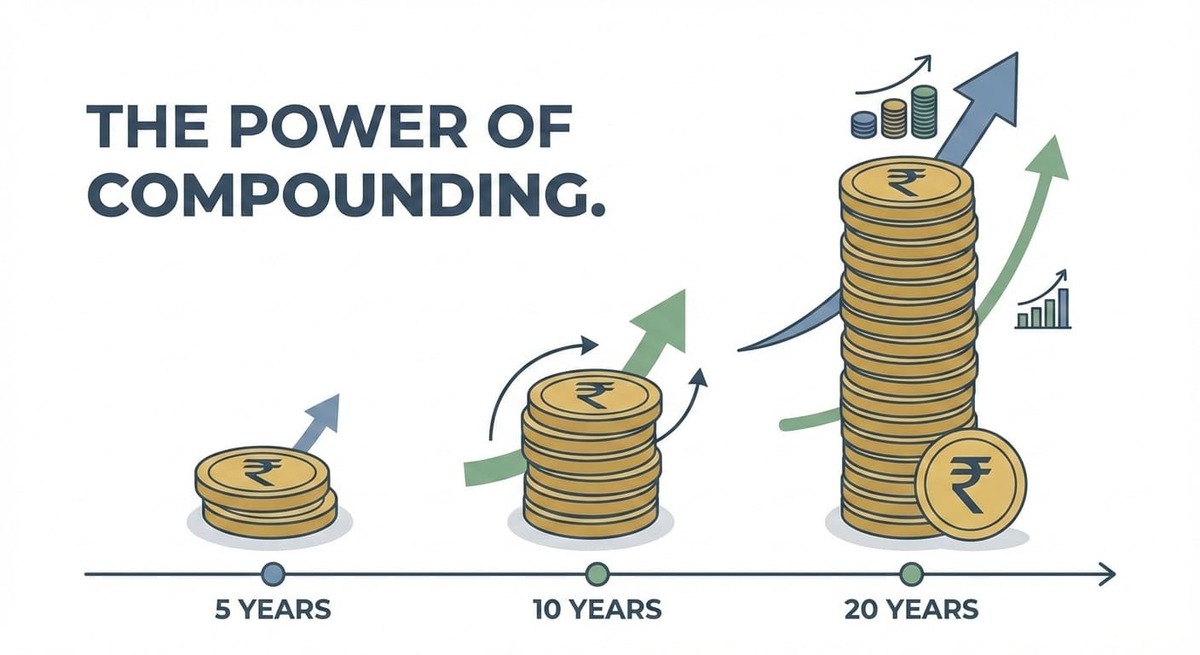
Have you ever wondered why your grandparents keep saying “start investing early, beta, don’t wait”? Or why every finance influencer on Instagram keeps throwing around the phrase “power of compounding” like it’s some kind of magic spell?
Here’s the truth: it kind of is magic. Except it’s not magic at all — it’s math. Simple, predictable, unglamorous math that quietly turns small, boring monthly investments into life-changing wealth if you give it enough time.
This guide breaks down how compounding works, using plain language, real numbers, and examples anyone can follow — even if you’ve never opened a demat account in your life. By the end, you’ll understand not just the concept, but exactly how to use it to build wealth for yourself, starting with whatever amount you have today.
If you’re completely new to money management, it might help to first skim our beginner’s guide to personal finance — it covers the foundational habits that make compounding possible in the first place.
1. What Is Compounding, Really?
Let’s strip away the jargon. Compounding simply means you earn returns on your original investment, and then you also earn returns on those returns.
Say that again slowly: money earns money, and then that new money also earns money.
Think of it like a snowball rolling down a hill. At the top of the hill, it’s small and moves slowly. But as it rolls, it picks up more snow, gets bigger, and starts moving faster — not because the hill got steeper, but because the snowball itself got bigger. That’s exactly how your wealth behaves when compounding kicks in.

According to Investopedia’s definition of compound interest, compounding is the process by which interest is added to the principal sum, so that going forward, the added interest also earns interest. It’s the single biggest reason why long-term investors consistently outperform people who try to time the market or chase quick profits.
The basic idea in one line:
Wealth = Principal + Interest Earned + Interest on That Interest
The longer your money stays invested, the more powerful this snowball effect becomes. This is also why understanding saving vs. investing matters so much — parking money in a low-interest savings account barely lets compounding do its job.
2. Simple Interest vs. Compound Interest
Numbers make this instantly clear. Let’s compare the two using the exact same starting amount.
Simple Interest Example
- You invest ₹10,000 at 10% annual interest
- Every year, you earn a flat ₹1,000
- After 10 years → Total = ₹20,000
Compound Interest Example
- You invest ₹10,000 at 10%, compounded annually
- Each year’s interest gets added back to the principal
- After 10 years → Total ≈ ₹25,937
Same starting money. Same interest rate. Same time period. But compounding earned you nearly ₹6,000 more — purely because your interest was allowed to earn its own interest.
| Feature | Simple Interest | Compound Interest |
|---|---|---|
| Interest calculated on | Original principal only | Principal + accumulated interest |
| Growth pattern | Straight line (linear) | Curved, accelerating (exponential) |
| Best for | Short-term loans | Long-term wealth building |
| 10-year result on ₹10,000 @ 10% | ₹20,000 | ₹25,937 |
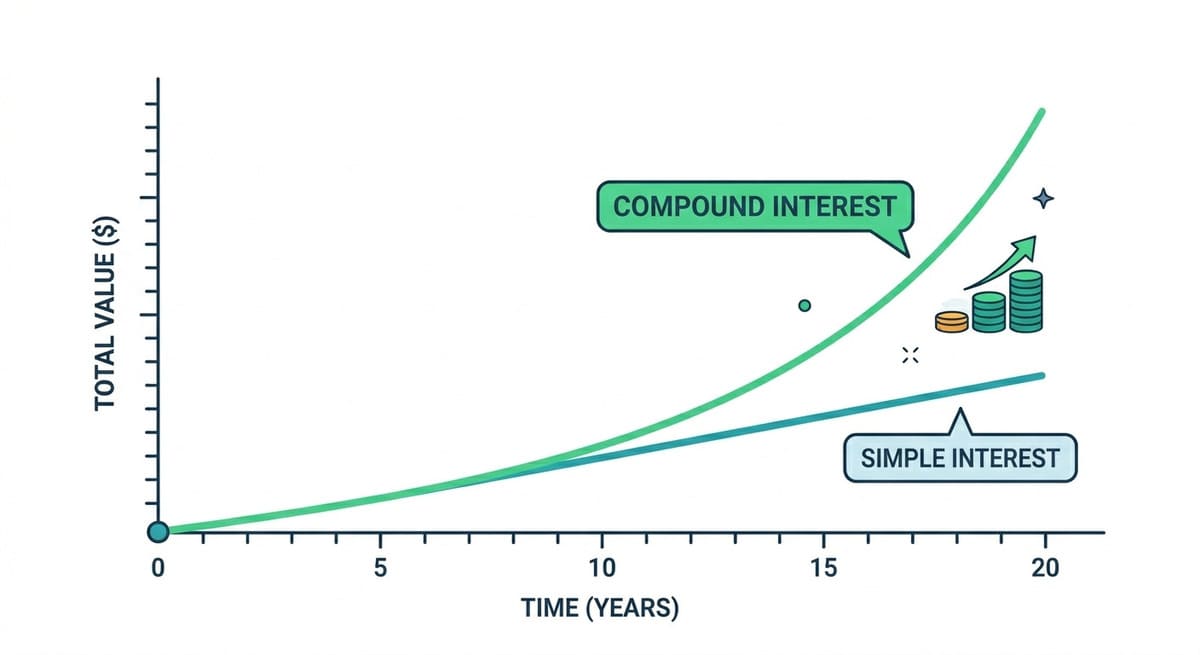
This one comparison is the entire reason financial advisors keep repeating the same advice: start early, stay invested, and let compounding do the heavy lifting.
3. The Compounding Formula (Explained Without the Math Headache)
You don’t need to memorize this to benefit from compounding, but it helps to see where the numbers come from.
A = P (1 + r/n)^(nt)
Where:
- A = final amount
- P = principal (your initial investment)
- r = annual interest rate (in decimal form)
- n = number of times interest compounds per year
- t = number of years invested
Don’t worry if this looks intimidating — every mutual fund website, SIP calculator, and even a basic Excel sheet will do this math for you instantly. What matters is understanding the relationship: as t (time) goes up, growth doesn’t just add up — it multiplies on itself.
4. Real Examples: How Compounding Works With Actual Numbers
Theory is nice, but numbers convince people. Let’s look at how compounding plays out in real investing scenarios that most Indian investors actually use.
Example 1: A Simple Monthly SIP
Suppose you invest ₹5,000 per month in a mutual fund SIP earning an average 12% annual return.
| Investment Period | Total Invested | Value After Compounding |
|---|---|---|
| 10 years | ₹6 lakh | ~₹11.6 lakh |
| 20 years | ₹12 lakh | ~₹49.9 lakh |
| 30 years | ₹18 lakh | ~₹1.76 crore |
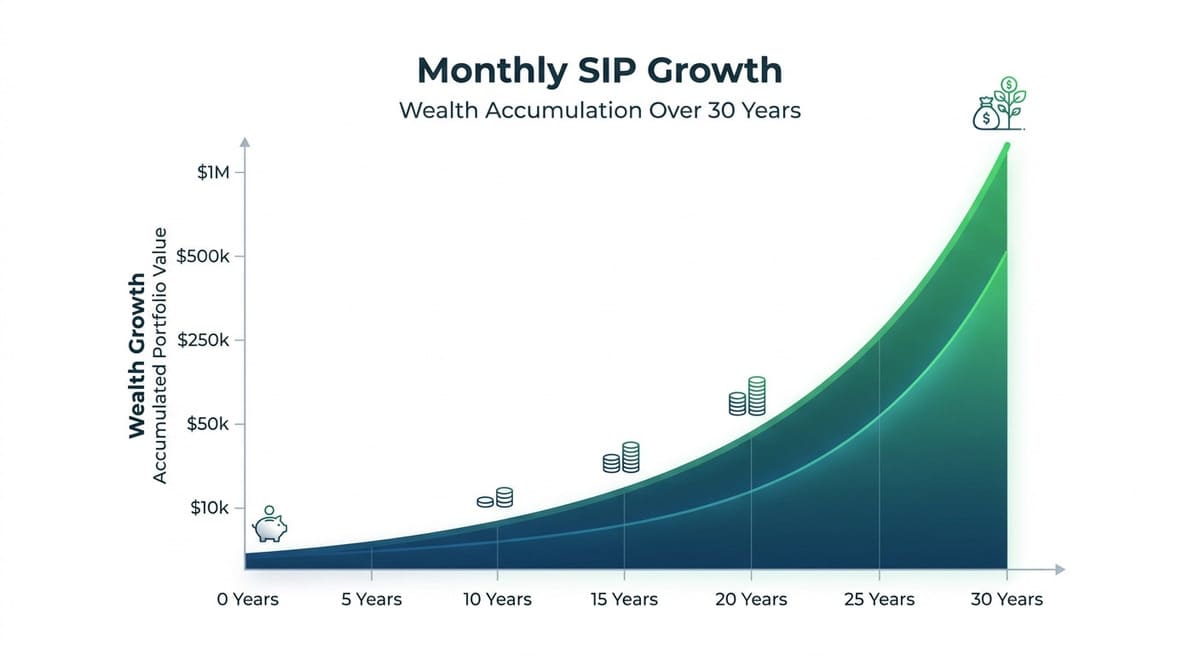
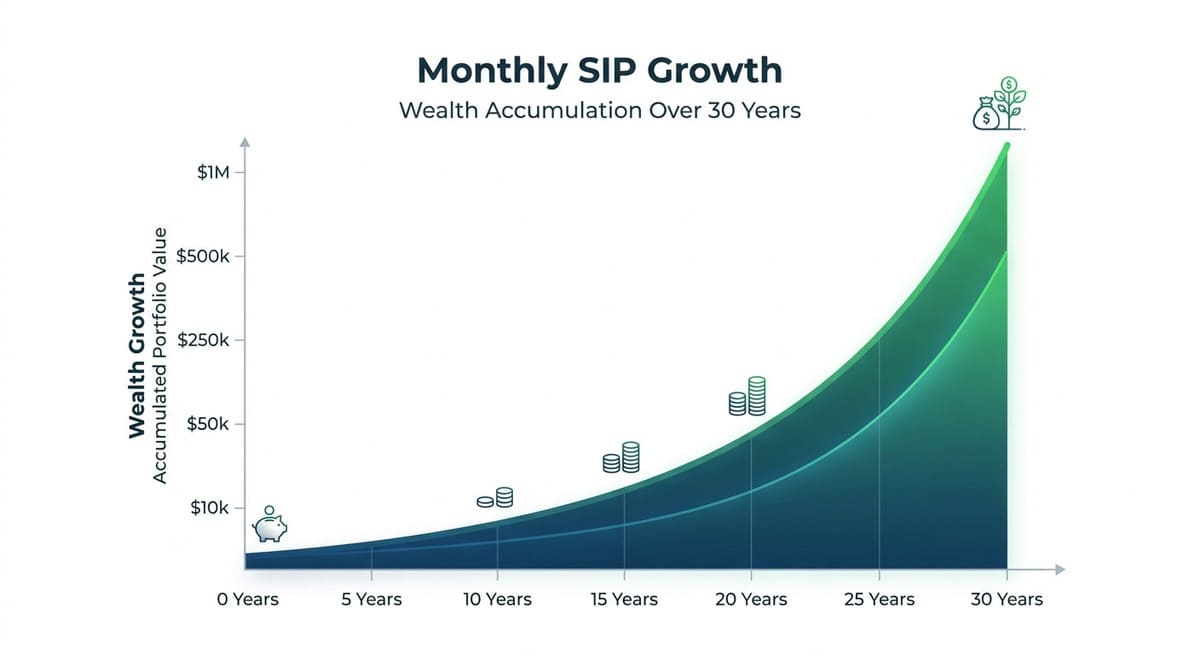
Notice something important here: between year 20 and year 30, you only added ₹6 lakh more of your own money — but your total wealth jumped by over ₹1.26 crore. That jump is compounding accelerating in the later years. This is exactly how compounding works — slow in the beginning, explosive toward the end.
Example 2: Starting Early vs. Starting Late
This is the example that convinces most people to stop procrastinating.
Person A — The Early Starter
- Starts investing at age 25
- Invests ₹5,000/month
- Stops completely at age 35 (only 10 years of investing)
- Total invested: ₹6 lakh
- Then simply lets the money sit untouched until age 60
Person B — The Late Starter
- Starts investing at age 35
- Invests ₹5,000/month
- Continues steadily until age 60 (25 years of investing)
- Total invested: ₹15 lakh
Assuming a 12% annual return for both:
- Person A’s final value at 60 ≈ ₹1.1 crore
- Person B’s final value at 60 ≈ ₹95 lakh
Read that again. Person A invested less than half the money Person B did — and still ended up wealthier, simply because their money had more years to compound. This single example captures the entire philosophy behind “time in the market beats timing the market.”
Example 3: Small but Consistent Investing
Many beginners assume compounding is only for people with big salaries. That’s false.
- ₹2,000 per month
- 12% annual return
- 25 years
Total invested: ₹6 lakh Final value: ~₹38 lakh
The lesson isn’t the amount — it’s the consistency and the time horizon. If you’re not sure where to begin with small, regular investments, our guide on SIP investing for long-term wealth walks through the exact steps.
5. Why Time Beats Timing
Most beginners obsess over the wrong things:
- ❌ Finding the “next multibagger” stock
- ❌ Trying to time market highs and lows
- ❌ Chasing funds with the highest recent returns
The real secret isn’t a hot stock tip — it’s time. Here’s how compounding typically plays out over a 30-year investment horizon:
- First 10 years: Growth feels painfully slow. You keep investing, and the numbers barely seem to move. This is the phase where most people give up.
- Next 10 years: Growth starts noticeably accelerating. The account balance finally starts looking meaningfully bigger than what you put in.
- Final 10 years: Wealth explodes. The bulk of your total gains typically happen in this last stretch — not because you invested more, but because your existing corpus is now large enough for compounding to work on a bigger base.
This is precisely why long-term investors — the ones who stay invested through market crashes, recoveries, and boring sideways years — end up far ahead of short-term traders. If you want to understand this trade-off in more depth, read our comparison of long-term vs. short-term investing.
6. How Compounding Frequency Changes Your Returns
Here’s a detail most beginners miss: compounding doesn’t always happen once a year. Depending on the product, interest can compound:
- Annually — once a year
- Semi-annually — twice a year
- Quarterly — four times a year
- Monthly — twelve times a year
- Daily — every single day (common with some savings instruments and credit cards)
The more frequently interest compounds, the faster your money technically grows — because each compounding cycle adds interest back to the principal sooner, giving it a head start on earning even more.
Quick Comparison:
- Investment: ₹1,00,000 at 10% annual rate
- Compounded annually: After 1 year → ₹1,10,000
- Compounded quarterly: Interest is added four times through the year → final amount is slightly higher than ₹1,10,000
In a single year, the difference looks tiny — maybe a few hundred rupees. But stretch that gap across 15–20 years, and compounding frequency alone can add up to a meaningfully larger corpus. This is one reason it’s worth comparing the fine print between products like SIPs and recurring deposits — the compounding frequency and effective return often differ more than the headline interest rate suggests.
7. The Rule of 72: The Fastest Way to Estimate Growth
If you want a mental shortcut — no calculator, no app — to estimate how long it takes your money to double, use the Rule of 72.
Formula:
Years to Double = 72 ÷ Annual Interest Rate
Example:
If your investment earns 12% annually:
72 ÷ 12 = 6 years
That means your money doubles roughly every 6 years at a 12% return. Invest ₹1 lakh today, and in about 24 years (four doubling cycles), it could theoretically grow to roughly ₹16 lakh — assuming a consistent 12% return, which real markets rarely deliver in a straight line, but it’s a useful ballpark.
This rule works beautifully as a quick gut-check whenever you’re comparing investment options, evaluating a fixed deposit rate, or just want to know “how long until this doubles” without opening a calculator app.
8. Compounding in Everyday Life (Not Just Money)
Compounding isn’t confined to bank statements and mutual fund folios — it shows up everywhere in life, for better or worse.
Positive Compounding
- Learning a skill daily: 20 minutes of practice a day feels pointless in week one. By year three, it’s the difference between a beginner and an expert.
- Saving consistently: Small, automated savings each month compound into a meaningful emergency fund or investment corpus.
- Healthy habits: Exercising regularly, reading daily, or building a professional network — each small action compounds into outsized long-term results.
Negative Compounding
Compounding cuts both ways, and this is the side nobody talks about enough:
- Credit card debt: Interest rates on unpaid credit card balances in India often run between 30–45% annually. Left unpaid, this compounds against you just as aggressively as SIP returns compound in your favor.
- High-interest personal loans: Similar story — the longer a high-interest loan sits unpaid, the more the compounding works against your finances.
- Bad financial habits: Repeated impulsive spending, ignoring your credit score, or missing EMI payments all compound into bigger long-term problems.
If your credit score has taken a hit from this kind of negative compounding, our guide on how to improve your CIBIL score is a good next read. And if you’re weighing borrowing options, it’s worth comparing personal loans vs. credit card loans before compounding debt works against you.
The core lesson: just as money grows exponentially when invested wisely, debt grows exponentially when ignored. Compounding is neutral — it amplifies whatever direction you’re already moving in.
9. How Much Money Do You Actually Need to Start?
This is probably the single biggest myth stopping people from investing: “I’ll start once I have more money.”
That thinking works against you. Compounding rewards time in the market, not the size of your first investment. A ₹2,000/month SIP started today will very likely outperform a ₹10,000/month SIP started five years from now, purely because of the extra years of compounding.
A simple starting framework:
- Start with whatever you can comfortably invest — even ₹500–1,000 a month is a valid starting point.
- Automate it. Set up an auto-debit so you’re not relying on willpower every month.
- Increase it gradually. As your income grows, increase your SIP amount — this is sometimes called a “step-up SIP.”
- Don’t wait for the “perfect” amount or the “perfect” market condition. Both are myths that cost you years of compounding.
If you’re on a tight monthly budget and unsure how to carve out room for investing, our article on planning a monthly budget on a ₹30,000 salary shows practical ways to free up money for consistent investing — and the 50-30-20 budgeting rule is a simple framework for splitting income between needs, wants, and savings/investments.
10. Where Compounding Works Best
Not every financial product lets compounding work at full strength. Here’s where it genuinely shines:
- Mutual Funds (via SIP): Returns are automatically reinvested, letting compounding work continuously. Learn the basics in our beginner’s guide to mutual funds.
- Index Funds: Low-cost, diversified, and ideal for long-term compounding. See how they stack up in our index fund vs. large-cap fund comparison.
- Stocks (long-term holding): Especially with dividend reinvestment, quality stocks held for decades benefit enormously from compounding.
- Public Provident Fund (PPF): A government-backed, tax-efficient compounding instrument popular in India.
- Employee Provident Fund (EPF): Compounds steadily over a working career, forming a strong retirement base.
- Dividend Reinvestment Plans (DRIPs): Automatically reinvest dividends into more shares instead of paying them out as cash.
By contrast, regular savings accounts and most fixed deposits offer relatively low interest rates, which limits how much compounding can realistically achieve — even though the mechanism is technically the same. If you’re deciding between the two, our detailed mutual fund vs. FD comparison breaks down exactly how much more compounding-friendly one option is over the other.
For official, unbiased investor education on how different instruments work in India, the Securities and Exchange Board of India’s investor education portal is a reliable resource worth bookmarking.
11. Common Mistakes That Kill Compounding
Many people unknowingly sabotage their own compounding progress. Watch out for these:
1. Frequent Withdrawals Every time you pull money out of an investment, you interrupt the compounding cycle. Even a single mid-way withdrawal can meaningfully dent your final corpus, because you’re removing the base amount that future growth would have been calculated on.
2. Starting Late As Example 2 above showed, delaying your first investment by even a few years can cost you lakhs — sometimes crores — in future wealth. There’s no way to “catch up” on lost compounding time except investing significantly more money later, which is much harder than starting small and early.
3. Chasing Short-Term Profits Constantly switching funds or stocks in search of quick gains disrupts the long-term compounding curve and usually results in lower returns than simply staying invested.
4. Panic-Selling During Market Falls Markets correct periodically — that’s normal. Selling out of fear during a downturn locks in your losses and permanently stops compounding on that money. Historically, investors who stayed invested through corrections recovered and grew their wealth; those who sold in panic often missed the recovery entirely.
5. Ignoring Fees and Expense Ratios High expense ratios on mutual funds quietly eat into your compounding returns year after year. A 1% difference in fees might sound small, but compounded over 20–30 years, it can cost you a significant chunk of your final corpus.
12. A Simple, Safe Compounding Strategy for Beginners
You don’t need to be a finance expert to make compounding work for you. Here’s a straightforward approach:
- Start a SIP in an index fund or diversified large-cap mutual fund. These offer broad market exposure without requiring you to pick individual stocks.
- Invest on a fixed schedule — ideally monthly. Consistency matters more than trying to time your entry.
- Increase your SIP amount whenever your income increases. Even a 10% annual step-up compounds meaningfully over time.
- Stay invested for the long haul — 15 to 20+ years, ideally. Compounding needs time; don’t interrupt it.
- Review your portfolio annually, not daily. Checking your investments every day only tempts you to react to short-term noise.
- Keep an emergency fund separate from your investments, so you’re never forced to withdraw invested money during a personal financial crunch.
This isn’t a get-rich-quick plan — it’s a get-rich-slowly-but-surely plan, and that’s precisely why it works for ordinary people with ordinary incomes.
13. Compounding vs. Inflation: The Real Fight
Here’s something many beginners overlook: money sitting idle in a savings account isn’t actually “safe” — it’s slowly losing purchasing power.
Inflation in India has historically averaged around 5–6% annually, according to data tracked by the Reserve Bank of India. If your savings account offers 3–4% interest while inflation runs at 6%, your money’s real value is shrinking every year — even though the number on your bank statement keeps growing.
This is exactly why simply saving isn’t enough — you need:
Compounding + Inflation-Beating Returns = Real Wealth Creation
Equity mutual funds, index funds, and long-term stock investments have historically delivered returns well above inflation over extended periods, which is why they remain the preferred vehicles for long-term compounding. To understand this trade-off in more detail, read our breakdown of saving vs. investing, and if you want a structured way to manage your income before investing, the 50-30-20 budgeting rule is a great starting framework.
14. Tools to Track Your Compounding Journey
You don’t need to calculate compound growth by hand. A few practical tools make it effortless:
- SIP calculators offered by most mutual fund platforms and AMC websites let you plug in your monthly amount, expected return, and time horizon to instantly see projected growth.
- Compound interest calculators, widely available online, help you compare simple vs. compound growth for any principal amount and rate.
- Portfolio tracking apps consolidate your mutual funds, stocks, EPF, and PPF in one dashboard so you can watch your compounding progress without manually checking multiple accounts.
- Spreadsheets (Excel or Google Sheets) using the
FV()function are a simple, free way to model your own “what if” compounding scenarios.
Using these tools periodically — say, once every quarter — helps you stay motivated during the slow early years of compounding, when growth feels invisible but is quietly building momentum underneath the surface.
15. Final Thoughts: Why Compounding Is Life-Changing
Compounding doesn’t reward the smartest investor in the room. It rewards:
✔ Patience — the willingness to let your money sit and grow without constant interference ✔ Discipline — investing consistently, month after month, regardless of market mood ✔ Consistency — showing up with the same SIP amount whether markets are up, down, or sideways
You don’t need a six-figure salary or a large lump sum to benefit. You need to start — with whatever amount is realistic for you — and then get out of your own way.
As the saying goes: the best time to start compounding was yesterday. The second-best time is today. If you’ve read this far, you already understand how compounding works better than most people ever will. The only step left is to actually begin.
Frequently Asked Question
Q-1 What is compounding in simple words?
Ans – Compounding means earning returns on both your original investment and on the returns that investment has already generated. In short, your money earns money, and that new money starts earning money too.
Q2. Why is compounding important in investing?
Ans – Compounding is what allows your wealth to grow exponentially rather than in a straight line. It’s the single biggest driver of long-term wealth creation, especially for retail investors who can’t rely on large lump sums.
Q3. Is compounding useful for beginners with small incomes?
Ans – Yes — arguably more than anyone else. Beginners who start small but early often end up wealthier than people who start big but late, simply because time matters more than the initial amount
Q4. Which investment is best for compounding?
Ans – Mutual fund SIPs, index funds, long-term stock holdings, PPF, and EPF are generally considered the most compounding-friendly options because returns are reinvested automatically over long periods.
Q5. Can compounding beat inflation?
Ans – Yes, but only if your investment’s return rate is meaningfully higher than the inflation rate. Equity-oriented investments have historically outpaced inflation over long horizons, unlike most savings accounts and short-term deposits.
Q6. How long should I stay invested for compounding to really show results?
Ans – At minimum, 10–15 years. The most dramatic compounding growth typically shows up in the final third of your investment horizon, so staying invested for 20–30 years produces significantly better results than stopping at 10.
Q7. Does compounding work in fixed deposits?
Ans – Yes, technically — most FDs do compound interest, usually quarterly. However, since FD interest rates are generally lower than equity market returns, the compounding effect is far more modest compared to mutual funds or stocks.
Q8. What’s the biggest mistake that stops compounding from working?
Ans – Withdrawing money early or panic-selling during market downturns. Both actions interrupt the compounding cycle and prevent your money from benefiting from the accelerated growth that typically happens in later years.
Disclaimer: This article is for educational purposes only and does not constitute financial advice. Returns mentioned are illustrative estimates based on assumed rates and are not guaranteed. Please consult a certified financial advisor before making investment decisions.
Related Reads on All Finance Knowledge:
- SIP Investing for Long-Term Wealth: A Simple Guide for Beginners
- Mutual Fund vs FD: Which Is Better for Beginners in India?
- Long-Term vs Short-Term Investing: Key Differences
- Saving vs Investing: Why Saving Alone Isn’t Enough
- Index Fund vs Large Cap Fund: Which Is Safer?

Shilpesh Rathod is the founder of All Finance Knowledge. He holds a B.Com degree along with JAIIB and CAIIB banking certifications, and brings 19+ years of experience in the banking sector across savings, investments, and financial planning. Read more: https://allfinanceknowledge.com/about-us/
9 thoughts on “How Compounding Works: The Complete Beginner’s Guide With Real-Life Examples (2026)”