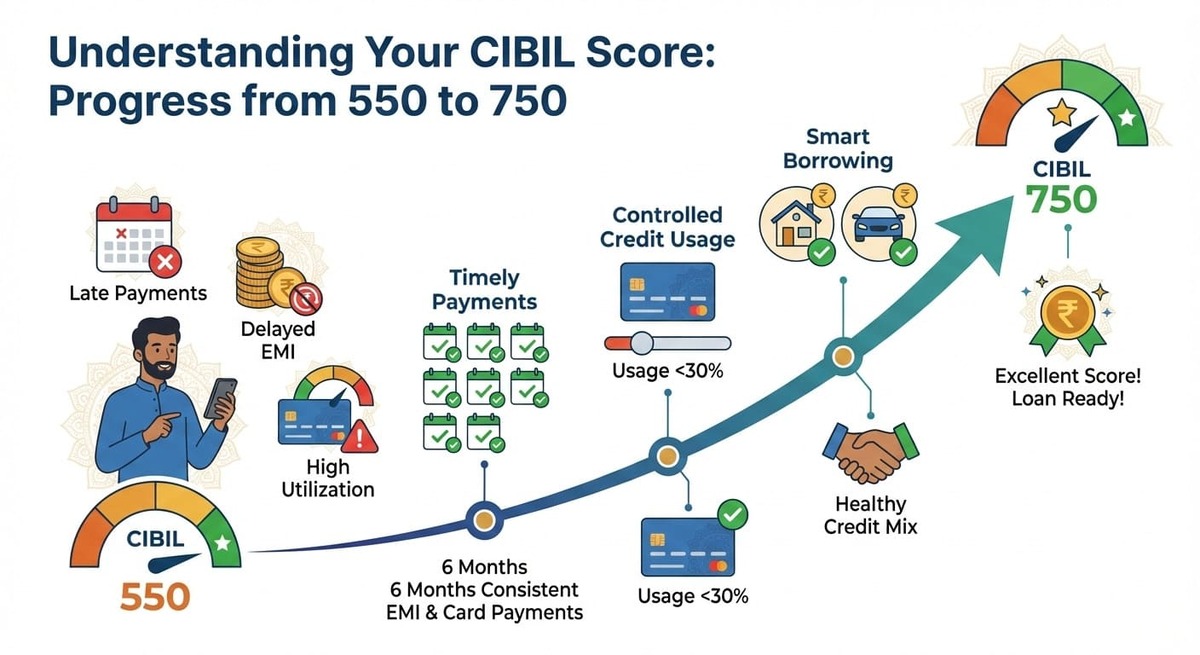
If you’ve just checked your CIBIL score and seen a number like 550 staring back at you, take a breath. It feels worse than it is. A 550 score isn’t a life sentence — it’s a snapshot of your past repayment behaviour, and past behaviour can absolutely be changed with future behaviour.
The frustrating part is that most articles on this topic give you the same five bullet points (“pay on time,” “reduce utilization,” “don’t apply for too many loans”) without explaining why those things matter, how much they matter, or how long it actually takes to see the number move. That vagueness is exactly why so many people in India stay stuck between 550 and 650 for years, doing the “right” things but not doing them in the right order.
This guide is longer than most because we’re going to actually walk through the mechanics — how your score is calculated, what’s dragging yours down right now, and a realistic month-by-month plan to get from 550 to 750 or higher. If you’re also fuzzy on the basics of what a CIBIL score even measures, it’s worth reading our complete explainer on CIBIL scores alongside this one.
What a 550 CIBIL Score Actually Means
Your CIBIL score is a three-digit number between 300 and 900, calculated by TransUnion CIBIL using the data that banks and NBFCs report about your loans and credit cards. Think of it as a report card for how reliably you’ve handled borrowed money over the last several years.
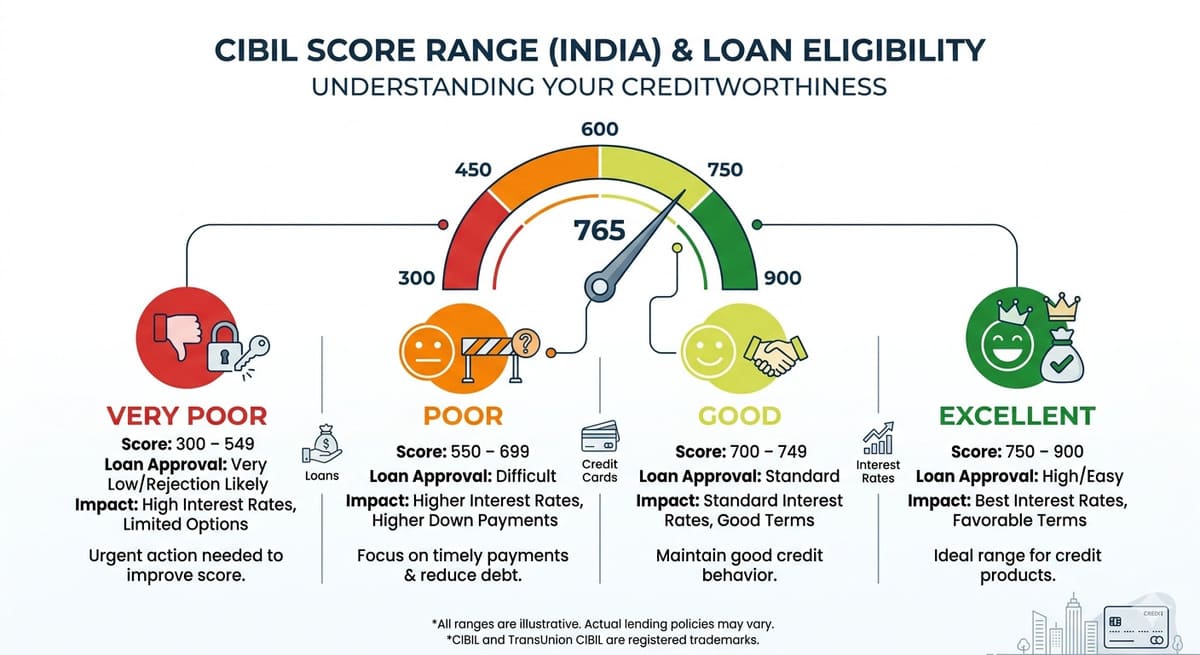
Here’s how lenders in India typically read the range:
| Score Range | Category | What Lenders Think |
|---|---|---|
| 300–549 | Very Poor | High risk — most lenders will decline |
| 550–649 | Poor to Fair | Risky — approvals possible but at higher interest |
| 650–749 | Good | Acceptable — decent approval odds |
| 750–900 | Excellent | Low risk — best interest rates and fastest approvals |
A score sitting at 550 usually points to one or more of these patterns in your credit history:
- Missed or delayed EMI payments
- A credit card bill that went unpaid or was only partially paid
- A loan that was “settled” instead of paid in full
- Credit cards being used close to their limit
- A flurry of loan or credit card applications in a short span
None of these are permanent scars. Every one of them is the result of a specific behaviour, and specific behaviours can be reversed. That’s the entire premise of this guide.
Why Your Score Dropped in the First Place
Before fixing anything, it helps to understand why the number fell, because the reason changes your starting point.
If it was a genuine cash-flow problem (job loss, medical emergency, business slowdown), your credit behaviour itself may have been fine before that period — which is actually good news, because lenders and the scoring model both give more weight to recent behaviour than old behaviour.
If it was carelessness (forgetting due dates, not tracking multiple cards, ignoring small overdue amounts), the fix is largely procedural — reminders, auto-debit, and better tracking will solve most of it.
If it was a settlement or write-off, this is the trickiest category. A “settled” status stays on your report for years and signals to future lenders that you didn’t repay the full amount owed. We’ll cover how to manage this specifically in the special situations section below.
Whatever the reason, your very first move should be to look at your actual credit report rather than guessing which brings us to Step 1 later in this guide.
Is 550 to 750 Really Achievable? Setting Honest Expectations
Yes — thousands of people do this every year. But let’s be upfront about what “achievable” means here, because a lot of websites oversell the speed of this journey.
- There is no legal way to jump 200 points in a month. Anyone promising “instant CIBIL score repair” for a fee is either exaggerating or running a scam. The Reserve Bank of India does not recognize any official “credit repair” service, and TransUnion CIBIL itself states clearly that scores are updated only when lenders report fresh data — usually once a month.
- Realistic timeline: 6 to 18 months for a genuine, sustained jump from 550 to 750, depending on how many negative marks you’re clearing and how disciplined you are.
- The trend matters more than any single month. Lenders (and the scoring algorithm) respond well to a consistent upward trend, even if you’re not at 750 yet.
If someone tells you they can fix your score in a week for a fee, that’s your cue to walk away. The only sustainable path is the boring one: consistent, on-time repayment behaviour, reported month after month.
The Four Pillars That Decide Your CIBIL Score
Nobody outside TransUnion knows the exact formula, but based on published guidance and industry consensus, your score is built from four broad pillars. Understanding the weight of each one tells you where to focus your energy first.
1. Payment History (the biggest factor, roughly 30–35%)
This is simply: did you pay what you owed, when you owed it? One missed payment, especially a recent one, does more damage than almost anything else on this list.
2. Credit Utilization (roughly 25–30%)
How much of your available credit card limit you’re actually using. Someone using ₹90,000 out of a ₹1,00,000 limit looks far riskier to a lender than someone using ₹20,000 of the same limit — even if both pay their bills on time.
3. Credit History Length and Mix (roughly 15–20%)
How long you’ve held credit accounts, and whether you have a healthy mix of secured loans (like a home loan or car loan) and unsecured credit (like credit cards or personal loans).
4. New Credit / Inquiries (roughly 10%)
Every time you apply for a loan or credit card, the lender makes a “hard inquiry” on your report. Too many inquiries in a short window signals that you might be desperate for credit, which worries lenders.
Every step in the plan below maps back to improving one or more of these four pillars.
Step-by-Step Plan: 550 to 750
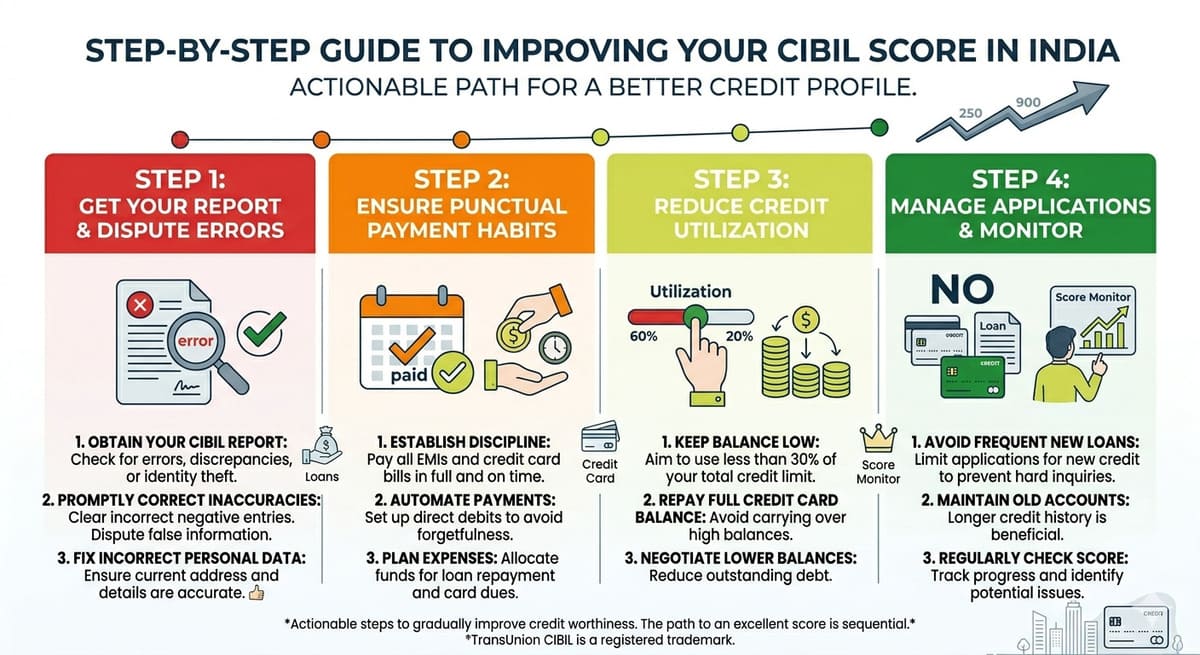
Step 1: Pull Your Full Credit Report and Read It Line by Line
Most people check only their score, not their report. The report is where the actual story lives — every loan, every card, every payment marked late, every inquiry.
What to look for:
- Accounts that aren’t yours (sign of identity theft or a data-entry error)
- Loans marked “active” that you’ve already closed
- Payment dates marked late when you actually paid on time
- Outdated address or personal details linked to the wrong file
Action: If you spot an error, raise a dispute directly with TransUnion CIBIL through their official portal, or ask the reporting bank to correct it. Errors get fixed within 30–45 days typically, and correcting even one wrongly-marked “late payment” can lift your score meaningfully. This step costs you nothing but an hour of your time, and it’s often skipped — don’t skip it.
Step 2: Clear Every Pending Due — Starting with the Smallest
Outstanding dues, even small ones (a ₹500 late fee sitting unpaid on an old card, a forgotten utility EMI), report to the bureau just like large defaults do.
Do this:
- List every account with even a rupee outstanding
- Clear the smallest ones first — this reduces the number of negative marks quickly, which matters as much as the total amount
- Avoid partial payments; a partial payment on a defaulted loan often still shows as “partially settled,” which doesn’t help much
Once dues are cleared and the bank reports the update (usually within 30–45 days), you should start seeing early movement in your score.
Step 3: Never Miss an EMI or Card Bill Again
This is the single highest-weight factor, so it deserves the most discipline.
Practical setup:
- Enable auto-debit or standing instructions for every EMI and credit card minimum due
- Set a calendar reminder 3 days before the due date, not on the day itself, in case of bank processing delays
- If you genuinely can’t pay a bill on time one month, call the lender before the due date — a proactive call and a short extension is far less damaging than a missed payment silently reported to the bureau
If you’re also building broader money habits alongside fixing your score, our guide on personal finance basics for beginners is a useful companion read.
Step 4: Get Your Credit Utilization Under 30% (Ideally Under 10%)
Credit utilization is calculated per card and across all cards combined, so both matter.
Example:
- Card limit: ₹1,00,000
- Keep your outstanding balance below ₹30,000 at any given time — ideally closer to ₹10,000 for the fastest score improvement
Pro tip most people miss: Your utilization is usually reported based on your statement date balance, not your due date balance. So even if you pay your full bill by the due date, if your balance was high on the statement date, that’s the number that gets reported. Paying down your balance a few days before the statement is generated (not just before the due date) keeps your reported utilization low.
Step 5: Stay Away from Loan Settlements
A “settlement” means you negotiated to pay less than what you actually owed, and the lender agreed to close the account as “settled” rather than “closed.” It sounds like relief in the moment, but it’s one of the most damaging tags on a credit report — it can stay visible for years and signals to future lenders that you didn’t honour the full agreement.
Better alternatives if you’re struggling:
- Ask for loan restructuring (extending tenure to reduce EMI)
- Negotiate a revised repayment schedule instead of a lump-sum settlement
- Convert credit card dues into a structured EMI plan through the bank
If you’ve already settled a loan in the past, it’s not the end of the road — its negative weight on your score fades over time as you build new, positive repayment history on top of it.
Step 6: Space Out Your Loan and Credit Card Applications
Every application triggers a hard inquiry, and a cluster of inquiries in a short window makes lenders nervous, even if each individual application was approved.
Smart rule: Leave at least 3–6 months between credit applications unless there’s a genuine, unavoidable need. If you’re comparing a personal loan against a credit card for a specific expense, it’s worth reading our breakdown of personal loan vs credit card loan before applying for either, so you don’t end up applying for both and taking two inquiry hits unnecessarily.
Step 7: Keep Your Oldest Credit Accounts Open and Active
The length of your credit history matters, and closing your oldest card resets part of that clock.
Do this instead:
- Keep old cards open even if you rarely use them
- Run one small, recurring bill (like an OTT subscription) through an old card and pay it off in full each month, just to keep it “active” in the bureau’s eyes
- Avoid closing multiple accounts in the same year — space out closures if you must close any at all
Step 8: If You’re Being Rejected Everywhere, Start with Secured Credit
If your score is low enough that banks are declining fresh unsecured credit, secured options are your on-ramp back into the system.
Options available in India:
- A secured credit card issued against a fixed deposit
- A loan against your fixed deposit
- A small gold loan
These products report to CIBIL just like any other credit line, but because they’re backed by collateral, approval is far easier even at a 550 score. Used responsibly for 6–12 months, they rebuild trust in your file.
Step 9: Track Your Score Monthly, Not Obsessively
Checking your own score through official channels is a “soft inquiry” and does not reduce your score — a myth that keeps far too many people from monitoring their own progress.
Why tracking helps:
- You catch reporting errors early, while they’re easy to dispute
- You see the trend line, which keeps you motivated even before you hit 750
- You know exactly when you’re in a strong enough position to apply for the loan or card you actually want
A Realistic Month-by-Month Timeline
Here’s roughly what to expect if you follow the plan above consistently, assuming a starting score of 550:
| Timeframe | What You’re Doing | Expected Score Movement |
|---|---|---|
| Month 1 | Pull report, dispute errors, clear small dues | Small bump, or no visible change yet |
| Months 2–3 | Clear larger dues, set up auto-debit | +20 to +40 points |
| Months 3–6 | Consistent on-time payments, utilization under 30% | +40 to +80 points cumulative |
| Months 6–12 | Sustained discipline, old accounts active, spaced-out applications | 650–700 range |
| Months 12–18 | Full track record of clean payments and low utilization | 720–750+ range |
These numbers are directional, not guaranteed — someone with a single old settlement and otherwise clean history might move faster than someone recovering from multiple defaults. But the shape of the curve holds true across most cases: slow in the first couple of months, then accelerating as clean data accumulates.
Advanced Strategies for Faster Improvement
Once the basics are in motion, these tactics can shave a few months off your timeline:
1. Request a Credit Limit Increase A higher limit with the same spending automatically lowers your utilization ratio. Just don’t use the extra limit — the point is the ratio, not the spending power.
2. Build a Healthy Credit Mix A file with only credit cards looks different to lenders than a file with a mix of secured (say, a car or home loan) and unsecured credit. If you’re already planning a home loan, understanding how home loan EMIs are actually calculated will help you plan the mix sensibly rather than over-borrowing.
3. Always Pay More Than the Minimum Due Paying only the minimum due on a credit card keeps the account “current” on paper, but the remaining balance still counts toward your utilization and racks up interest. Pay the full statement amount whenever you possibly can.
4. Don’t Close Multiple Accounts at Once Even if you’re consolidating debt, close accounts one at a time, months apart, so your average credit age doesn’t drop sharply in a single reporting cycle.
Common Mistakes to Avoid
- Paying only the minimum due month after month, thinking the account is “fine” because it’s not overdue
- Ignoring small overdue amounts because they feel too small to matter — bureaus don’t apply a minimum threshold
- Closing all your credit accounts at once, thinking a clean slate helps (it usually hurts your credit age and mix)
- Applying for too many loans or cards in a short window, especially right after being rejected once
- Using unofficial “credit repair” services that promise guaranteed score jumps for a fee — no legitimate service can alter your factual repayment history
Special Situations: Settlements, Write-Offs, and the Defaulters List
If your 550 score includes a settled or written-off account, here’s what you specifically need to know:
- A settled account typically remains visible on your report for a long period, but its negative influence on your score diminishes over time as new positive data accumulates on top of it.
- There is no way to have an accurate settlement or write-off removed from your report — only genuine errors can be disputed and removed. Anyone offering to erase a legitimate settlement is not telling you the truth.
- The single best move here is volume and time: the more months of clean, on-time repayment you add after a settlement, the more the older negative entry gets diluted in the overall calculation.
If you’re unsure whether an old loan is even active or reporting correctly, it’s worth reading our piece on why your CIBIL score might not be updating — reporting delays are more common than most people realize and can make your progress look slower than it actually is.
What a 550 vs 750 Score Actually Costs You in Rupees
It’s easy to treat a credit score as an abstract number, so let’s make it concrete. Lenders price risk into your interest rate — the lower your score, the higher the rate you’re offered, assuming you get approved at all.
Take a ₹10 lakh personal loan over 5 years as an example:
| Your Score | Typical Interest Rate | Approx. EMI | Approx. Total Interest Paid |
|---|---|---|---|
| 550 (often rejected outright) | 18–24% (if approved at all) | ₹25,400–₹28,700 | ₹5.2–₹7.2 lakh |
| 650 | 15–18% | ₹23,800–₹25,400 | ₹4.3–₹5.2 lakh |
| 750+ | 10.5–13% | ₹21,500–₹22,800 | ₹2.9–₹3.7 lakh |
The exact numbers vary by lender, but the pattern is consistent across every product category — personal loans, car loans, and especially home loans, where the loan amount is larger and even a 1–2% rate difference compounds into lakhs of rupees over a 15–20 year tenure. This is really the entire financial case for putting in the work to move from 550 to 750: it isn’t just about getting approved, it’s about how much of your own future income you end up handing over in interest. If you’re evaluating a home loan specifically, running your numbers through our home loan EMI calculation guide alongside your current score will show you exactly what’s at stake.
A low score doesn’t just cost you approvals — it costs you money, every single month, for the entire life of any loan you do manage to get.
How to Check Your CIBIL Score for Free
You’re entitled to one free full credit report from TransUnion CIBIL every calendar year directly through their official website. Beyond that, most major banks and RBI-regulated fintech apps offer free score checks as often as monthly, since these are soft inquiries that don’t cost you anything on your score.
If you’re new to the whole concept of what these checks actually show, our guide on whether checking your CIBIL score reduces it clears up this exact confusion in more depth.
FAQs: Improve CIBIL Score from 550 to 750
1. Can I improve my CIBIL score quickly?
Ans – There’s no legitimate way to jump 100+ points in a few weeks. What you can do quickly is stop the bleeding — clear dues, fix errors, and set up auto-payments — which lays the groundwork for the score to start climbing within 2–3 months.
2. Does checking my own CIBIL score reduce it?
Ans – No. Self-checks are recorded as “soft inquiries” and have zero impact on your score. Only “hard inquiries,” triggered when a lender checks your report because you’ve applied for credit, have any effect.
3. Will paying off one overdue EMI immediately boost my score?
Ans – It helps, but it’s the pattern of on-time payments over several months that moves the needle the most, not a single payment.
4. Can a loan settlement be removed from my credit report?
Ans – No, not if it’s factually accurate. Only genuine errors can be disputed and corrected. A real settlement stays on record, though its impact fades with time and good behaviour.
5. Is a 750 CIBIL score actually good enough?
Ans – Yes. Most banks and NBFCs in India treat 750+ as their threshold for the best interest rates and fastest approvals. Some premium credit cards or the very lowest home loan rates may look for 780+, but 750 puts you comfortably in the “low risk” bracket for nearly every lender.
6. How many points can my score realistically increase in 6 months?
Ans – For most people starting around 550, a disciplined 6-month effort typically results in a score somewhere in the 650–700 range, assuming dues are cleared early and no new negative marks are added.
7. Should I take a new loan just to “build” my credit score?
Ans – Not unless you actually need the loan. Taking on unnecessary debt purely to build history usually backfires if it adds even one missed payment or pushes your utilization up.
Final Thoughts
Getting from 550 to 750 isn’t about a clever trick — it’s about removing every source of ongoing damage (missed payments, high utilization, needless applications) and then simply giving your file time to accumulate good data. The scoring model rewards boring consistency far more than it rewards anything dramatic.
Start with the report, not the score. Fix what’s broken, automate what you can, and be patient with the parts that only time can heal. Eighteen months from now, a 750 score isn’t a stretch goal — for most people who follow through on this plan, it’s simply where the math lands.
Disclaimer: This article is for educational purposes only and does not constitute financial or credit advice. Individual credit score outcomes vary depending on your specific credit history, and timelines mentioned here are general estimates, not guarantees. For decisions about your specific credit profile, consult your bank or a certified financial advisor.

Shilpesh Rathod is the founder of All Finance Knowledge. He holds a B.Com degree along with JAIIB and CAIIB banking certifications, and brings 19+ years of experience in the banking sector across savings, investments, and financial planning. Read more: https://allfinanceknowledge.com/about-us/
8 thoughts on “How to Improve CIBIL Score from 550 to 750: A Complete, Honest Guide”