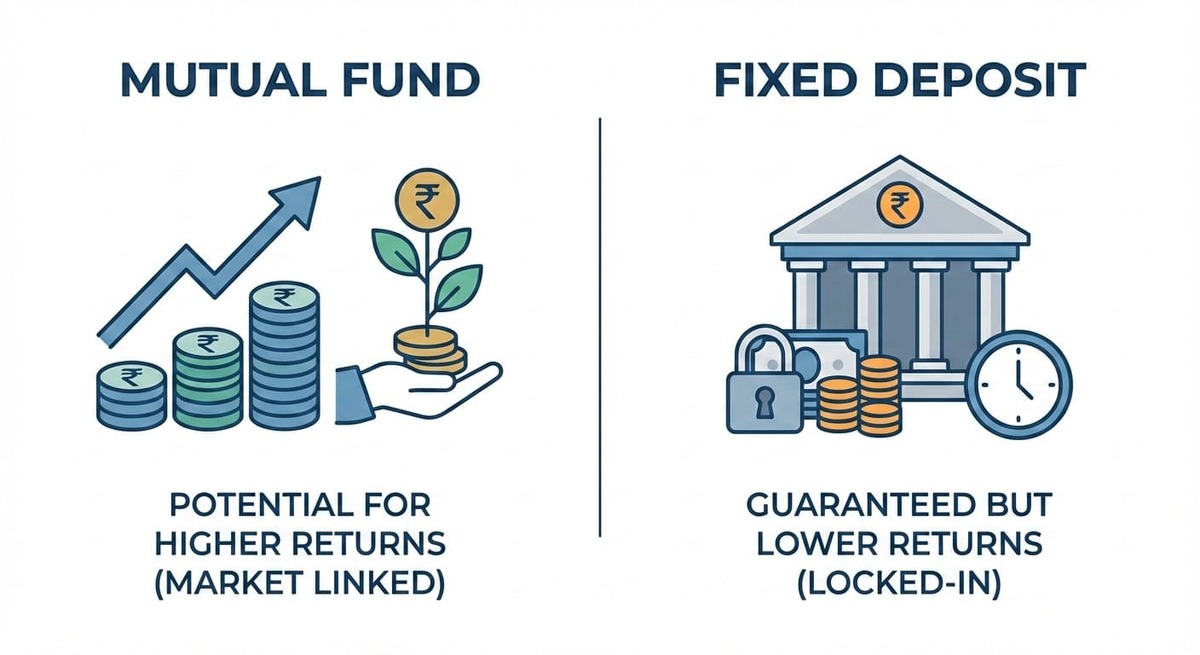
I remember opening my first fixed deposit at 22, mostly because my father told me to, and feeling genuinely proud of myself for “investing.” It took me a few more years to realize an FD isn’t really investing in the way that grows wealth — it’s parking money somewhere safe. That’s not a criticism. It’s just a different job than the one a mutual fund does.
This is the question almost every new investor in India eventually asks: should my money go into a Fixed Deposit, where the bank tells me exactly what I’ll get, or into a mutual fund, where the returns aren’t promised but have historically been a lot higher? This guide breaks both down honestly, with real numbers, so you can actually decide instead of just picking whichever one your relatives recommend.
What Is a Fixed Deposit (FD)?
A Fixed Deposit is about as simple as investing gets. You hand a bank or NBFC a lump sum, agree on a tenure — anywhere from 7 days to 10 years — and the institution pays you a fixed, pre-decided rate of interest for the privilege of holding your money.
Key features of an FD:
- Guaranteed, fixed returns — no surprises either way
- Very low risk, especially with established banks
- Flexible tenure, from a week to a decade
- Current rates across most major Indian banks hover roughly between 6% and 7.5% depending on tenure and bank (small finance banks sometimes offer more, into the 8%+ range, for those willing to take on slightly more institutional risk)
FDs exist for one job: certainty. If you need to know exactly what you’ll have on a specific date, nothing does that job better.
One distinction worth knowing early: not all FDs carry identical risk. A Fixed Deposit with a large, well-established bank is about as safe as an investment gets in India. An FD with a smaller NBFC or a company deposit scheme, on the other hand, can offer a noticeably higher rate — sometimes a full percentage point or two above what a bank offers — precisely because it carries more credit risk. That higher number on the brochure isn’t free; it’s compensation for the fact that the institution behind it is less certain to honour it than a large public-sector bank would be. If safety is the entire reason you’re choosing an FD in the first place, it’s worth checking the credit rating of the issuer rather than just chasing the highest advertised rate.
What Is a Mutual Fund?
A mutual fund pools money from thousands of investors and puts it to work in stocks, bonds, or some mix of the two, run by a professional fund manager whose entire job is to make decisions you’d otherwise have to research yourself.
Key features of a mutual fund:
- Returns move with the market — there’s no fixed promise
- Historically higher growth potential than fixed-income products like FDs
- Built for long-term goals, not next month’s rent
- You can start with an SIP of as little as ₹500 a month — no need to hand over a lump sum at all
Where an FD’s job is certainty, a mutual fund’s job is growth. Neither is “better” in the abstract — they’re built for different problems.
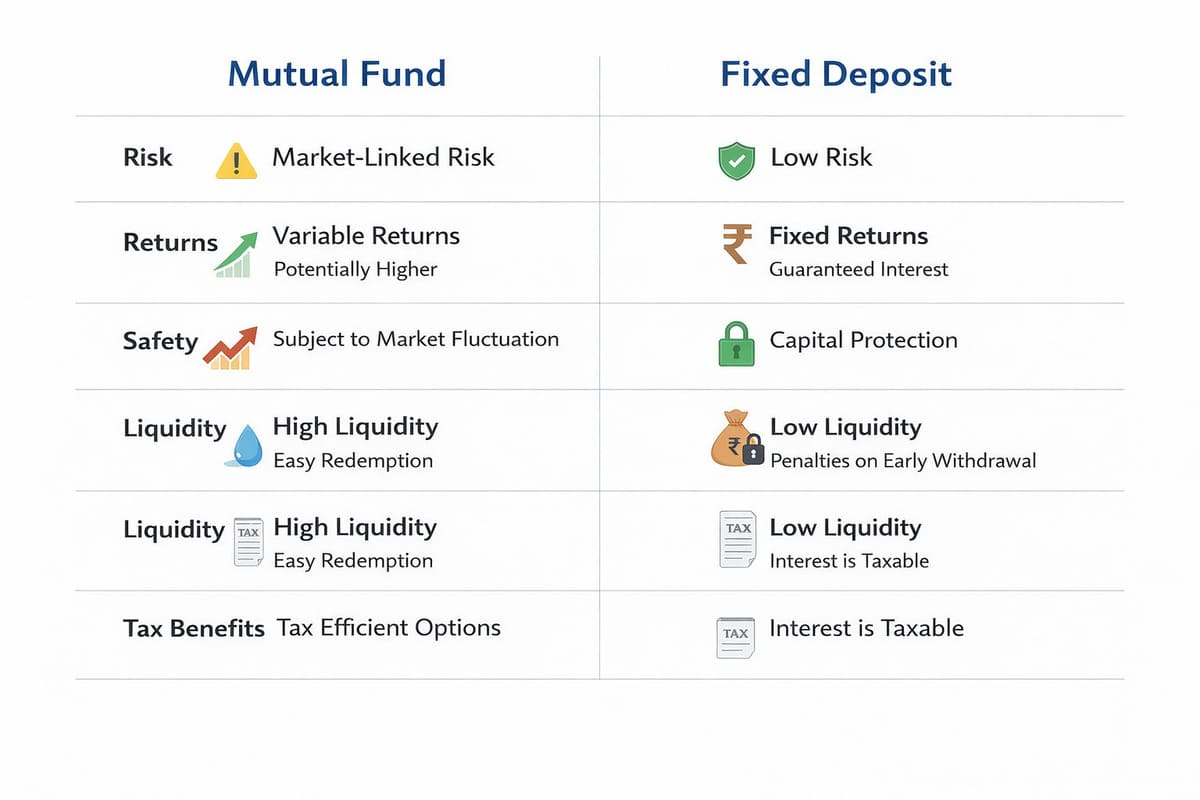
Mutual Fund vs FD: Detailed Comparison Table
| Factor | Fixed Deposit | Mutual Fund |
|---|---|---|
| Risk | Very low | Low to high, depending on fund type |
| Typical returns | 6%–7.5% | 8%–14% (long-term average, not guaranteed) |
| Safety | Very high — bank-backed | Market-linked, varies by fund category |
| Inflation protection | Weak | Comparatively strong, especially equity funds |
| Liquidity | Medium (penalty for early withdrawal) | High for open-ended funds |
| Tax efficiency | Low — fully taxed as income | Better — LTCG rates and ELSS benefits |
| Beginner friendly | Yes | Yes, especially via SIP |
A Real Example: Ravi vs Suresh, ₹1 Lakh Over 10 Years
Numbers make this real in a way tables don’t, so here’s a simple side-by-side.
The scenario: Ravi puts ₹1,00,000 into a Fixed Deposit at 6.5% for 10 years. At the same time, Suresh puts the same ₹1,00,000 into a mutual fund that averages 12% annually over the same decade.
After 10 years:
- Ravi (FD): roughly ₹1.87 lakh
- Suresh (Mutual Fund): roughly ₹3.10 lakh
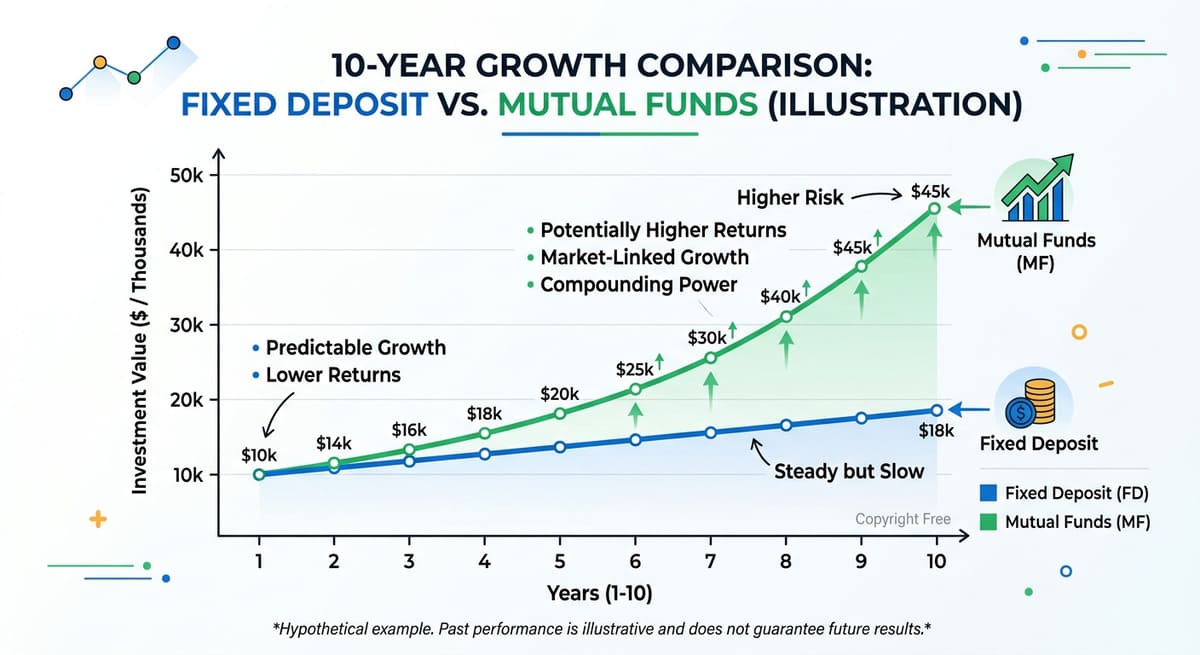
Same starting amount, same time period — and Suresh ends up with nearly ₹1.25 lakh more. That gap isn’t a fluke or a trick; it’s the compounding difference between a fixed 6.5% and a market-linked 12% average, sustained over a decade. It’s also worth being honest about the flip side: Suresh’s 12% is an average, not a guarantee — some years his mutual fund might have shown a loss, and he had to sit through that discomfort to get to ₹3.10 lakh at the end. Ravi never had that discomfort, but he also never had that upside.
Types of Mutual Funds Worth Knowing as a Beginner
A lot of people avoid mutual funds entirely because they assume “mutual fund” means “risky stock market gamble.” That’s not accurate — the category is broad, and picking the right type inside it changes your risk level enormously.
Equity Mutual Funds — Invest primarily in stocks. Higher long-term return potential, but also more short-term volatility. Best suited to goals at least 5 years away.
Debt Mutual Funds — Invest in bonds and fixed-income instruments. Meaningfully lower risk than equity funds, and a reasonable fit for shorter to medium-term goals where you still want slightly better returns than a savings account.
Hybrid Funds — A blend of equity and debt in a single fund, aiming for a middle ground between growth and stability.
Index Funds — These simply track an index like the Nifty 50 or Sensex rather than trying to beat the market. Low cost, relatively stable performance, and generally considered one of the most beginner-friendly starting points in the mutual fund world.
If you’re new to this and unsure where to start, index funds or large-cap funds via SIP are usually the least intimidating entry point.
The Honest Case for FDs
FDs get dismissed a bit too quickly by people excited about the stock market, and that’s not entirely fair. There are real, legitimate reasons to hold one.
Capital safety. Your principal is protected, particularly with established banks, and deposits are insured up to ₹5 lakh per depositor per bank.
Guaranteed returns. You know the exact number you’ll have on maturity day. No app to check anxiously, no market news to track.
No market stress. There’s a real psychological cost to watching an investment fluctuate, and some people genuinely don’t want that in their life — that’s a legitimate preference, not a financial mistake.
Simplicity. No fund categories to compare, no expense ratios to understand. Deposit, wait, collect.
The Honest Case for Mutual Funds
Higher return potential. Over long stretches, equity-oriented mutual funds have historically outpaced FD returns by a meaningful margin.
Inflation protection. This is arguably the single biggest reason serious long-term investors lean toward mutual funds — more on this in the next section.
Professional management. Someone whose full-time job is analyzing markets is making the allocation decisions, not you, working off a hunch.
Flexibility. You can start small, increase your contribution as your income grows, switch funds, or withdraw money (subject to exit load rules on some funds) — far more room to adjust course than an FD allows.
What Nobody Tells Beginners About Inflation
This is the part of the FD conversation that rarely gets said out loud, and it matters more than almost anything else in this article.
Say your FD is paying 6%, and inflation for the year runs at roughly 6% as well. On paper, you earned interest. In real terms — what your money can actually buy — you earned nothing. You didn’t lose money, but you didn’t gain any either. Your ₹1 lakh still buys roughly what ₹1 lakh bought a year ago, not more.
Mutual funds, particularly equity-oriented ones, have historically generated real, inflation-beating returns over long time horizons. That’s the actual argument for choosing a mutual fund over an FD for long-term goals — it’s not about greed or chasing higher numbers, it’s about your money actually growing in terms of what it can buy you, not just the number printed on a passbook.
Risk: Which One Is Actually Safer?
FD risk is about as close to zero as investing gets. Your money is protected, your return is locked, and short of the issuing bank itself failing, there’s very little that can go wrong.
Mutual fund risk genuinely varies by category. An equity fund can show a loss over any given year, sometimes a sharp one. A debt fund is comparatively calmer. Within mutual funds, beginner-friendly, lower-volatility options include index funds, large-cap funds, and balanced/hybrid funds — none of these eliminate risk, but they meaningfully reduce it compared to sector-specific or small-cap equity funds.
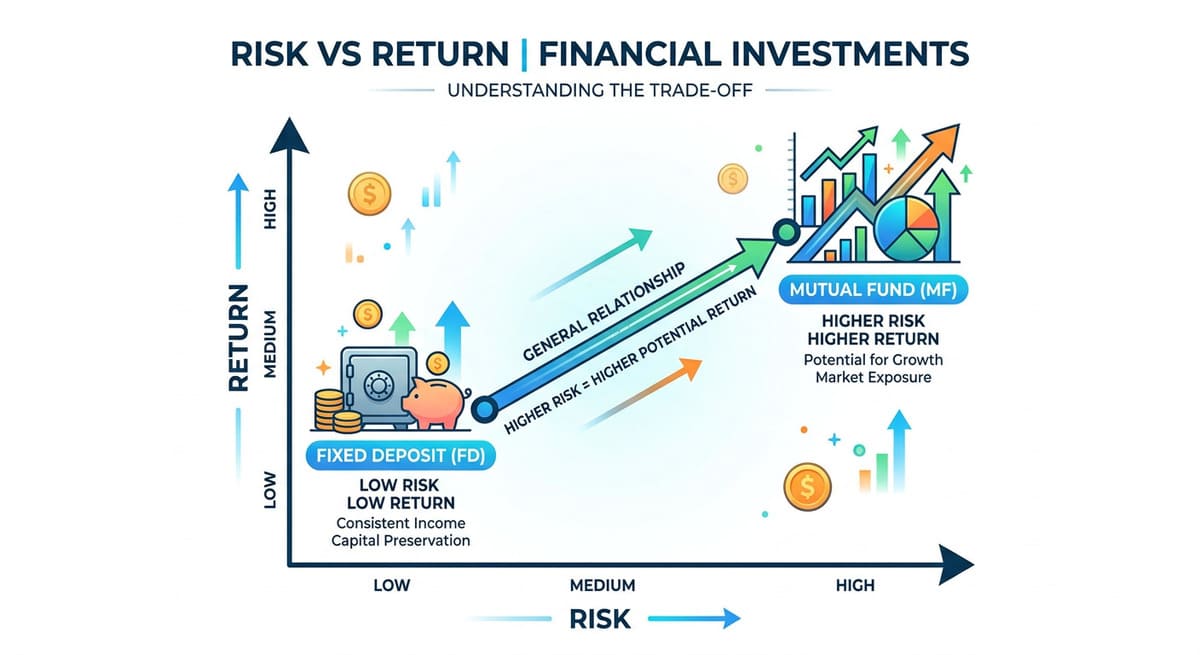
The honest takeaway: FD is safer in the short term, almost by definition. Mutual funds, held long enough, have historically reduced their own risk simply by giving compounding and market cycles more time to average out — but “long enough” usually means 5-10 years, not 5-10 months.
Taxation: Mutual Fund vs FD
FD taxation:
- Interest earned is fully taxable and added straight to your income, taxed at your income slab rate
- Banks deduct TDS once interest crosses ₹40,000 in a year (₹50,000 for senior citizens)
- The one exception is a 5-year tax-saving FD, which qualifies for a Section 80C deduction — but the interest itself is still taxable
Mutual fund taxation:
- Gains are treated as capital gains, not regular income, which is a meaningfully different (and usually lower) Long-term capital gains… taxed at 12.5% on gains above ₹1.25 lakh in a financial year, as per current income tax rules.”
- Long-term capital gains on equity mutual funds (units held over 1 year) are taxed at 12.5% on gains above ₹1.25 lakh in a financial year, per current
- ELSS (Equity Linked Savings Schemes) go further, qualifying for a deduction of up to ₹1.5 lakh under Section 80C — a benefit an FD’s interest income doesn’t get
For most working professionals in the 20-30% tax bracket, mutual funds come out ahead here too, not just on raw returns but on what you actually get to keep after tax.
When FD Makes Sense
Choose an FD when:
- Your goal is 1-3 years away and you genuinely can’t afford a bad market year before you need the money
- You want zero ambiguity about what you’ll have on a specific date
- You’re building an emergency fund and certainty matters more than growth
- You’re a risk-averse investor, or the market genuinely keeps you up at night
When Mutual Funds Make Sense
Choose mutual funds when:
- Your goal is 5+ years away — retirement, a child’s education, a house down payment
- You want your money to actually beat inflation, not just sit still
- You can tolerate short-term ups and downs without panic-selling
- You’re building long-term wealth rather than parking short-term savings
Mistakes Beginners Keep Making
Putting everything into FD “to be safe.” This feels responsible, but over 15-20 years it usually means leaving a substantial amount of growth on the table — safety at the cost of actually building wealth.
Avoiding mutual funds purely out of fear. Fear of short-term volatility often ends up costing more, in missed long-term growth, than the volatility itself ever would have.
Expecting mutual fund returns in a year or two. Equity investing rewards patience. Judging it on a short window almost guarantees disappointment.
Stopping an SIP the moment the market dips. This is usually the worst possible time to stop — it interrupts compounding right when your money would otherwise be buying units cheap.
A Simple 4-Step Starting Plan
If all of this still feels like a lot, here’s a plan that works for most beginners without overthinking it:
Step 1: Keep 3-6 months of expenses in an FD or a savings account as your safety net.
Step 2: Start a mutual fund SIP with whatever you can spare — even ₹500-₹2,000 a month is a real start.
Step 3: Increase your SIP amount gradually as your income grows, rather than waiting for some “ideal” moment to start big.
Step 4: Stay invested for the long haul — 10, 15, 20 years — and resist the urge to check and react to short-term dips.
A quiet fifth step that rarely makes these lists: revisit your split once a year, not more often. Reviewing your investments daily or weekly tends to make people more anxious and more likely to make emotional decisions, not better-informed ones. An annual check-in — has your income changed, has your goal timeline shifted, should your SIP amount go up — is usually enough to keep the plan on track without turning investing into a source of constant stress.
Can You Use Both? (Yes, and You Probably Should)
This isn’t really a competition where one has to win. Most people who’ve been investing for a while use both, for different jobs, at the same time
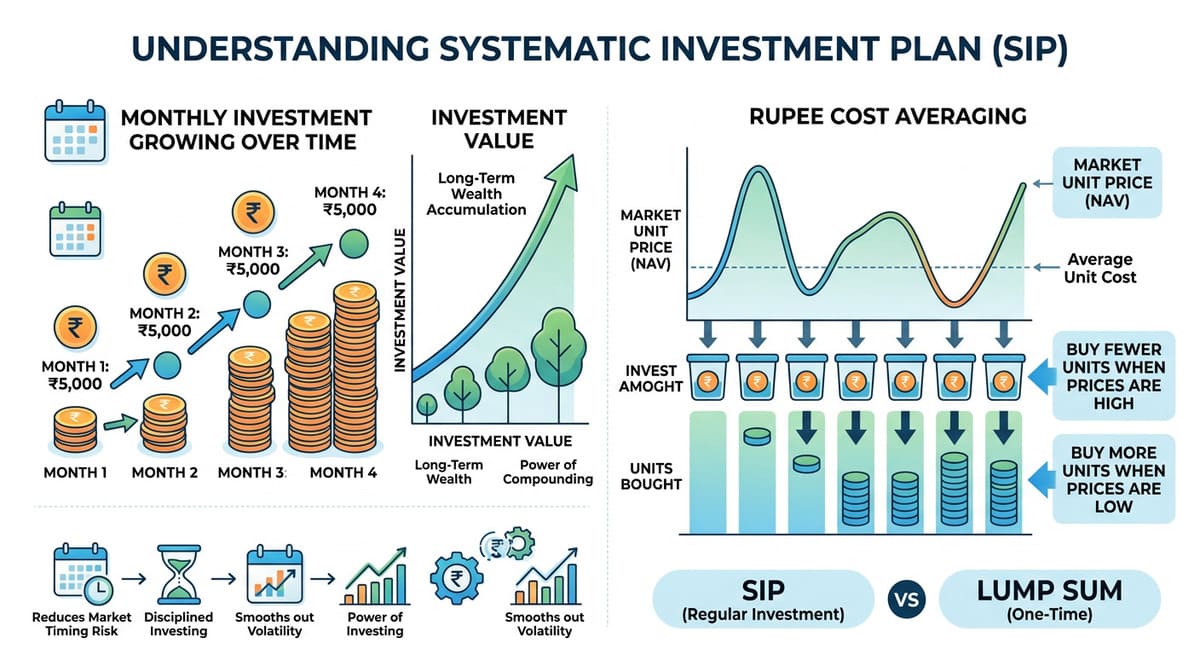
A workable split: your emergency fund and any money you’ll need within 1-3 years stays in FDs or a savings account, where certainty matters most. Everything meant for goals 5+ years out goes into mutual funds via SIP, where growth matters most.
Think of it as: FD for safety, mutual fund for growth, not FD versus mutual fund.
Final Verdict: Mutual Fund vs FD — Which Is Better?
There isn’t a single “better” answer — there’s a better answer for your specific goal and timeline.
- FD = safety and stability. Ideal for short-term goals and money you can’t afford to see dip.
- Mutual Fund = growth and long-term wealth creation. Ideal for goals 5+ years out where beating inflation actually matters.
The smartest approach most beginners land on, eventually, is using both — not picking a side.
FREQUENTLY ASKED QUESTION
Q1. Is mutual fund safe for beginners?
Ans – Reasonably, yes — especially index funds and large-cap funds held for the long term. They carry more risk than an FD, but far less than people often assume.
Q2. Which gives better returns, FD or mutual fund?
Ans – Mutual funds have historically delivered higher returns over the long term, though unlike an FD, those returns aren’t guaranteed.
Q3. Can beginners invest in mutual funds monthly?
Ans – Yes — that’s exactly what an SIP is for, and you can start with as little as ₹500 a month.
Q4. Is FD better than mutual fund?
Ans – FD is safer. Mutual funds are generally better for long-term wealth creation. “Better” depends entirely on your goal and timeline.
Q5. Should beginners invest in both?
Ans – Yes — combining both gives you safety for the near term and growth for the long term, which is how most experienced investors actually structure their money.
Q6. Can I lose money in mutual funds?
Ans – Yes, particularly in the short term. Over longer holding periods, the historical risk of ending up in the red has been meaningfully lower, though never zero.
Q7. Is FD 100% safe in India?
Ans – Largely, yes, with established banks — and deposits are insured up to ₹5 lakh per depositor per bank under DICGC coverage.
Q8. Which is better for monthly income?
Ans – FDs (via monthly interest payout options) are more predictable for steady income. Mutual funds are better suited to growth than to generating stable monthly income.
Final Thoughts
Neither option is wrong. An FD isn’t “boring” or “unambitious,” and a mutual fund isn’t “risky” in the way people often mean it as a warning. They’re simply built for different jobs — one protects what you already have, the other grows what you’re building toward. Most people who end up financially comfortable aren’t the ones who picked the “right” product; they’re the ones who started early, stayed consistent, and matched each product to the goal it was actually built for.
If you take one thing away from this article, let it be this: the question was never really “FD or mutual fund.” It was always “what is this specific pile of money for, and when do I need it back?” Answer that honestly for each goal you’re saving toward, and the FD-versus-mutual-fund decision mostly answers itself.
Disclaimer: This article is for educational purposes only and does not constitute financial advice. Interest rates, fund performance, and tax rules mentioned here are indicative and subject to change — please verify current figures with your bank or fund house, and consult a qualified financial advisor before making investment decisions.
About the Author: Shilpesh Rathod is the founder of All Finance Knowledge. He holds a B.Com degree along with JAIIB and CAIIB banking certifications, and brings 19+ years of experience in the banking sector across savings, investments, and financial planning.

Shilpesh Rathod is the founder of All Finance Knowledge. He holds a B.Com degree along with JAIIB and CAIIB banking certifications, and brings 19+ years of experience in the banking sector across savings, investments, and financial planning. Read more: https://allfinanceknowledge.com/about-us/
3 thoughts on “Mutual Fund vs FD: Which One Should Beginners Actually Choose?”