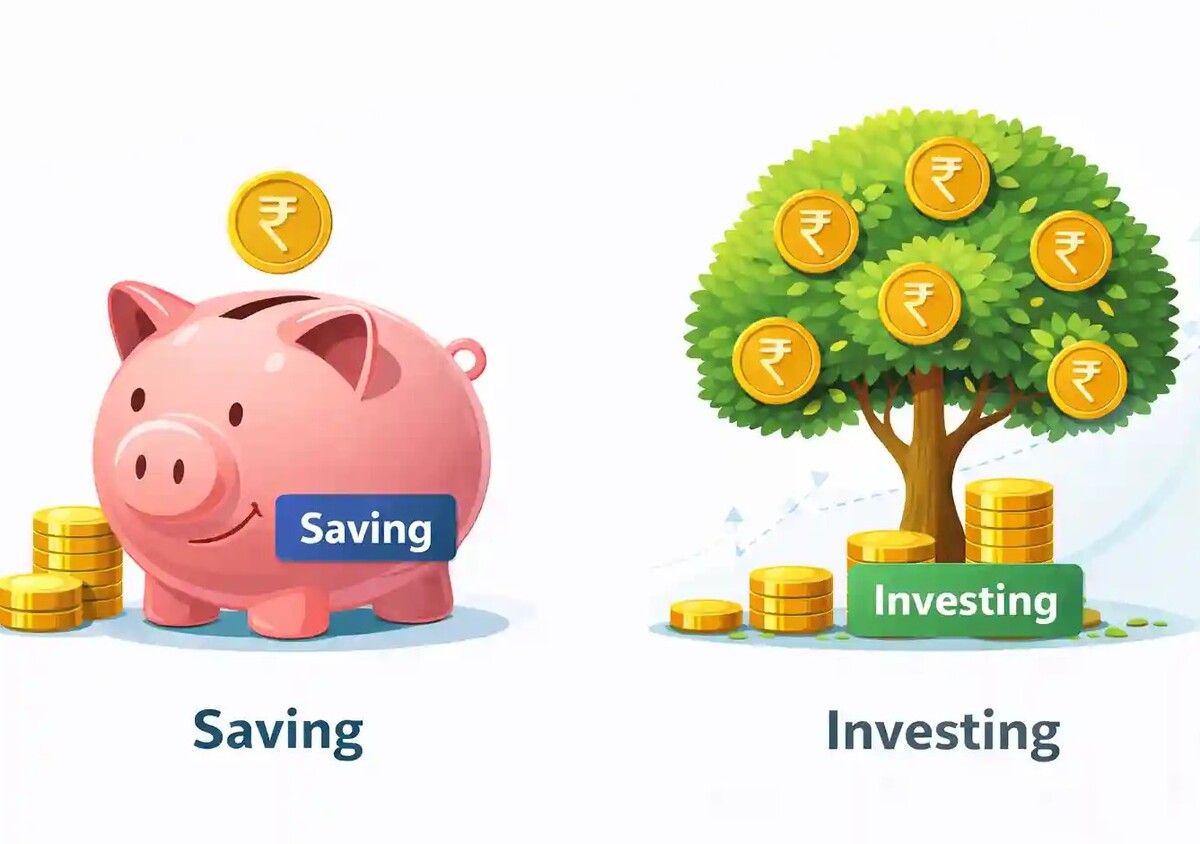
Most of us grew up hearing the same advice: “Save your money.” It’s not wrong advice — it’s just incomplete. Saving teaches discipline and gives you a safety net, but on its own, it rarely makes you wealthy. In fact, in years when inflation runs hotter than your bank’s interest rate, the money sitting in your savings account can quietly lose value even while the number on your passbook goes up.
This guide breaks down saving vs investing in plain language — what each one actually does for you, where each one falls short, and how to combine both so your money is protected today and growing for tomorrow.
What Saving Really Means
Saving is the act of setting aside money in a safe, easily accessible place instead of spending it right away. The goal isn’t growth — it’s protection and availability.
Common saving instruments include:
- Savings bank accounts – instant access, very low interest
- Fixed Deposits (FDs) – locked in for a fixed term at a fixed rate
- Recurring Deposits (RDs) – disciplined monthly saving with fixed returns
- Cash reserves – for genuine emergencies
If you’re unsure how FDs stack up against market-linked options, our detailed Mutual Fund vs FD comparison breaks down returns, risk, and liquidity side by side.
Why Saving Still Matters
Don’t mistake this article for an argument against saving. Saving is the foundation everything else is built on. It:
- Covers emergencies without forcing you into debt
- Reduces financial stress and anxiety
- Funds short-term goals (a trip, a gadget, a deposit for rent)
- Keeps your money instantly accessible when you need it most
The problem isn’t saving itself — it’s stopping there.
Why Saving Alone Isn’t Enough Anymore
1. Inflation Quietly Erodes Your Money
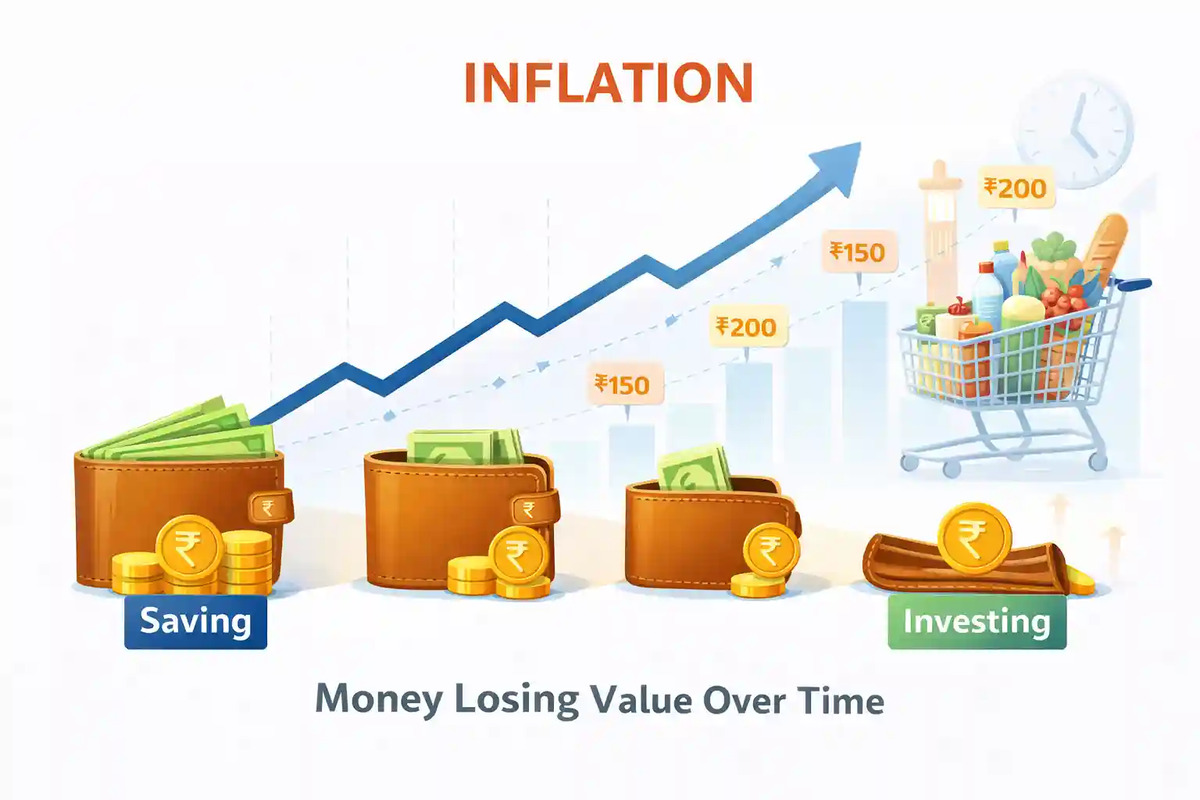
Inflation is the gradual rise in the price of goods and services, which reduces how much your money can actually buy over time. As of early-to-mid 2026, India’s retail inflation (CPI) has moved in a range of roughly 3%–4.4% year-on-year, generally sitting within the Reserve Bank of India’s (RBI) target band of 2%–4%, according to data from the Ministry of Statistics and Programme Implementation. Meanwhile, a typical savings account pays around 2.5%–3.5%, and FDs typically offer somewhere between 6%–7.5% depending on the bank and tenure.
Here’s the simple math: if inflation is running close to your FD rate, your money isn’t really growing — it’s roughly standing still in terms of what it can buy. If inflation runs higher than your return, you’re actually losing purchasing power even as your bank balance grows. You can track current CPI data directly on the Reserve Bank of India’s website or MOSPI’s official CPI releases.
2. Returns Are Structurally Low
Savings accounts and RDs are designed for safety, not growth. Banks keep these rates low because they’re offering you instant liquidity and zero risk — that convenience has a cost, and the cost is a lower return. Our SIP vs RD comparison shows exactly how much this gap can add up to over 10–15 years.
3. You Miss Out on Compounding
Compounding is what happens when your returns start earning returns of their own. It’s often called the “snowball effect” of money — small at first, then increasingly powerful the longer it runs. If this concept is new to you, we’ve explained it step by step in how compounding works.
- With saving, you typically earn simple or fixed interest with limited reinvestment.
- With investing, especially through vehicles like mutual funds or SIPs, your gains get reinvested and start generating their own gains.
Over 10–15 years, this difference compounds into a genuinely enormous gap in outcomes — not just a slightly better number.
4. Big Goals Get Delayed
Retirement, a child’s higher education, a home down payment — these are expensive, long-horizon goals. Saving alone, at rates barely above inflation, usually can’t get you there within a realistic timeframe. Investing gives your money the growth rate needed to actually close that gap.
5. It Creates a False Sense of Security
A healthy bank balance feels safe. But if that balance is growing slower than prices are rising, your real wealth is shrinking even while the number looks fine. This is one of the most under-discussed traps in personal finance — the comfort of a stable balance can mask a real loss in value.
What Investing Really Means
Investing means putting your money into assets — mutual funds, stocks, bonds, real estate — with the goal of growing it over time, in exchange for accepting some level of risk.
Common investment options in India include:
- Mutual Funds – professionally managed pooled investments. New to the concept? Start with our beginner’s guide to mutual funds.
- SIP (Systematic Investment Plan) – investing a fixed amount regularly into a mutual fund
- Stocks / Equities – direct ownership in listed companies
- Bonds – lending money to a government or company for fixed interest
- Real Estate – property investment for appreciation or rental income
- Public Provident Fund (PPF) / National Pension System (NPS) – government-backed, long-term, tax-advantaged options
How Investing Actually Grows Wealth
- You put money into an asset.
- That asset generates returns (interest, dividends, capital appreciation).
- If you reinvest those returns rather than withdrawing them, your base grows.
- Future returns are now calculated on a larger base — this is compounding in action.
- Over long periods, this creates non-linear, accelerating growth.
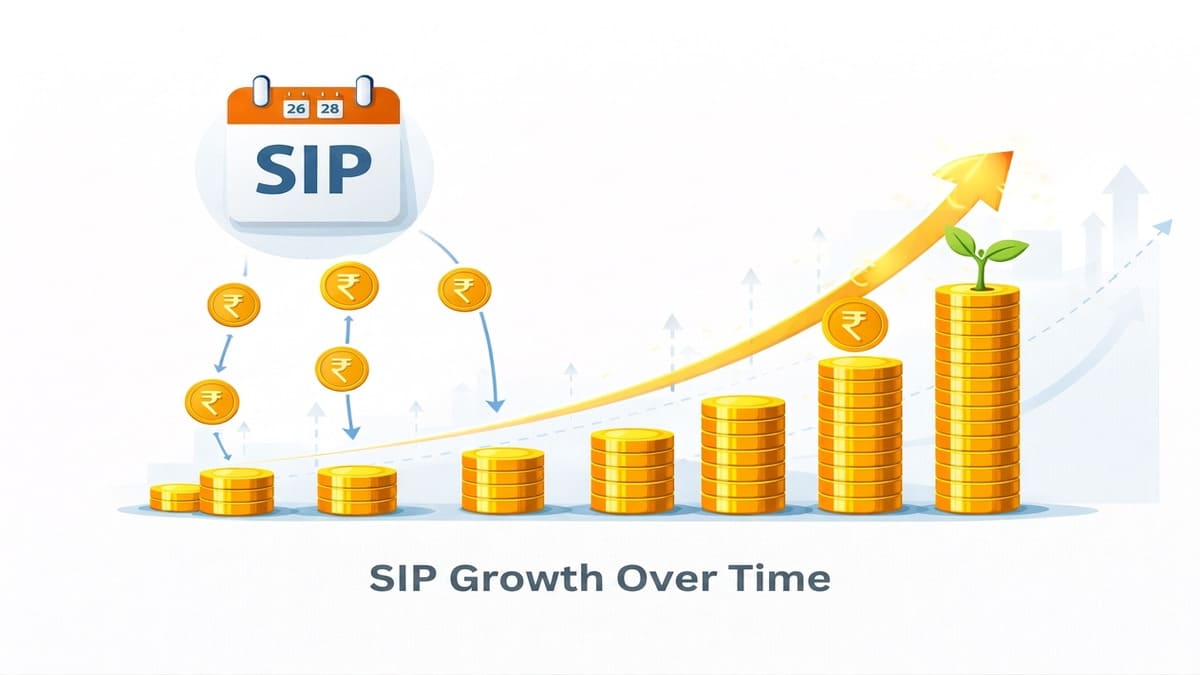
This is exactly the mechanism behind claims like “SIPs can make you a millionaire” — we break down the real math (and the assumptions behind it) in this deep dive.
Key Benefits of Investing
- Higher long-term return potential than saving instruments
- A realistic chance of beating inflation, not just matching it
- Long-term wealth creation, not just preservation
- A structured path toward big financial goals
For a deeper technical explanation of how compounding works mathematically, Investopedia’s guide to compound interest is a solid, neutral reference.
Saving vs Investing: Side-by-Side Comparison
| Factor | Saving | Investing |
|---|---|---|
| Risk | Very low | Low to high, depending on asset |
| Typical Returns | 2.5%–7.5% | Historically higher long-term, but variable |
| Inflation Protection | Weak | Generally stronger over long horizons |
| Liquidity | High (instant to short lock-in) | Varies — some options are highly liquid, others aren’t |
| Best For | Emergencies, short-term goals | Long-term wealth creation |
| Time Horizon | Under 2–3 years | 5+ years ideally |
| Volatility | None to minimal | Can fluctuate, especially short-term |
Neither column is “the right answer” on its own — they’re built for different jobs. Saving is your financial shock absorber. Investing is your financial growth engine. You need both.
A Real-Life Example: Two People, Two Choices
Let’s compare two hypothetical people, both starting with the same monthly amount.
Person A — The Saver
- Puts ₹5,000/month into a Recurring Deposit
- Earns a fixed rate, roughly in line with or slightly below inflation
- Money is safe, accessible, and predictable
- After 15–20 years: a decent but modest corpus, with real (inflation-adjusted) growth that’s fairly limited
Person B — The Investor
- Invests the same ₹5,000/month through an SIP into a diversified mutual fund
- Returns compound and reinvest over time
- Experiences market ups and downs along the way (this matters — see below)
- After 15–20 years: historically, disciplined long-term SIP investors in diversified equity funds have built meaningfully larger corpora than RD savers over comparable periods, though actual results vary by market cycle and fund performance
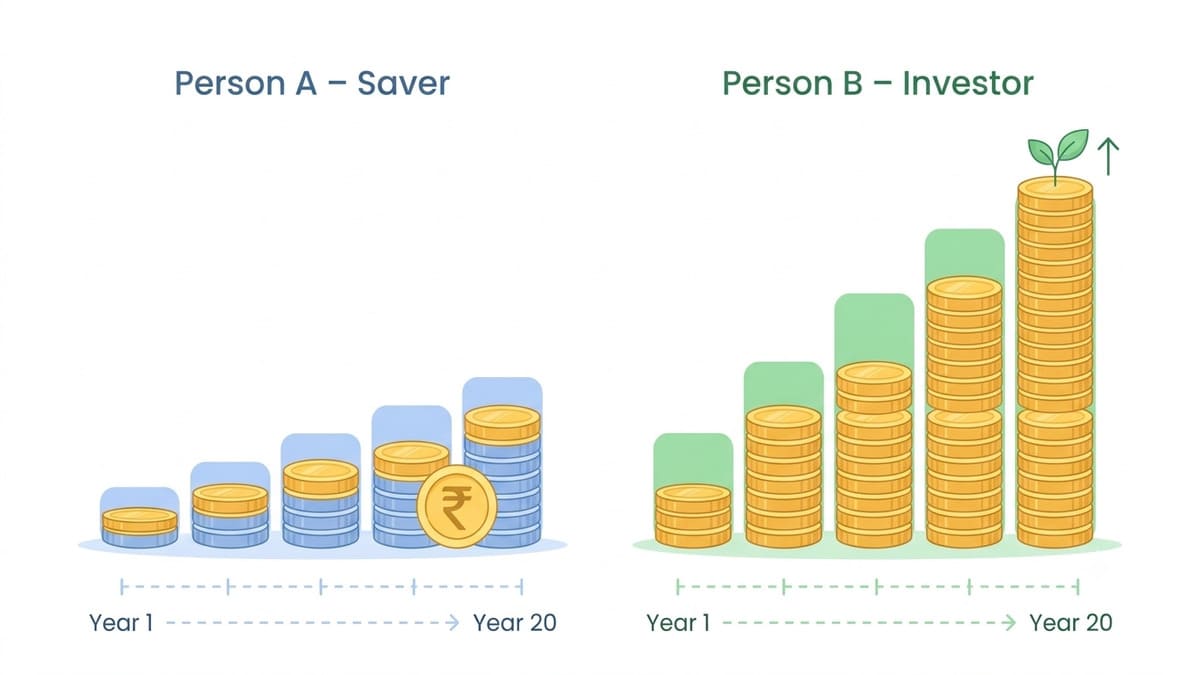
Important honesty check: Person B’s outcome is not guaranteed. Markets fluctuate, and mutual fund returns are not fixed like an RD. Person B’s advantage comes specifically from time in the market, diversification, and discipline — not from investing being automatically “better” in every scenario. This is exactly why emergency funds should stay in savings, not investments — you don’t want to be forced to sell investments at a bad time just to cover a sudden expense.
Is Investing Safe for Beginners?
Yes — if you start with the right instruments and the right mindset. “Safe” doesn’t mean “zero risk.” It means appropriately risky for your goals and time horizon, with risk you understand and can tolerate.
Beginner-Friendly Options
- Index Fund SIPs – low-cost, diversified, track a market index rather than relying on a fund manager’s stock-picking. Not sure which type suits you? See our comparison of index funds vs large-cap funds.
- Large-Cap Mutual Funds – invest in established, financially stable companies
- Hybrid Funds – blend equity and debt for a smoother ride
- PPF / NPS – government-backed and tax-advantaged, ideal for long-term, low-risk exposure
In India, mutual funds are regulated by the Securities and Exchange Board of India (SEBI), which enforces disclosure norms and investor protection standards. You can verify any mutual fund or advisor’s registration directly on the SEBI website before investing — a simple habit that protects you from unregistered or fraudulent schemes.
How to Split Your Money Between Saving and Investing
The real question isn’t “saving or investing” — it’s “how much of each, and when.”
A Practical Framework
- Build an emergency fund first — 3 to 6 months of essential expenses, kept in a savings account or liquid fund.
- Save for anything you need within 2–3 years — a wedding, a planned purchase, a short-term goal.
- Invest for anything 5+ years away — retirement, a child’s education, long-term wealth building.
- Automate your SIP — treat investing like a fixed monthly bill, not an optional leftover.
- Review annually — your goals, income, and risk tolerance change over time; your split should too.
When to Prioritize Saving vs Investing
Lean Toward Saving When:
- You don’t yet have an emergency fund
- Your goal is less than 2–3 years away
- Your income is unstable or uncertain (freelance, new job, etc.)
- You need guaranteed access to the money without risk
Lean Toward Investing When:
- Your emergency fund is already in place
- Your goal is 5+ years out (retirement, a child’s education, a home)
- You want growth that has a realistic shot at outpacing inflation
- You’re mentally prepared for some ups and downs along the way
Not sure how your time horizon should shape your strategy? Our guide on long-term vs short-term investing walks through exactly how to match your goals to the right instruments.
The Balanced Approach
A simple mental rule: save for safety, invest for growth. Keep your safety net in savings instruments, and put your growth capital to work through investments. This isn’t an either/or decision — it’s a portfolio decision.
Common Myths That Stop People From Investing
Myth: “Investing is basically gambling.”
Reality: Gambling relies on chance with no underlying value creation. Long-term investing in regulated instruments like index funds or diversified mutual funds is backed by real economic growth, company earnings, and decades of historical data — very different from a casino bet.
Myth: “You need a lot of money to start.”
Reality: Many SIPs in India can be started with as little as ₹500 a month. The amount matters less than starting early and staying consistent.
Myth: “The stock market is too risky for beginners.”
Reality: Direct stock-picking can be risky without research. But diversified instruments like index funds and large-cap mutual funds spread that risk across dozens or hundreds of companies, which meaningfully reduces single-stock risk.
Mistakes to Avoid
- ❌ Only saving, never investing, and letting inflation quietly erode your money
- ❌ Investing before building any emergency fund
- ❌ Expecting quick, guaranteed returns from market-linked investments
- ❌ Panic-selling investments the moment the market dips
- ❌ Investing in schemes or “advisors” that aren’t SEBI-registered
- ❌ Ignoring your asset allocation as your goals and age change
A Simple 6-Step Plan to Get Started
- Track your monthly income and expenses for at least one full month
- Aim to save 20–30% of your income overall
- Build a 3–6 month emergency fund in a savings account or liquid fund
- Start a small SIP — even ₹500–₹1,000/month is a real start
- Increase your SIP amount gradually as your income grows
- Review your saving-to-investing ratio once a year
Final Thoughts: Saving vs Investing
Saving and investing aren’t rivals — they’re teammates with different jobs. Saving protects what you already have. Investing grows what you’re building toward. Relying on saving alone in a world where prices keep rising means your money’s real value can shrink even as the number on your statement climbs.
The smartest approach isn’t choosing a side — it’s using both, deliberately:
✔ Save for safety and short-term needs
✔ Invest for growth and long-term goals
Starting small, starting early, and staying consistent will do more for your financial future than waiting for the “perfect” amount or the “perfect” time.
Frequently Asked Questions (FAQs)
Q1-Why is saving money not enough today?
Ans – Because savings account and RD interest rates often run close to or below inflation, meaning your money’s real purchasing power may barely grow — or even shrink — over time.
Q2. What is the main difference between saving and investing?
Ans – Saving protects your money with low risk and low returns. Investing aims to grow your money over the long term, in exchange for taking on some risk.
Q3. Is investing risky for beginners?
Ans – Direct stock trading can be risky without knowledge. But diversified options like index fund SIPs and large-cap mutual funds are considered relatively beginner-friendly, see our beginner’s guide to mutual funds for more.
Q4. How much should I save before investing?
Ans – Most financial planners recommend building an emergency fund covering 3–6 months of essential expenses before directing money toward investments.
Q5. Can I save and invest at the same time?
Ans – Yes — and for most people, this is the ideal approach. Keep an emergency fund and short-term goals in savings, and put long-term goals into investments.
Q6. What’s the safest way for a beginner to start investing in India?
Ans – Starting a small SIP in a SEBI-regulated index fund or large-cap mutual fund is widely considered one of the more beginner-friendly entry points. Compare your options in our SIP vs RD breakdown.
Disclaimer: This article is for educational purposes only and does not constitute financial advice. Interest rates, inflation figures, and market conditions referenced here are illustrative and subject to change — verify current rates with your bank or on official RBI/SEBI sources. Please consult a qualified, SEBI-registered financial advisor before making investment decisions.

Shilpesh Rathod is the founder of All Finance Knowledge. He holds a B.Com degree along with JAIIB and CAIIB banking certifications, and brings 19+ years of experience in the banking sector across savings, investments, and financial planning. Read more: https://allfinanceknowledge.com/about-us/
10 thoughts on “Saving vs Investing: Which One Actually Builds Wealth?”